To analyze interview data, you sort what people said into categories, describe each category across your interviews and back every claim with a quote. In practice that means five steps: choose a method, build a coding frame, code every transcript with it, summarize per category and write up. Below we do all five with one invented 40-second interview, a bike shop owner talking about online bookings, and show the frame with definitions, anchor examples and coding rules, every coded segment and the counts.
Choose a method before you code
Two families of methods are common in interview studies. Thematic analysis was introduced by Virginia Braun and Victoria Clarke in a 2006 paper in Qualitative Research in Psychology; their website reports that Nature ranked it the third most cited article of the 21st century. Qualitative content analysis was developed in the German-speaking world by Philipp Mayring and later by Udo Kuckartz and Stefan Rädiker, and it works with a fixed coding frame.
Braun and Clarke now call their approach reflexive thematic analysis. On their website they separate three kinds of thematic analysis: coding reliability, codebook approaches such as template analysis and framework analysis, and their own reflexive version. Reflexive TA avoids a codebook: codes change as your understanding grows, and you build the themes yourself. They criticize the phrase "themes emerged" for that reason. If your supervisor expects a frame with definitions and rules, you are doing a codebook approach or a content analysis. Say which one in your methods section, because Braun and Clarke advise against mixing approaches with different philosophies.
| Question | Reflexive thematic analysis | Qualitative content analysis |
|---|---|---|
| Phases | familiarize, code, generate initial themes, develop and review themes, refine and name themes, write up | read the material, build main categories, code, build subcategories and code again, analyze per category, report |
| Coding frame | no fixed codebook, codes evolve | yes: definition, anchor example and coding rule per category |
| Second coder | not to check "accuracy"; discussing your coding with a supervisor is fine | agreement checks are common; Mayring (2000) calls Cohen's kappa above 0.7 sufficient |
| Numbers | generally against reporting frequencies | category frequencies can be part of the analysis |
| Result | a few themes, each built around one central idea | categories with summaries and comparisons between cases |
Deductive, inductive, or both
Deductive categories exist before you read the transcripts. They come from your research question, your interview guide or a theory. Mayring calls this deductive category application. Inductive categories come from the material: you decide what kind of text counts, read through it, form categories step by step and revise them in feedback loops. Mayring calls this inductive category development.
Most student projects mix the two. In Kuckartz and Rädiker's content-structuring approach, as Rädiker outlines it in a 2026 workshop description, you develop main categories, code all interviews with them, then build subcategories from the material and code everything a second time.
Our example works the same way. The research question, invented like the interview, is "Why do small repair shops move bookings online, and what changes for them?" Five main categories follow from that question. Two subcategories under "Reasons for switching" came from the transcript itself, because the owner names two different problems with the phone.
Build a coding frame: category, definition, anchor example, rule
Mayring's 2000 article describes a coding agenda with four columns: the category, its definition, examples and coding rules. Kuckartz and Rädiker call it a coding guide. Each column has a job:
- Definition: what belongs in the category, in one or two sentences.
- Anchor example: a real quote from your data that is a clear case. It shows the next coder what the definition means.
- Coding rule: how to decide borderline cases, especially between two neighbouring categories.
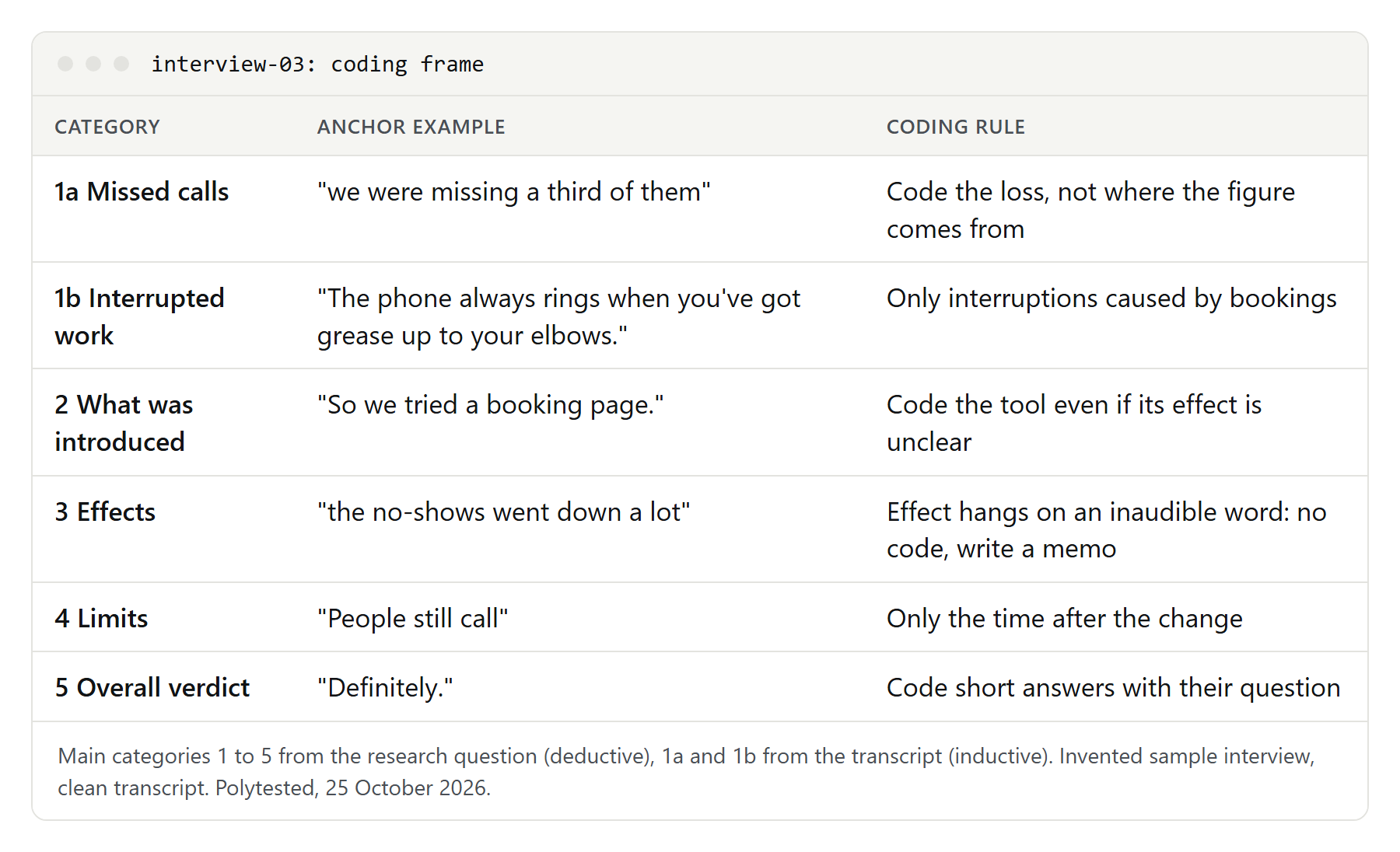
| Category | Definition | Anchor example | Coding rule |
|---|---|---|---|
| 1 Reasons for switching | Problems with the old way of booking that the speaker gives as a reason for the change | see 1a and 1b | Problems with the new system go to 4 |
| 1a Missed calls (inductive) | Bookings lost because nobody answered | "we were missing a third of them" | Code the loss, not where the figure comes from |
| 1b Interrupted work (inductive) | Booking tasks that disrupt repair work | "The phone always rings when you've got grease up to your elbows." | Only interruptions caused by bookings |
| 2 What was introduced | Tools or routines the shop started using | "So we tried a booking page." | Code the tool even if its effect is unclear |
| 3 Effects | Changes the speaker links to the new booking system | "the no-shows went down a lot" | If the effect depends on an inaudible word, don't code it; write a memo |
| 4 Limits | What stayed the same or got worse after the change | "People still call" | Only statements about the time after the change |
| 5 Overall verdict | Judgments about the change as a whole | "Definitely." | Code short answers together with the question they answer |
Test the frame on one or two interviews and revise it then; if you change it later, recode what you have already coded. Mayring builds this revision into his procedure as a feedback loop.
Code the transcript, segment by segment
We coded the research version of the transcript from our transcript examples: clean verbatim, names replaced, a timestamp at every change of speaker. A segment is the shortest stretch of text that carries one meaning. The owner's three answers split into ten segments.
| No. | Time | Segment | Code |
|---|---|---|---|
| 1 | 00:00:05 | Last March. | not coded |
| 2 | 00:00:05 | Before that it was all phone calls, and we were missing a third of them. | 1a |
| 3 | 00:00:05 | [her brother] kept count. [laughs] | not coded |
| 4 | 00:00:05 | The phone always rings when you've got grease up to your elbows. | 1b |
| 5 | 00:00:05 | So we tried a booking page. | 2 |
| 6 | 00:00:25 | Mostly. | 5 |
| 7 | 00:00:25 | People still call, | 4 |
| 8 | 00:00:25 | but the no-shows went down a lot. | 3 |
| 9 | 00:00:25 | The reminder texts [inaudible 00:00:31] help. | 2, memo |
| 10 | 00:00:34 | Definitely. | 5 |
Three decisions in this table come up in almost every interview:
- Not everything gets a code. "Last March" answers the interviewer's first question, but it isn't part of our research question. Put facts like this in a short summary of the case instead. Segment 3 tells us how the owner knows the figure; we noted that in a memo.
- An inaudible word blocks a code. Segment 9 is clearly about a tool, so it gets code 2. Whether the texts help depends on the missing word, which could have been "don't". So no code 3, and a memo: listen again at 00:00:31. If the recording doesn't settle it, the effect stays out of your findings.
- Short answers need their question. "Definitely" only means something next to "Would you do it again?" Rule 5 says to code the two together.
Summarize each category, then count with care
When every transcript is coded, collect all segments per category and write a short summary of each in your own words. For our single interview: phone-only booking cost the shop calls and interrupted repairs; it started a booking page and reminder texts; no-shows fell, but customers still phone.
| Category | Segments | Words |
|---|---|---|
| 1a Missed calls | 1 | 15 |
| 1b Interrupted work | 1 | 12 |
| 2 What was introduced | 2 | 10 |
| 3 Effects | 1 | 7 |
| 4 Limits | 1 | 3 |
| 5 Overall verdict | 2 | 2 |
| Not coded | 2 | 4 |
| Total | 10 | 53 |
Eight of ten segments, 49 of the owner's 53 words, carry a code. That says nothing about bike shops. With one 40-second interview, counts only show how the frame works. Whether to count at all depends on your method: Mayring notes that category frequencies can be analyzed when the research question calls for it, while Braun and Clarke generally advise against reporting frequencies or percentages in reflexive TA. With several interviews, a table with one row per interview and one column per category, each cell holding a one-line summary, usually tells you more than segment counts.
Report your findings with quotes
Write up category by category, or theme by theme: a claim, the quote that supports it, then what it means. Braun and Clarke's quality checklist asks for a good balance between data extracts and your own analysis, and for extracts that actually support each claim.
A paragraph from our example could read: "The owner moved bookings online because the phone competed with repair work: 'The phone always rings when you've got grease up to your elbows' (interview 03, 00:00:05). She reports fewer no-shows, but customers still phone."
- Quote from the clean or verbatim transcript, never from an edited version that rewrites what people said.
- Give the location: interview code plus time or paragraph number, as explained in our guide to time-coded transcripts.
- Mark cuts with […] and keep the pseudonyms from the transcript.
- In the methods section, name the method and its source, say whether categories were deductive, inductive or both, add the coding frame as an appendix and say who coded with which software.
Spreadsheet, QDA software or AI?
A spreadsheet is enough for a handful of interviews: one row per segment with columns for interview, location, segment, code and memo, then filter by code. If you mark codes as comments in Word, Braun and Clarke's website links a free macro by Duncan Babbage and Gareth Terry that exports the comments with their text to Excel.
Dedicated QDA software pays off from about the point where you lose track in the spreadsheet. MAXQDA, ATLAS.ti and NVivo are commercial. QualCoder is free and open source (LGPLv3), with version 4.0 released on 2 October 2026; according to its README it imports DOCX, ODT, TXT, PDF and other files, groups codes into categories and reports coding frequencies and coder comparisons. If your interviews were recorded with Fireflies, you can download the transcript as DOCX or CSV with speaker labels and timestamps, on Pro plans and higher. How to get the transcript in the first place is covered in how to transcribe an interview and in our test of free ways to transcribe audio.
| Tool | What the vendor documents | Check yourself |
|---|---|---|
| MAXQDA AI Assist (add-on) | AI Coding with a comment explaining each suggestion; code and subcode suggestions; Local AI in the premium version | Do the suggestions follow your definitions and rules? |
| ATLAS.ti | AI Coding (beta): automatic inductive coding per paragraph, skips very short paragraphs; Intentional AI Coding (beta) starts from your research question | One-word answers like "Definitely"; text is sent to ATLAS.ti and OpenAI servers after you consent |
| NVivo 15 AI Assistant | summaries of text, documents and coded content; Suggest Child Codes | Compare each summary with the transcript; data goes to OpenAI under an enterprise agreement |
| QualCoder | optional AI with your own OpenAI API key or the Blablador service | Which model and server your transcripts reach |
Kuckartz and Rädiker added a chapter on AI to the 2024 edition of their textbook. In its preface they describe AI as an assistant in the analysis that can't yet replace the human analyst. Treat every AI code as a suggestion: check it against your coding rules, look at short answers and inaudible passages yourself, and record in your methods section which tool did what. If you need decisions and to-dos from a meeting rather than findings from interviews, write meeting minutes instead.
Anonymization and consent, in short
Replace names and details that could identify someone before you share transcripts, coded segments or quotes; in our sample "Tom" became "[her brother]". Keep the list that links pseudonyms to real names apart from the data. Check that your consent form covers analysis, quotes in your thesis or report and any cloud or AI tool you plan to use. This is not legal advice: your university's ethics committee or data protection officer has the final word.