Website translation for SEO means translating a site so that each language version can be found by searchers in its own market. Translating the words isn't enough: each version needs the keyword people there actually type, its own title, description and URL, examples that fit, and a native speaker's review. We tested how far a plain translation gets you. We pasted ten English keywords from our content plan into Google Translate and DeepL, and none of the 20 translations was the German query we had chosen for the same topic.
What SEO translation adds to a translation
Three terms often get mixed up:
- Translation carries the meaning of a text into another language.
- Localization also adapts it to the market: currency, number and date formats, units, examples, legal details and text inside images.
- Transcreation rewrites a text, usually marketing copy, so that it has the same effect in the other language. Researchers have no single agreed definition for it, a 2021 review notes.
SEO translation is localization with one more goal: the page has to be found in search in the target market. That adds three tasks a standard translation job doesn't include:
- keyword research in the target language, before anyone translates;
- adapting the page to what searchers there expect, even if that changes its structure;
- localizing everything that appears in search results or that search engines read: title, meta description, headings, URL, alt text, internal links and structured data.
If you only translate the body text, you get a correct page for a keyword that few people in that market may type.
Website translation methods compared
| Method | How it works | Fit for SEO |
|---|---|---|
| Browser translation | The visitor's browser or Google Translate's website translates the page on the fly | Poor: no URL of your own for each language |
| Machine translation, published as is | A translator tool or AI model translates, nobody checks | Risky: wrong keywords and wrong terms go live |
| Machine translation plus full post-editing | A translator corrects the output until it reads like a human translation | Good, if keyword research and on-page localization are part of the job |
| Human translation with revision | A translator works from the source, a second check compares both texts | Good, same condition |
| Writing each version for its market | The source gives structure and facts; the text is written for local searchers | Best fit, most work |
Browser translation helps visitors read your page, but it gives search engines nothing to index on your site. Google recommends a separate URL for each language version instead of cookies or browser settings. When we ran our German page through Google Translate's website on October 13, 2026, the copy opened at polytested-com.translate.goog, a Google address, and its canonical tag still pointed to our German original.
Two ISO standards separate the middle rows. ISO 17100:2015 covers translation services, defines revision as a bilingual check against the source, and leaves post-edited machine output out of its scope. ISO 18587:2017 covers full post-editing, which aims at a result comparable to human translation; light post-editing, which only makes a text understandable, sits in an informative annex. Both are being revised, according to ISO. Neither covers keywords, so if you hire an agency, ask whether keyword research in the target market is part of the quote.
Our test: ten keywords in Google Translate and DeepL
On October 14, 2026, we pasted the English main keywords of ten topics from our content plan into Google Translate and DeepL, one per line, signed out, and had them translated into German. Next to each result is the main keyword we had chosen for the same topic in Germany.
| Our US keyword | Google Translate | DeepL | Our German keyword |
|---|---|---|---|
| how to write meeting minutes | Wie man ein Sitzungsprotokoll erstellt | Wie schreibt man ein Sitzungsprotokoll? | besprechungsprotokoll vorlage (590) |
| how to turn off auto dubbing youtube | Wie man die automatische Synchronisierung bei YouTube deaktiviert | Wie deaktiviert man die automatische Untertitelung auf YouTube? | youtube synchronisation ausschalten (880) |
| what is an srt file | Was ist eine SRT-Datei? | Was ist eine SRT-Datei? | srt datei (590) |
| n8n tutorial for beginners | n8n-Anleitung für Anfänger | N8N-Tutorial für Anfänger | n8n tutorial deutsch (140) |
| transcribe audio recording to text | Audioaufnahme in Text transkribieren | Audioaufnahmen in Text umwandeln | audio transkribieren (2,900) |
| how to translate youtube videos | Wie man YouTube-Videos übersetzt | Wie übersetzt man YouTube-Videos? | youtube video übersetzen (720) |
| how to change chatgpt voice | Wie man die ChatGPT-Stimme ändert | Wie ändert man die Stimme von ChatGPT? | chatgpt sprachausgabe (390) |
| how to record teams meeting | Wie man eine Teams-Besprechung aufzeichnet | Wie zeichnet man ein Teams-Meeting auf? | teams aufzeichnen (260) |
| how to properly transcribe an interview | Wie man ein Interview korrekt transkribiert | Wie transkribiert man ein Interview richtig? | interview transkribieren (880) |
| website translation seo | Website-Übersetzung und SEO | Website-Übersetzung und SEO | seo übersetzung (390) |
None of the 20 translations was exactly the German query, not even for this guide's own topic. The closest were technical terms: "was ist eine srt datei" does get searched in Germany, about 110 times a month according to Semrush, but "srt datei" gets 590. Three patterns run through the table:
- The form doesn't match. English keywords often start with "how to" or "what is", and the tools turned them into full German questions. Our German keywords are mostly short phrases without a question word: "srt datei", "teams aufzeichnen", "interview transkribieren".
- The word doesn't match. Both tools made "meeting minutes" a "Sitzungsprotokoll", the minutes of a formal session. Our German keyword is "besprechungsprotokoll vorlage", a template for minutes of an everyday meeting. For ChatGPT's voice, our German keyword uses "Sprachausgabe", speech output, a word neither tool produced.
- The modifier is missing. German queries often carry a word the English one lacks: "vorlage" (template) for the minutes, "deutsch" for the n8n tutorial. No translation can add what isn't in the source.
One translation changed the meaning: DeepL turned "auto dubbing" into "automatische Untertitelung", automatic subtitles, a different YouTube feature. A page built on that phrase would attract people with a different problem. The output wasn't stable either: when we pasted the list again the same day, DeepL worded two lines differently.
Six short terms, translated one by one as a cross-check, came out almost always right: "read text aloud" became "Text vorlesen" in both tools. The weak point isn't vocabulary but the query as a whole: its form, its modifiers and the intent behind it.
One topic, four markets
The gap gets wider when you put one topic side by side in four markets. Here are seven topics from our plan with the main keyword we chose in each country:
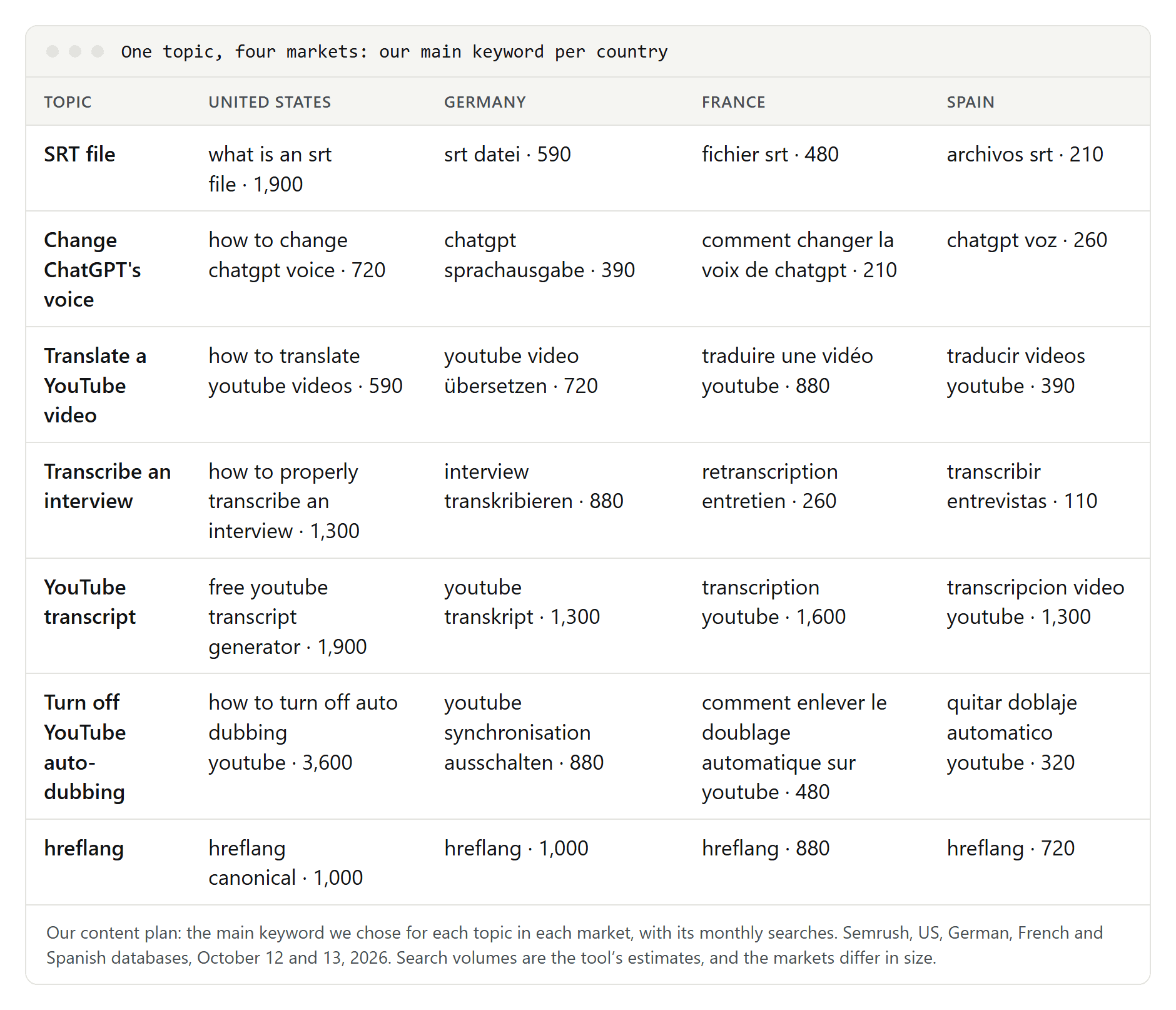
- English asks, the others name. Five of the seven US keywords are questions or "how to" phrases. None of the German or Spanish ones is; in France, two are: "comment changer la voix de chatgpt" and "comment enlever le doublage automatique sur youtube".
- Different words. The French interview keyword uses "entretien" and "retranscription", not "interview". Spain's dubbing keyword says "quitar", to remove, rather than "desactivar", to turn off: 320 searches a month against 260.
- Different sizes. For translating a YouTube video, France (880) and Germany (720) beat the United States (590). A smaller country isn't automatically a smaller market for your topic.
- Technical terms travel. "hreflang" is the main keyword in Germany, France and Spain. Translate it and you lose the searchers.
A website translation strategy: which markets, which pages
A translation strategy starts before the first sentence: pick the markets, then the pages. Our plan from October 2026 has 305 topic slots, 95 for the United States, 76 for Germany, 68 for France and 66 for Spain, and only 12 topics made it into all four markets. Each language got its own list from its own country data. Our international keyword research guide shows how we built it.
- Translate what has a market. Look up each topic in the target country's database. For turning off YouTube's auto-dubbing, our chosen keywords get 3,600 searches a month in the US and 320 in Spain. A topic that is small in one market can be large in the next.
- Don't scale for its own sake. Mass-produced translations with little value for users fall under Google's spam policies (see below). On our site, a language version can't go live without its own local example, such as a screenshot in that language, and an approval.
- Decide what happens to pages you don't translate. On our site, a page that doesn't exist in a language returns a 404 there; we never show English text under a German menu. Google likewise advises one language for content and navigation on each page.
What to localize on every page
Besides the body text, every language version needs its own version of these elements:
| Element | What to do | On polytested.com |
|---|---|---|
| Title tag | Write it around the local keyword, in the page's language | Each version has its own title, built around its own keyword |
| Meta description | Rewrite it for the local query | A translated one describes the source page, not yours |
| H1 and subheadings | Follow the local search intent | Our German meeting-minutes guide opens with the template, the English one with what minutes are |
| URL slug | Use words in the target language | /blog/how-to-write-meeting-minutes-template-example and /de/blog/besprechungsprotokoll-vorlage-beispiel |
| Images | New screenshots from the target-language interface, local alt text and file names | Every language gets its own images |
| Internal links | Link to the page in the same language | A link to a page not yet published in that language turns into plain text |
| Numbers and dates | Use local formats | 1.234,56 € in Germany, 1 234,56 € in France, 1234,56 € in Spain |
| Structured data | Set the language and translate the fields | Our JSON-LD sets inLanguage to en, de, fr or es |
Google asks for a title in the same language and writing system as the page's main content; if they don't match, it may show other text. Localized words in URLs are fine if the URL is UTF-8 encoded and escaped correctly in links. The number formats are what Node.js 20's built-in Intl formatting produces for Germany, France and Spain; our site formats prices the same way, as each vendor lists them, without converting currencies.
Intent can change the outline, too. "how to write meeting minutes" asks for instructions, the German "besprechungsprotokoll vorlage" for a template, and our French and Spanish data adds "exemple" and "ejemplo". Keep the English outline and you answer the wrong question first.
Translations run longer
Plan for length wherever space is tight: titles, descriptions, buttons and menus. On October 17, 2026, we measured the interface text of our own site, the menus, buttons, labels and notices that exist in all four languages, 154 strings in each:
| Language | Characters | Longer than English | English strings of up to 10 characters (50) |
|---|---|---|---|
| English | 3,648 | — | — |
| German | 4,190 | 14.9 percent | 1.38 times as long on average |
| French | 4,292 | 17.7 percent | 1.31 times |
| Spanish | 4,272 | 17.1 percent | 1.40 times |
Short labels grow the most: "Pros" became "Points forts" in French and "Puntos fuertes" in Spanish, "Worst" became "Schlechtester Wert" in German. A few shrink: "incl. VAT" is "TTC" in French, and "Advertisement" is "Anzeige" in German. A title that just fits in English may be too long in French or Spanish, so write it again in the target language instead of cutting it down.
What machine translation got wrong on our own pages
Our earlier tests show the errors a fluent translation hides:
- Literal headings. Google Translate turned the heading of our German page "So testen wir" into "This is how we test"; our own English page says "How we test". The section "Eine echte Aufgabe" became "A real challenge", where we wrote "One real task" (October 13, 2026).
- Names and codes. The same run changed our language code "ES" into "IT", because "es" means "it" in German, and split our name into "poly tested". Marking both with
translate="no", which MDN describes as the way to keep text from being translated, fixed it; details in our guide on how to translate a website. - Menu names. We had three sentences from our English YouTube guides translated into German on October 14, 2026. Both tools wrote "Untertitel/CC", while YouTube's German player menu just says "Untertitel". Neither tool got every label right, so copy menu names from the interface in the target language.
- Form of address. For "Can you hear the difference?", Google chose the formal "Sie" in German, DeepL the informal plural "ihr" and Microsoft Bing Translator "du" (October 13, 2026). Our German pages use "du". Our subtitle translation test has the French and Spanish results.
Google's own documentation shows the same risk. Its Spanish page on multilingual sites, marked in its code as machine-translated from English, turns the English statement that Google doesn't use code-level language information such as lang attributes into an instruction: "No incluyas el idioma en el código", don't include the language in the code (checked October 17, 2026).
What Google says about machine-translated pages
Google doesn't ban machine translation. What it targets is mass production without value:
- Scaled content abuse. Since March 5, 2024, Google's spam policies include scaled content abuse: many pages made mainly to manipulate rankings, however they're produced. One of its examples is scraping other content to produce many pages, including by translating it automatically, when users get little value from the result.
- The older rule is gone. Until then, the policy on automatically generated content listed text translated by an automated tool without human review or curation before publishing. On June 11, 2025, Google also removed a section on blocking all automatically translated pages with robots.txt from its multilingual documentation, to align with the March 2024 update; Google calls it a documentation change only.
- Review comes first. Google's guidance on generative AI content asks you to fact-check and review AI-generated content manually before publishing, including title elements, meta descriptions, structured data and image alt text.
- Effort counts. Google's helpful content page lists translating a poem manually as an example of high effort, and generating large amounts of text without manual oversight as little or no effort.
- Translations aren't duplicates. Google treats localized versions of a page as duplicates only when the main content stays untranslated. Google detects a page's language from its visible content, not from lang attributes or the URL, and advises against redirecting users automatically based on the language you assume they speak.
Our workflow, step by step
This is how a new language version comes about on our site:
- A keyword for each language. Each guide gets its own main keyword per country from Semrush's database for that country; title, URL and subheadings follow from it.
- A style sheet for each language. Form of address ("du" in German, "vous" in French, "tú" in Spanish), quotation marks, number formats, names we never translate (n8n, YouTube, Semrush, DeepL) and menu names from the target-language interface.
- Text written for the reader. One version gives the outline and the facts; the text is written for that language's reader, with local examples, sources and screenshots.
- Native review. Every German, French and Spanish version is checked by a native-speaking language editor whose name appears on the page: Lukas Becker, Julien Laurent and Alejandro Morales.
- SEO check. Title and description length, URL, alt text, internal links, numbers and dates.
- Technical setup. Our site adds hreflang, the sitemap entry and the canonical tag once a language version is approved; there are no automatic language redirects. Our guides on hreflang and canonical tags and international SEO show the setup.
- Measurement. In Google Search Console's Performance report, filter the pages to one language folder and compare the Queries tab with the keyword you planned; the Countries tab shows where clicks come from. For separate data per folder, Google's help suggests a URL-prefix property such as example.com/es/. Our site went live on October 13, 2026, too recently to compare languages.
Checklist for your website translation
- Main keyword researched in the target country's database, not translated.
- Local search intent checked and the outline adjusted.
- Title, meta description and URL slug written in the target language.
- Menu and button names copied from the target-language interface.
- Form of address, quotation marks, number, date and currency formats checked.
- Images with text redone; alt text and file names localized.
- Internal links point to pages in the same language.
- Read by a native speaker before publishing.
- Own URL, hreflang and sitemap entry in place, no automatic redirect.
- After launch: Search Console queries compared with the planned keyword.