International SEO means giving each language or country version of your site its own URL, telling Google which version is meant for whom, researching keywords in each market instead of translating them, and never sending visitors to another language automatically. We show how that works on our own site, which runs in English, German, French and Spanish, with its code, our Semrush data and what Google's documentation says. If you're a US company reaching Spanish speakers at home, Canada, the UK or Europe, you'll also see what changes from one market to the next.
Multilingual or multi-regional: what international SEO covers
Google's guide to multi-regional and multilingual sites separates two cases, and both of its examples come from North America:
- A multilingual site offers content in more than one language, like a Canadian business with English and French versions. Google tries to show the page in the searcher's language.
- A multi-regional site explicitly targets users in different countries, like a manufacturer that ships to both Canada and the United States. Google tries to show the right page for the searcher's locale.
Many sites are both. Local SEO is a different job: it targets a city or a region inside one country.
Your first decision is whether to organize versions by language or by country:
- By language (
es,fr): one Spanish version for Spain, Latin America and Spanish speakers in the US. It's less work, but prices, legal text and some words won't fit everywhere. - By country (
en-GB,es-MX,fr-CA): one version per country, with its own currency, legal pages and vocabulary. It's more precise, but every version has to be kept up to date.
You can mix both. Google's hreflang documentation describes a company with a US page in dollars, a UK page in pounds sterling, a German page and a generic English page for all other English speakers. Link same-language versions to each other with hreflang: when Google picks canonical URLs, it prefers pages in an hreflang cluster over a country page left outside it.
We chose languages: one English, German, French and Spanish version of each page. The trade-off is plain: a reader in Mexico sees our Spanish pages with prices in euros, not pesos.
ccTLD, subdomain or subdirectory?
Google describes four ways to separate versions in the URL:
| Structure | Example | Pros | Cons |
|---|---|---|---|
| Country-code domain (ccTLD) | example.de | clear geotargeting, server location irrelevant, sites easy to separate | expensive, limited availability, more infrastructure, sometimes strict registration rules, targets only one country |
| Subdomain | de.example.com | easy to set up, servers can be in different places, sites easy to separate | the URL alone doesn't show whether "de" is a language or a country |
| Subdirectory | example.com/de/ | easy to set up, low maintenance on one host | targeting not obvious from the URL, one server location, sites harder to separate |
| URL parameter | example.com?loc=de | none: Google doesn't recommend it | segmenting by URL is difficult, targeting not obvious from the URL |
Three details matter for US companies:
- Popular startup domains don't target a country. Google treats some country-code domains as generic because people see them that way, among them .io, .ai, .co, .me and .tv. A .co domain doesn't tell Google you're targeting Colombia.
- .eu is generic too. It doesn't target Europe.
- The Search Console country setting is gone. Google retired the International Targeting report and no longer supports country targeting there, while it keeps using hreflang. According to Search Engine Land, Google announced this on August 24, 2022, and scheduled the report's removal for September 22, 2022.
For a small team with a few languages and no country versions, subdirectories are the simplest choice: one deployment, one Search Console property, and every link to any language version points to the same domain. A ccTLD makes more sense when a country is a business of its own, with its own team and prices. Switching structures later is a site migration with a redirect for every URL; our website migration checklist covers the steps.
How Polytested is set up
Our site uses subdirectories, with English at the root. That is also the natural path for a US company: the English site stays where it is, and each new language gets its own folder and its own paths.
| Page | English | German | French | Spanish |
|---|---|---|---|---|
| Home | / | /de | /fr | /es |
| How we test | /how-we-test | /de/so-testen-wir | /fr/notre-methode | /es/como-probamos |
| Legal notice | /legal-notice | /de/impressum | /fr/mentions-legales | /es/aviso-legal |
| Privacy | /privacy | /de/datenschutz | /fr/confidentialite | /es/privacidad |
| Author page | /authors/sukru-celik | /de/autoren/sukru-celik | /fr/auteurs/sukru-celik | /es/autores/sukru-celik |
The rules behind the table:
- One URL per page.
/enand/en/blogredirect with a 308 to/and/blog,/ESto/es, andwww.polytested.com/estopolytested.com/es. - Paths in the reader's language, page types included: "autoren", "mentions-legales", "como-probamos".
- No accents in slugs. We write "como-probamos", not "cómo-probamos". Google accepts accented words if URLs use UTF-8 and links escape them properly; plain letters just leave less room for mistakes.
- One sitemap per language. On October 17, 2026, the English sitemap listed 46 URLs, the German one 57, the French one 27 and the Spanish one 29.
How Google recognizes language and target country
It's easy to assume that Google reads a page's language from the lang attribute in the HTML. Google's guide says otherwise: "Google uses the visible content of your page to determine its language." It doesn't use the lang attribute, the URL or hreflang for that. So keep one language per page, in the content and in the navigation. If you translate only the menu and footer, the same content can appear several times in the results, each time wrapped in a different language.
Set the lang attribute anyway: screen readers use it to choose the right pronunciation, and WCAG, the web accessibility guidelines, asks that a page's language can be determined by software.
For the target country, Google names these signals:
- a country-code domain, such as .de or .mx;
- hreflang annotations, in HTML tags, HTTP headers or sitemaps;
- the server location, which isn't decisive because many sites use content delivery networks;
- local addresses and phone numbers, local language and currency, links from other local sites and a Google Business Profile.
Google ignores location meta tags such as geo.position, and it doesn't vary its crawler's location to find versions of a page, so declare every version yourself.
No automatic redirects, and a switcher without flags
Many sites redirect visitors by browser language or IP address. Google advises against it, because such redirects can keep users and search engines from seeing all versions. Googlebot usually crawls from US IP addresses and sends no Accept-Language header, so a site that redirects by language may only ever show Google its English pages. If you adapt content by country anyway, Google asks you to treat Googlebot like any visitor from the country it appears to come from.
The W3C took a softer line in 2016: negotiate the language from the browser's settings, but link to every language version on every page. For search, Google's advice is the safer one. We never redirect:
GET /     Accept-Language: es-US   ->  200, no redirect, English page
GET /     Accept-Language: es-MX   ->  200, no redirect, English page
GET /     Accept-Language: fr-CA   ->  200, no redirect, English page
GET /     Accept-Language: en-GB   ->  200, no redirect, English page
GET /es                            ->  200, Spanish page
Without redirects, the language switcher has to be easy to find. The W3C advises against flags for languages, because some countries have several languages and some languages are spoken in many countries. A Spanish flag tells a reader in Mexico City or Los Angeles very little.
Our switcher shows the codes EN, DE, FR and ES, and its menu names each language in that language: English, Deutsch, Français, Español. Each link carries a lang attribute, and the menu is marked translate="no" so browser translation leaves it alone. If a page doesn't exist in a language, its entry is dimmed, links to that language's home page and says so in that language. On our voice category page, the French entry reads "Pas encore disponible dans cette langue". Those links get no hreflang, because they don't lead to a translation of the page.
Untranslated pages: a 404 instead of mixed languages
What should someone see at the Spanish address of a page that exists only in English? There are three common answers:
- Fallback content: the English text under a Spanish menu, against Google's advice to use one language per page.
- A redirect to the English page or the Spanish home page. The reader ends up somewhere else without knowing why.
- A 404: the Spanish address doesn't exist.
We chose the third. On October 17, 2026, before our voice guides had French and Spanish versions, /fr/voix and /es/voz returned 404, while /voice and /de/stimme returned 200. Hreflang only lists versions that exist: that day, our guide to hreflang codes for Spanish existed only in English and German, so it declared only en, de and x-default. Until a translation exists, readers can use their browser's translation, which doesn't count as a language version for Google; how to translate a web page shows the steps.
An English page can still reach other markets: Google may translate a result's title and snippet into the searcher's language, including Spanish, French, German and Portuguese, and a click opens a machine translation of the page. Search Console shows these clicks under the Search appearance filter, and the robots rule notranslate opts a page out. Treat it as a bonus, not a plan.
Hreflang, canonical and sitemaps in short
This is the head of our English home page:
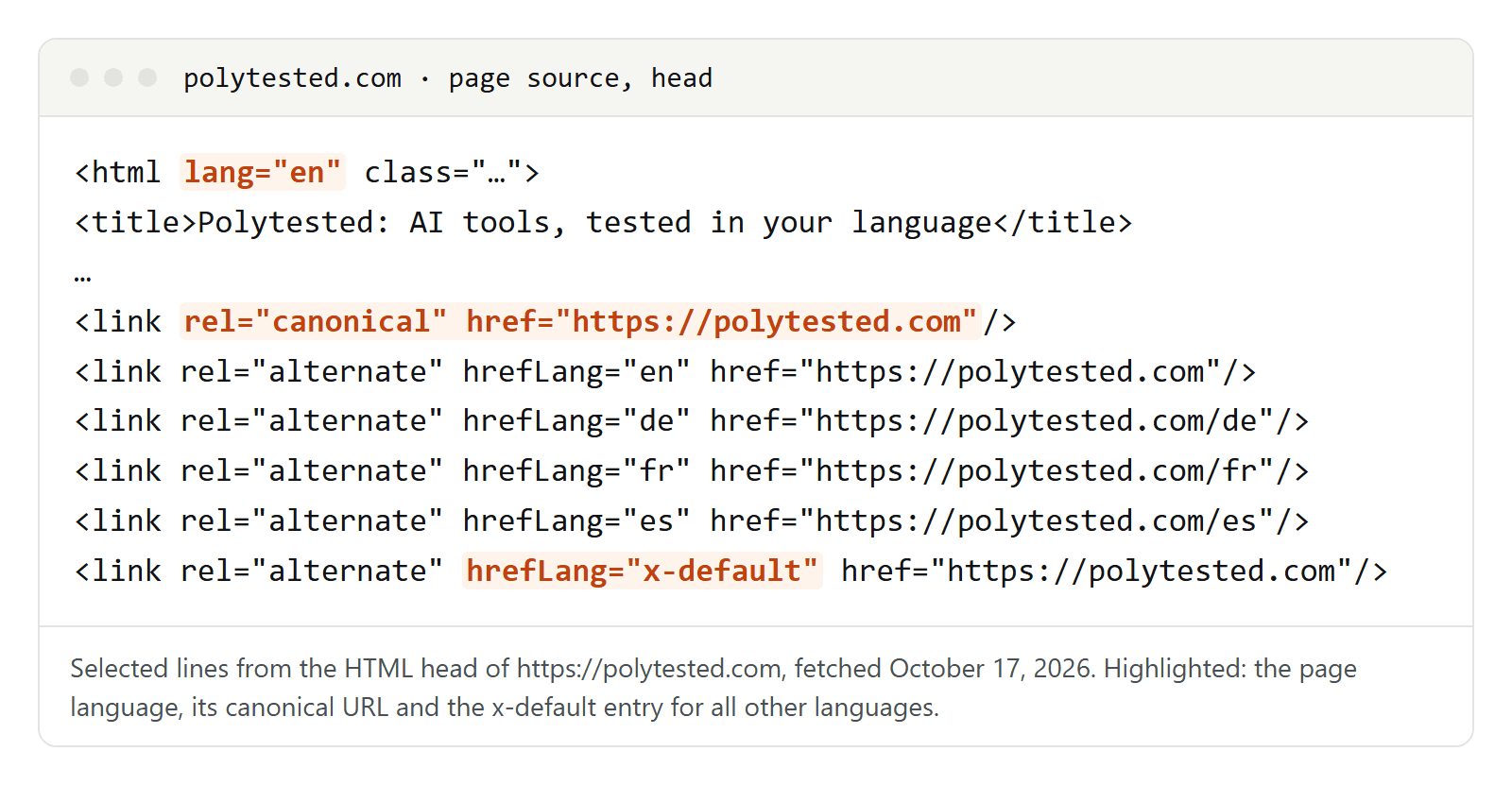
- The canonical points to the page itself. A translation is its own canonical, never a copy of the English page.
- Every version lists itself and all the others, in both directions. Google ignores a pair of pages that don't point to each other.
- x-default names the page for everyone else: for us, English.
- Translations aren't duplicates. Google treats localized versions as duplicates only when the main content stays untranslated.
Hreflang can go in the HTML head, in HTTP headers or in the sitemap. Google treats the three as equivalent, and using more than one brings no benefit in Search; we use the head and the sitemap only because that makes our own checks easier. Bing also recommends hreflang, in a December 2025 post on its webmaster blog. A sitemap per language has another use: Search Console's Page indexing report can be filtered by sitemap, so you can follow indexing language by language. Our guide to hreflang and canonical tags covers the codes and common mistakes.
Research keywords in each market instead of translating them
The most common mistake is translating your English keyword list. By October 13, 2026, our Semrush plan held 305 topics: 95 for the US, 76 for Germany, 68 for France and 66 for Spain. Only 12 made it into all four markets.
| Topic | United States | Germany | France | Spain |
|---|---|---|---|---|
| International SEO | none in our plan | seo international · 1,000 · 15 | seo international · 1,300 · 19 | posicionamiento seo internacional · 210 · 13 |
| Meeting minutes | how to write meeting minutes · 90,500 · 36 | besprechungsprotokoll vorlage · 590 · 20 | compte rendu de réunion · 1,600 · 36 | acta de reunion · 390 · 22 |
| Transcribing audio | transcribe audio recording to text · 2,400 · 12 | audio transkribieren · 2,900 · 14 | transcription audio en texte gratuit · 5,400 · 13 | transcribir mp3 a texto · 260 · 18 |
| Learning n8n | n8n tutorial for beginners · 260 · 30 | n8n tutorial deutsch · 140 · 32 | formation n8n · 1,000 · 23 | curso n8n · 480 · 19 |
Three differences stand out:
- The words. Americans look for a "tutorial for beginners", the French for a "formation" (training), Spaniards for a "curso" (course). Germans add "deutsch" to find a tutorial in German.
- The size. For meeting minutes, the US query has more than 150 times the German volume. For transcribing audio, France and Germany both beat the US. A smaller country isn't always a smaller market for your topic.
- The competition. For this guide's topic, the top 10 results Semrush stored for Germany, France and Spain don't share a single domain.
English terms travel, too: our French plan lists "multilingual seo", in English, with 210 searches a month in France. Research each market in its own country database, then look at what ranks there. Our international keyword research guide walks through the method.
Localize, don't just translate
The W3C defines localization as adapting a product or content to the language, cultural and other requirements of a specific market: number, date and time formats, currency, symbols and colors, content that may seem insensitive, legal requirements and more. On our site, that means a decimal comma in German, French and Spanish (8,6 rather than 8.6), "du", "vous" and "tú" as the form of address, local quotation marks, euro prices as the vendor lists them with a VAT note and no currency conversion, and separate legal pages per language.
Machine translation isn't banned, but it doesn't replace the work. Since March 5, 2024, Google's spam policies have covered "scaled content abuse": many pages made mainly to manipulate rankings, including automated transformations such as translating, where little value is added for users. The September 2025 version of Google's Search Quality Rater Guidelines counts a person translating a text as effort, but not running freely available content through translation software at scale without oversight.
Google machine-translates too, and labels it. Its Search Central pages in French, Spanish and German carry language codes such as es-x-mtfrom-en, the format Google Cloud's documentation gives for machine-translated text, and translated Search Console help pages say they may contain AI-translated content. Our German, French and Spanish versions are written for their readers and checked by a native-speaking editor whose name appears on the page.
The US, Canada, the UK and Europe: one language, many markets
Each market you add brings its own search habits and formats:
| Market | Google, percent | Bing, percent | Price | Short date | hreflang |
|---|---|---|---|---|---|
| United States | 85.19 | 9.89 | $1,234.56 | 10/17/2026 | en-US, es-US |
| Canada | 85.3 | 10.06 | $1,234.56 (en), 1 234,56 $ (fr) | 2026-10-17 | en-CA, fr-CA |
| United Kingdom | 91.39 | 6.08 | £1,234.56 | 17/10/2026 | en-GB |
| Mexico | 88.08 | 9.43 | $1,234.56 | 17/10/2026 | es-MX |
| Germany | 87.84 | 6.49 | 1.234,56 € | 17.10.2026 | de-DE |
| France | 88.16 | 5.47 | 1 234,56 € | 17/10/2026 | fr-FR |
| Spain | 93.81 | 3.49 | 1234,56 € | 17/10/2026 | es-ES |
StatCounter counts page views referred by search engines, not searches, and the US and Canada rows cover all users, whatever their language.
- Spanish in the US. 44.9 million people in the US speak Spanish at home, according to the Census Bureau's American Community Survey for 2024. A plain
espage reaches them, andes-USlabels a page written for them. Check your dates: the locale data browsers use writeses-USdates day first, unlikeen-US. - Canada. Bing's share is the highest in the table. The Québec government says businesses operating in Québec must make their catalogs, advertising and websites available in French.
- United Kingdom. The code is
en-GB. UK is a reserved code, so Google ignores the region inen-UK. Spelling changes too: Merriam-Webster lists "colour" as the chiefly British spelling of "color". - Europe. Standard VAT is 19 percent in Germany, 20 in France and 21 in Spain, so one VAT-inclusive price can't be right everywhere. Germany's price rules (PAngV) require total prices in offers to consumers, and its Digitale-Dienste-Gesetz (DDG, § 5) requires business websites to name the operator with an address. The EU's GDPR can apply to companies outside the EU that offer goods or services to people in the EU, and its recital 23 names using an EU language or currency, with the option to order in it, as one sign of such an offer.
None of this is legal advice. Have legal pages written or checked for each country instead of translating your US ones.
Measure results by country and language
Search Console shows whether a version works, as long as you split the data:
- A domain property for the whole site, so nothing is missing.
- A URL-prefix property for each language folder, such as
https://example.com/es/. Search Console's help recommends this type when you need to limit data to a path. - The Countries dimension of the Performance report. It groups data by the country where the search happened, not by page language. Filter pages for URLs containing
/es/to see whether your Spanish version is read in the US, Mexico or Spain. - The Page indexing report, filtered by a specific sitemap, if you have one sitemap per language.
- Bing Webmaster Tools, especially for the US, Canada and Mexico.
Our own numbers will come later: our site has been open to search engines only since October 13, 2026, too recently to compare countries.
Common international SEO mistakes
- A canonical tag pointing from the translation to the original, which tells Google the translated page is only a copy.
- Automatic redirects by language or IP address, even with an exception for Googlebot.
- Mixed languages on one page, such as English text under a Spanish menu.
- Translated keywords instead of keywords researched in each market.
- Invalid codes such as
en-UKores-LA(LA is Laos), and flags for languages. - Unreviewed machine translation, especially at scale.
- US legal pages translated word for word instead of written for each country.