A keyword is a search you want a page to show up for: the words people type into Google, such as "srt to txt" or "how to write meeting minutes". Choosing keywords means finding searches that match what your page offers, that the results page shows people really want, and that your site can realistically rank for. Below we explain the numbers and labels keyword tools give you, and show the 305 target keywords we picked for this site's guides in four markets, including one we dropped after looking at who ranked.
What a keyword is
A search is what one person types. A keyword is the same thing seen from the site owner's side: a search that enough people make, grouped with its spelling and word-order variations, that you can plan a page around it.
- Write for the words people use. Google's SEO Starter Guide tells site owners to "think about the words that a user might search for to find a piece of your content."
- You don't need every variation. The same guide says not to worry about anticipating every way someone might phrase a search, because Google's "language matching systems are sophisticated and can understand how your page relates to many queries."
- One page, many searches. A good page ranks for its main keyword and for many related searches. You pick one main keyword per page and write naturally around it.
Head terms and long-tail keywords
- Head terms are short, broad searches with large volumes, such as "seo".
- Long-tail keywords are specific searches with small volumes each, such as "how to find competitors keywords". Ahrefs defines the long tail by search volume rather than by word count, and says keywords with fewer than 10 searches a month make up almost 93 percent of its US database, 2.3 billion keywords.
- Why the long tail matters: specific searches say more about what the person wants, and fewer pages compete for each one. What a 0 in a keyword tool really means, and when a tiny keyword deserves a page, is in our guide to low-volume keywords.
Long keywords are usually long-tail, but not always. In our own list, 196 of the 305 target keywords have three words or more. German keeps more of them short, because it builds compound words: our German keyword "besprechungsprotokoll vorlage" has two words, where the English search for a meeting minutes template has three.
Search intent: what the searcher wants
Search intent is the reason behind a search. Semrush sorts keywords into four intents and labels them with a letter in its keyword tools:
- Informational (I): the person wants to learn something, for example "what is an srt file".
- Navigational (N): they want a specific site or brand, for example a company name followed by "login".
- Commercial (C): they are comparing products or services, for example "n8n vs zapier".
- Transactional (T): they are ready to act: buy, book or sign up.
Semrush notes that some keywords get more than one label. The labels come from a machine-learning model that looks at the results page, at words such as "buy" or "how" and at whether a brand is named, so check them against the results page yourself before you build a page on them.
Two examples from our own research:
- "what does srt stand for" had 4,400 searches a month in the US and a keyword difficulty of 12, which looked ideal for our subtitle guides. But in Semrush's record of the US top 10, five of the results were car dealerships' websites: SRT is also Dodge's performance badge. People searching it mostly want cars, so we dropped it.
- "keywords 101", the phrase this guide targets, is mixed too. On 13 October 2026, Google's English suggestions for it in the US included "keywords 101 etsy", Etsy's seller handbook article and searches about radio stations, such as "keyword 101.5". This guide covers the SEO meaning; Etsy sellers will find Etsy's own handbook more useful.
Search volume: what the number means
Search volume is an estimate of how often a keyword is searched in a month, in one country.
- It's an average. Semrush divides the searches of the past 12 months by 12, and Google's Keyword Planner also averages over 12 months by default. A seasonal topic can be far above or below its average in any given month.
- It's modeled. Semrush takes data from third-party providers, overlays it with clickstream data and applies machine learning to estimate billions of keywords. Its numbers include mobile and desktop searches.
- It's grouped and rounded. Keyword Planner counts a keyword together with its close variants, and rounds its figures.
- Tools disagree. Each tool models its own numbers, so the same keyword can show different volumes. Use volume to compare keywords within one tool and one country, not as a traffic forecast. We showed how far traffic estimates can be off in how to find your competitors' keywords.
Google Trends is a different kind of number. It takes a sample of searches, divides each data point by all searches in that place and period, and scales the result from 0 to 100. That shows how interest rises and falls, and how two searches compare, but not how many searches there are.
Keyword difficulty: what the score means
Keyword difficulty estimates how hard it is to reach the top 10 for a keyword. Semrush calls its score KD% and calculates it from the pages that rank: the median number of referring domains pointing to them, their mix of followed and nofollow links, the median Authority Score of their domains, and the features of the results page.
Semrush's own reading of the scale:
- 0–14, very easy: "the best opportunities to start ranking new web pages on Google".
- 15–29, easy: some competition, "but are still achievable, even if your domain is new."
- 30–49, possible: you need well-structured content optimized for the keyword.
- 50–69, difficult: you also need some quality backlinks.
- 70–84, hard: you need many better backlinks.
- 85–100, very hard: content, link building, on-page work and promotion all at once.
Ahrefs has its own keyword difficulty score with a different model, so a 20 in one tool isn't a 20 in the other. Neither is a Google number: Google doesn't publish a difficulty score.
The 305 keywords we picked
We are a new site, so we planned our first guides around searches a new site can win. For each planned guide we chose one target keyword in Semrush's database for its market: the US, Germany, France or Spain. The first round gave us 200 topics, 50 per market. For the second round of 105 topics, we only took keywords with a difficulty of 20 or less.
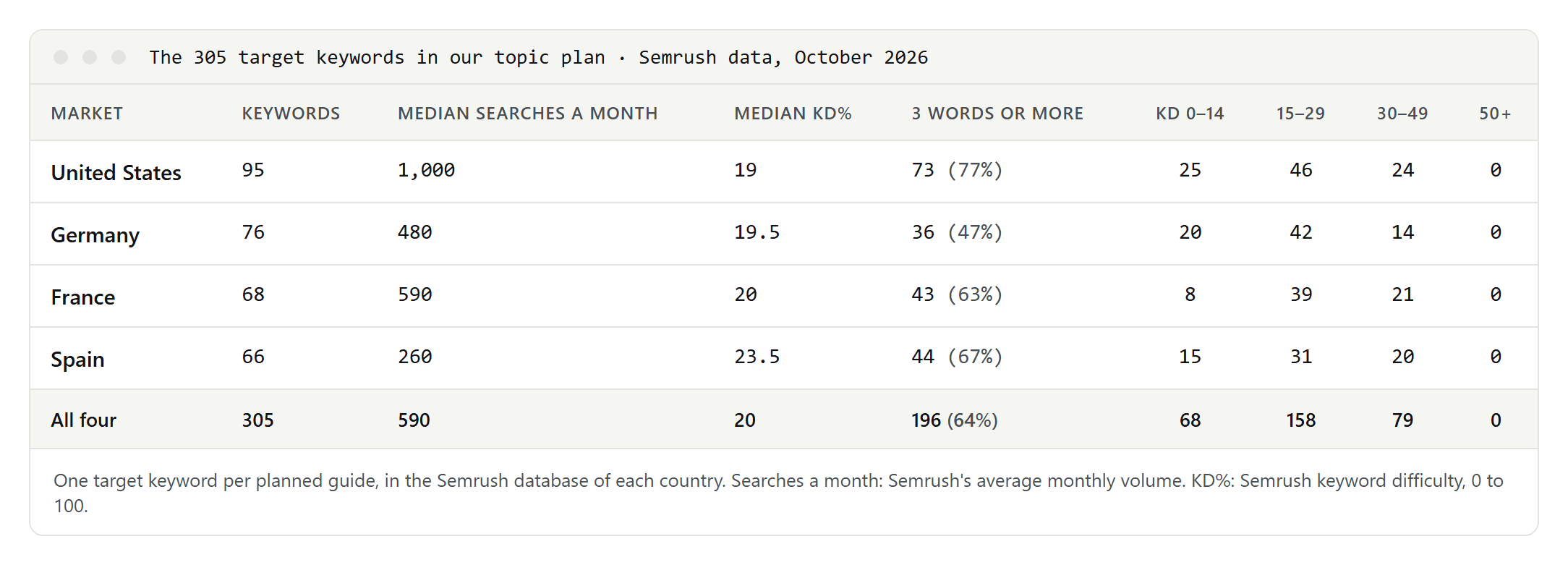
- No hard keywords. None of the 305 has a difficulty above 42, and 226 of them sit in Semrush's two easiest ranges.
- Modest volumes. The median keyword has 590 searches a month, and 291 of the 305 have between a hundred and five thousand.
- Markets differ. Our US keywords have a median of 1,000 searches a month, our Spanish ones 260. Compare a keyword with others in the same country, not across countries. Our guide to international keyword research shows why.
- Some keywords wait for their page. Searches for comparisons, alternatives and "best" lists stay out of the blog. They belong to test pages, which we publish after we have measured the tools.
Five checks before you pick a keyword
- Relevance: can your page answer this search completely, from your own knowledge or work?
- Intent: search it and look at what ranks. If the top results are a different kind of page, such as product pages, videos or car dealerships, pick another keyword.
- Difficulty for your site: a new site should start in the lowest difficulty ranges. Semrush's Personal Keyword Difficulty adjusts the score to your own domain.
- Volume last: use search volume to choose between keywords that pass the first three checks, not to choose which checks to skip.
- One page per topic: don't make a separate page for every variation. Google's spam policies call pages "created to rank for specific, similar search queries" doorway abuse.
Using your keyword on the page
Google's Search Essentials ask you to use the words people search for "in prominent locations on the page, such as the title and main heading of a page, and other descriptive locations such as alt text and link text." Our guide to keyword placement goes through each location.
Some old advice you can skip:
- Meta keywords: "Google Search doesn't use the keywords meta tag," the SEO Starter Guide says.
- Keyword density: Google gives no target number. Its guide warns that "excessively repeating the same words over and over (even in variations) is tiring for users", and that keyword stuffing breaks its spam policies.
- Word count: "there's no magical word count target, minimum or maximum."
- Keywords in the domain name: they "alone have hardly any effect beyond appearing in breadcrumbs."
Free tools to start with
- Google Search Console shows the searches your own pages already appear for, once you have verified your site.
- Google autocomplete: Google says its predictions "reflect real searches that have been done on Google", shaped by language, location and trends, and by your own past searches.
- Google Trends compares interest over time and between places, on its 0 to 100 scale.
- Google Keyword Planner sits inside Google Ads, and you must complete your account setup with billing information before you can get keyword ideas.
- Semrush's free account allows 10 reports a day across its main tools and one demo project, without a credit card.
For more on what each free route can and can't show, see the free route in how to find your competitors' keywords.