To find a competitor's keywords, you look up the searches their pages rank for in a keyword database such as Semrush or Ahrefs, compare that list with your own, and keep the searches you can realistically win. First, though, you need to know who your search competitors are, and they are rarely the companies you compete with. When we planned Polytested's first 200 topics in October 2026, the domains we kept meeting in Google's top 10 were YouTube, Reddit and help centers, not other review sites. Below is our method with that data, the free alternatives, and how far to trust the numbers the tools give you.
Search competitors aren't your business competitors
Business competitors sell what you sell. Search competitors are whoever ranks for the searches you want, whatever they sell. Ahrefs uses itself and Backlinko as the example: a software company and an SEO blog, competing for the same keywords.
For each of our 200 topics we chose one target search in its market and looked at who ranked in the top 10 for it:
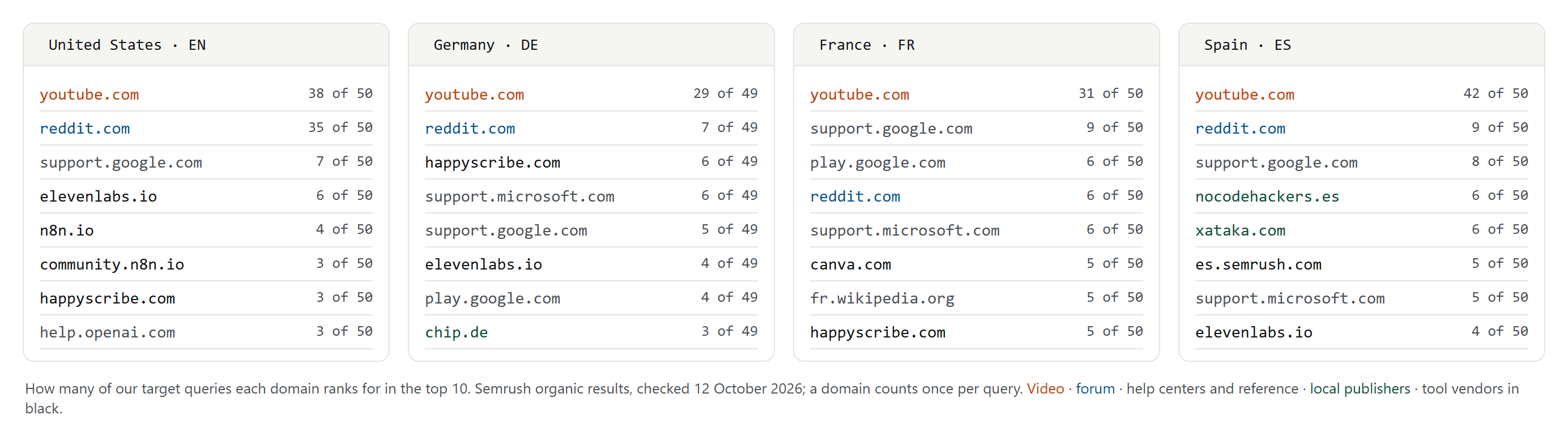
- YouTube was everywhere. It ranked in the top 10 for 140 of our 199 target searches across the four markets, and for 42 of 50 in Spain.
- Reddit is an American competitor. It ranked for 35 of our 50 US searches, but for only 6 to 9 of 50 in Germany, France and Spain.
- Help centers came next. Google's and Microsoft's support sites and other help or documentation pages showed up for 20 of our 50 US searches and 15 to 18 in each of the other markets.
- Tool makers rank for their own topics. ElevenLabs, Happy Scribe and n8n appeared repeatedly, with their blogs and docs.
- Each market has local publishers. CHIP in Germany, Xataka and NoCodeHackers in Spain, Jedha in France.
What this meant for us: a text page won't replace a video, but it can sit next to one if it offers what a video can't, such as a table, a file or a checklist. And Reddit's strength in the US says readers there want answers from people who have actually tried things, which is why every guide on this site includes our own test.
Step 1: Find out who ranks for your topics
- Write down 10 to 20 searches you want to rank for, in the country you are targeting.
- Look at the top 10 for each, either in Google with your search region set to that country, or in a tool's database for that country.
- Count the domains. The ones that keep coming back are your search competitors. Note platforms such as YouTube or Reddit, but don't pick them as models: you can't copy what makes them rank.
- Do it per market. Our list for Germany looked different from the one for the US, so a competitor list made for one country doesn't transfer.
Semrush can shortcut this: its Competitors report in Organic Research ranks domains by how many keywords they share with yours. For a new site with no rankings yet, the manual count is the only way.
Step 2: Pull a competitor's keywords
- Semrush, Organic Research, Positions report: every search a domain ranks for in Google's top 100, in the country database you pick, with position, search volume, keyword difficulty (KD%), intent, estimated traffic and the ranking URL. Filter to the top 10 or 20 to see where they really win.
- Remove their brand. In Semrush, open the advanced filters and set the keyword type to Non-branded. Otherwise the list starts with searches for the competitor's own name, which nobody else can win.
- Ahrefs, Site Explorer, Organic keywords: the same idea, sorted by estimated traffic, with a country selector; brand terms can be removed with a "doesn't contain" filter.
Step 3: Find the gaps
- Semrush Keyword Gap compares your domain with several competitors at once. Its Missing tab lists searches all the competitors rank for and you don't; Untapped lists searches at least one of them ranks for and you don't. You can compare organic rankings (top 100), paid ads or shopping ads.
- Ahrefs Content Gap does the same with up to ten competitors.
A brand-new site has no rankings, so every keyword is "missing". In that case use the gap list differently: look for searches where small sites already rank in the top 10. That is the best sign a search is winnable without years of links.
Step 4: The free route
- Google Search Console shows the searches your own site appears for, with clicks, impressions and average position, and lets you filter by country. It only works for sites you have verified, and it leaves out some searches (Google calls them anonymized queries) to protect searchers' privacy.
- Google Keyword Planner can suggest keyword ideas from a competitor's website: choose Discover new keywords, then Start with a website. These are ideas based on the site's content, not the searches it ranks for, and you need to enter billing details in Google Ads before you can use it.
- Your own eyes: search your target terms in each market and note who ranks. It's slow, but it's how we started, and it shows you things a table can't, such as videos, forums and AI answers on the page.
How far to trust the numbers
- Traffic is an estimate. Semrush calculates it from positions, search volume and an average click-through rate, and calls the result the traffic a website could get, not its visits. It advises against using it for your own site's traffic.
- The tools miss keywords. Ahrefs says its keyword counts are almost always smaller than the real number, because no database holds every search.
- Errors are large for single sites. In Ahrefs' own 2022 comparison of 1,635 US sites with their Search Console data, the typical traffic estimate was off by about half for Ahrefs and by about two thirds for Semrush. SparkToro, comparing 641 sites with Google Analytics the same year, found Semrush matched best but warned that individual estimates are often off by double or more.
Use the numbers to compare competitors and choose topics, not to predict your traffic.
From a long list to a short plan
- Drop brand terms and searches for products you don't cover.
- Check the intent. Open the results page: if the top results are product pages and you write guides, move on.
- Check the difficulty for your site, not the average. Semrush's Personal Keyword Difficulty adjusts its score to your domain.
- Keep markets apart. A search that is easy in Germany can be crowded in the US, as we showed in international keyword research.
- Match your format to what ranks. If YouTube owns the top results, plan a page with something a video can't give.
If search intent, volume or keyword difficulty are new terms to you, SEO keywords 101 explains them with the 305 target keywords we ended up with.