Good quality but low traffic keywords are worth targeting when the search is specific and your page can answer it completely, often as one section of a page you already plan rather than as a page of its own. A 0 in a keyword tool rarely means that nobody searches: in Semrush it means fewer than 10 searches a month, and many rare searches never make it into any tool's database. Below we explain what each tool's 0 means, what Google itself says about rare searches, and which searches our own new site appeared for in its first days in Search Console.
What counts as low search volume
There is no official line between low and normal search volume, and even one vendor gives different answers:
- Semrush's guide to keyword metrics (August 2024) recommends at least 100 monthly searches as a general rule of thumb and says keywords with 10 to 20 searches a month probably won't bring enough visitors.
- Semrush's long-tail guide (updated September 2026) says zero-volume questions can be worth targeting, and that you should judge them by whether you can answer them well and whether they fit a topic you already cover, not by a volume threshold.
- Semrush's German blog (2022) suggests aiming for a minimum of 100 to 1,000 monthly searches.
- An American content agency calls anything under 1,000 searches a month a good benchmark for low volume.
Low also depends on the market, because search volume is counted per country. In our own keyword plan, the median main keyword has 1,000 searches a month in the US, 590 in France, 480 in Germany and 260 in Spain: a small number in the US is a median one in Spain. Our guide to international keyword research explains why you should only compare volumes within one country.
That gives this guide an odd start. The phrase it targets, "good quality but low traffic keywords", shows 1,000 searches a month in Semrush's US database, with a keyword difficulty of 14. That is exactly the median of our 95 US main keywords, so in our own plan the keyword about low traffic isn't a low-traffic keyword. If search volume and difficulty are new terms to you, SEO keywords 101 explains both.
What a 0 means in each keyword tool
A 0 in a keyword tool is a statement about the tool's data, not about the world. Each tool draws the line in a different place:
- Semrush shows "0" for volume when a keyword has fewer than 10 average monthly searches in the location you chose. "N/A" means something else: Semrush didn't get enough clickstream data to calculate the volume at the moment.
- Ahrefs counts 2.3 billion US keywords with fewer than 10 searches a month, almost 93 percent of its US database. Rarer searches usually aren't in the database at all: Ahrefs says it filters more than 110 billion discovered keywords down to the 28.7 billion most popular ones, and that keywords it doesn't hold are usually excluded because search interest is extremely low.
- SISTRIX, a German SEO tool, wrote in 2023 that keywords with up to 10 searches a month make up 69.9 percent of the keywords in its data. For very low volumes it averages over periods longer than the usual 12 months.
- Google Keyword Planner doesn't show keywords with very low search volumes at all. You get an error message and a prompt to try other keywords.
- Google Trends only shows data for popular terms, so searches with low volume appear as 0, and the noise Google adds for privacy is most noticeable on queries with low or no search interest.
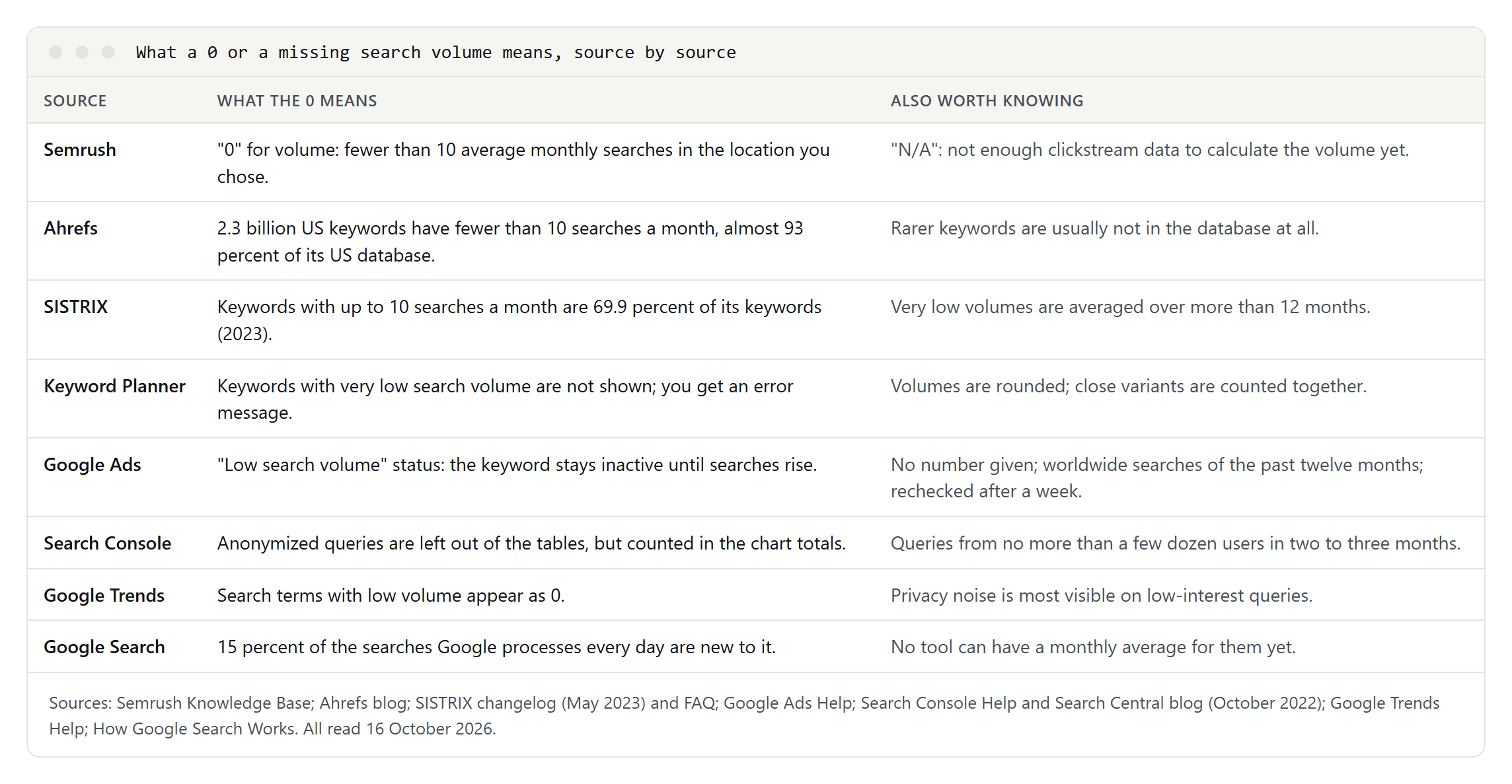
So a 0 in Semrush means "fewer than ten", a missing keyword in Ahrefs means "too rare for the database", and a 0 in Trends means "too rare to show". None of them means that nobody searched.
Google's own label: "Low search volume" in Google Ads
Google has its own name for these searches, though you'll only meet it in Google Ads. "Low search volume" is a keyword status for a keyword with very little or no search history on Google. According to Google Ads Help:
- The keyword is switched off. It doesn't trigger ads until its searches increase; if they rise even a small amount, it's reactivated. Google checks the status regularly.
- Google looks at a whole year, worldwide. Before it keeps a keyword out of the ad auction, it evaluates the keyword's worldwide searches over the past twelve months. It gives no number for the threshold.
- Typical causes, according to Google, are keywords that are too specific, obscure or badly misspelled.
- It's not a penalty. The status has nothing to do with Quality Score, bid or ads.
Google's suggested fixes are worth reading even if you never buy an ad. You can wait for the automatic recheck after a week, which Google says can help when you advertise a new brand, term or product. Or you can make the keyword less specific: Google's example shortens "gardenia flower delivery in spring NYC" to "gardenia delivery NYC", and a more general keyword such as "blue bicycles" can still show an ad for the search "red and blue bicycles for sale".
We take two things from this for organic search. Google itself treats some searches as too rare to count, so a missing number is normal. And a new term can leave that zone quickly, which is one reason a page about a new product can be worth writing before any tool shows a volume.
Why no tool sees the bottom of the long tail
Google says 15 percent of the searches it processes every day are ones it has never seen before. (Some SEO guides quote 16 to 20 percent and apply it to keywords; Google's figure is 15 percent of daily searches.) A search that is new today can't have a monthly average yet.
Ahrefs adds a second reason: long conversational questions, the kind people type into AI chats, are rarely phrased the same way twice, so they never collect enough repetitions to register in a keyword database.
The numbers that do exist are coarse. Keyword Planner counts a keyword together with its close variants, and Google says its search volume statistics are rounded. Semrush describes its volumes as the output of a model built from third-party data and historical clickstream data. So the claim in several SEO guides that most tools simply copy Keyword Planner doesn't describe Semrush, and Ahrefs says Planner data are the base of its model, not the final number.
We saw the coarseness in our own data. We took every keyword in our Semrush plan for the US, Germany, France and Spain (main and secondary keywords, 865 per-market keywords, captured 12 and 13 October 2026) and counted their search volumes. They take only 29 different values. Up to 1,000 those are 40, 50, 70, 90, 110, 140, 170, 210, 260, 320, 390, 480, 590, 720, 880 and 1,000. Nothing lies between 880 and 1,000 or between 1,000 and 1,300, and most steps are roughly 20 to 30 percent above the one before.
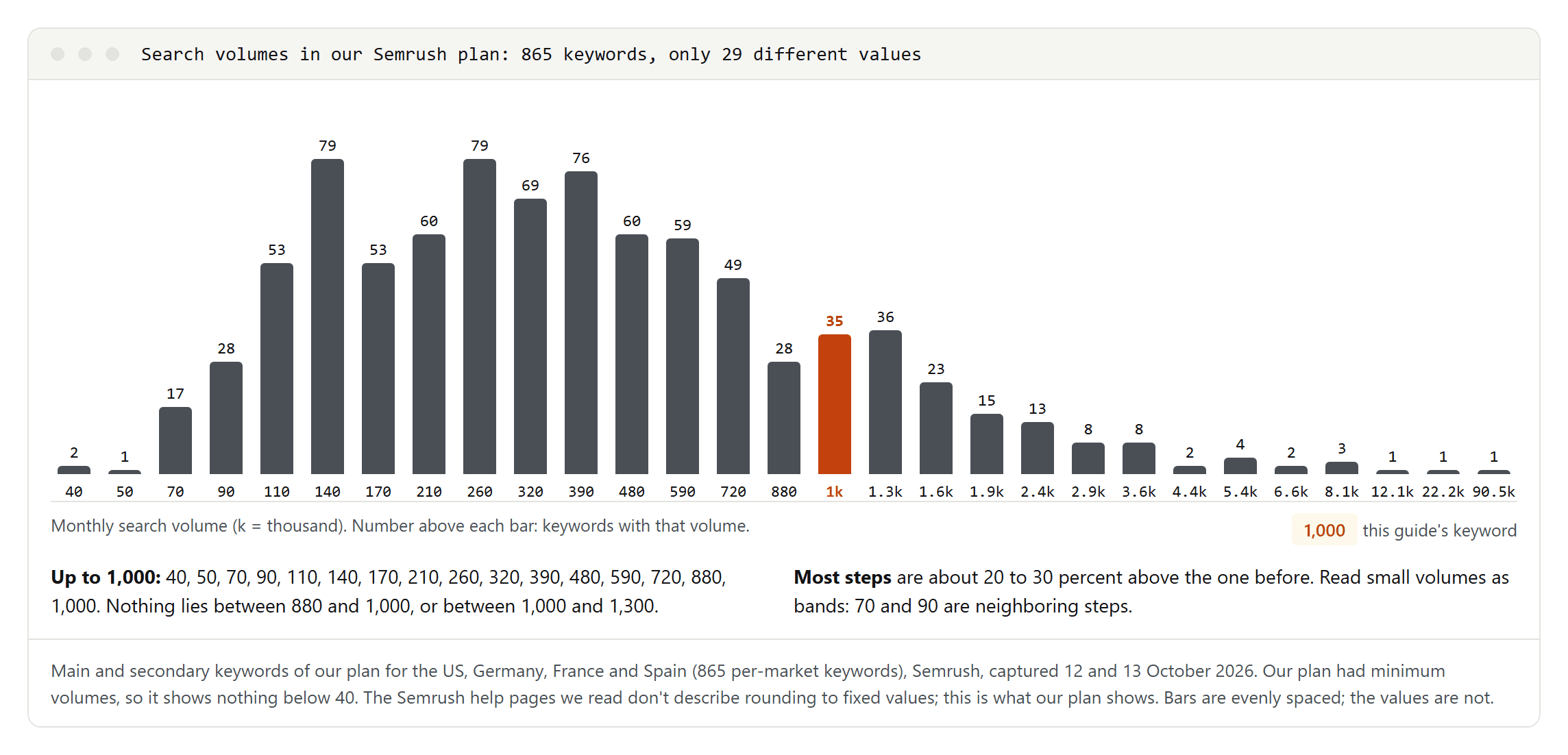
The Semrush help pages we read don't mention rounding to fixed values, so all we can say is that this is what our plan shows. In practice, read small volumes as bands. A keyword at 70 and one at 90 sit on neighboring steps, and the real difference between them may be a handful of searches.
How low our own keyword picks went
Before we suggest that you target small searches, here is how small ours were. Our plan is not a low-volume plan:
- We set the floors ourselves. In the second research round we only took keywords with a difficulty of 20 or less and a minimum of 200 searches a month in the US, 100 elsewhere (70 in a second pass for Germany, France and Spain). So the plan can't show the zero end of the market. It shows our choices.
- Only 12 of our 222 US keywords have 200 or fewer searches (main and secondary keywords together), and only 2 of our 95 US main keywords do. The smallest US value in the whole plan is 90, for "website translation strategy", with a difficulty of 9.
- Our 25 live English guides target a median of 1,300 searches a month, with a median difficulty of 20. Only one targets 260 or fewer: Lovable SEO, planned for "lovable seo" at 170 searches and a difficulty of 16.
We chose low difficulty first, not low volume. That was a sensible start for a new domain, but the low end is where we have the least experience, and it's where we'll look next.
Are low-volume keywords easier to rank for?
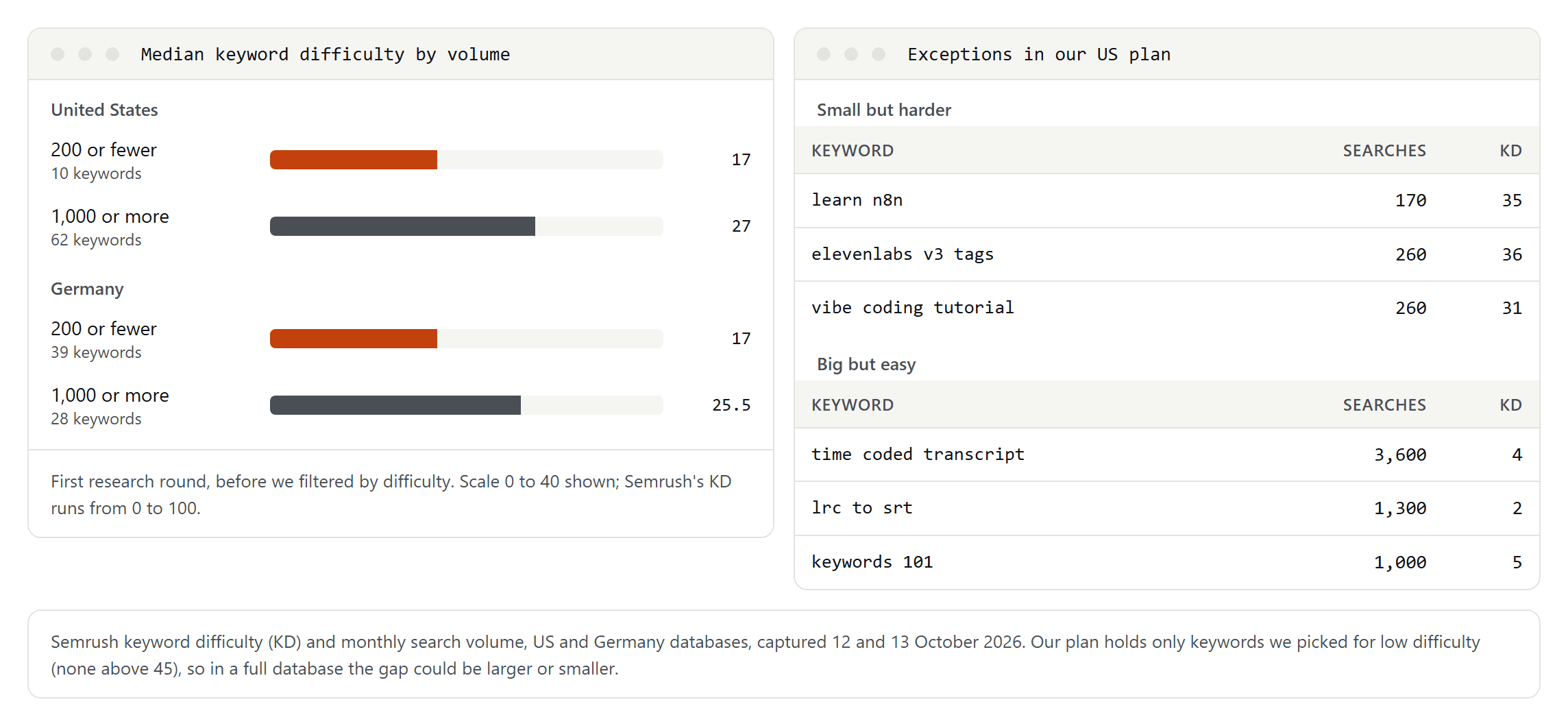
On average a little, but not reliably. We compared Semrush's keyword difficulty for low- and high-volume keywords in our plan, using the first research round, before we filtered by difficulty:
- US: keywords with 200 or fewer searches had a median difficulty of 17 (10 keywords); keywords with 1,000 or more had a median of 27 (62 keywords).
- Germany: 17 for the small ones (39 keywords) and 25.5 for the big ones (28 keywords).
The exceptions matter more than the medians. "learn n8n" has only 170 searches a month but a difficulty of 35, "elevenlabs v3 tags" (260 searches) has 36 and "vibe coding tutorial" (260) has 31. Meanwhile "time coded transcript" has 3,600 searches and a difficulty of 4, "lrc to srt" has 1,300 and 2, and "keywords 101" has 1,000 and 5.
Small top-10 lists can also belong to big players. In Semrush's record of the US top 10 for "elevenlabs v3 tags", ElevenLabs' own site held 5 of the 10 places; for "vibe coding tutorial", YouTube held 7. And the number of different domains in a top 10 didn't change with volume: the median was 6 both in the quarter of our lists with the lowest volumes and in the quarter with the highest, in the US and in Germany.
One caveat: our plan only holds keywords we picked for low difficulty (none above 45), so in a full keyword database the gap between small and big keywords could be larger or smaller.
Ahrefs explains why a small keyword can be hard. Many low-volume keywords are just an unpopular way of searching for something popular. Google understands that both searches mean the same thing and shows an almost identical set of results for both, so the rare phrasing is no easier to rank for than the popular one.
Two kinds of low-volume keyword
That leaves two kinds of small search, and they need different treatment:
- Its own topic. The search asks something specific that the popular searches don't answer. Ahrefs' example is "link building for roofers", a zero-volume keyword with a Keyword Difficulty of 0 in its tool. In our own data, "studio dub meaning" was such a question.
- A rare phrasing of a big topic. Ahrefs' example is "submit domain to search engines": an estimated 10 searches a month, while Ahrefs' guide on the topic gets an estimated 3,800 visits a month from search, because it ranks for hundreds of long-tail searches that mean much the same thing.
How to tell them apart:
- Compare the results. Search the rare phrase and the popular one by hand and compare the two result pages. If they show mostly the same pages, the rare phrase is a variant, and your page for the popular search can cover it.
- Compare volume with traffic. Ahrefs' Traffic Potential is the estimated search traffic of the current top-ranking page across all its keywords. If it's far higher than the keyword's own volume, there are more popular ways of searching for the same thing; "submit website to search engines" has a volume of 500 and a Traffic Potential of 7.8k in Ahrefs' example.
- Look at your own data. Our meeting minutes guide appeared for 59 different searches between 12 and 16 October, and 51 of them were the planned keywords or other phrasings of the same topic: "example of meeting minutes", "minutes of meeting sample", "how to write minutes of meeting format". None of them needs a page of its own.
A variant belongs in your page's wording, a heading or an FAQ answer. Its own topic may deserve a section, and sometimes a page.
What Search Console showed for our new site
Polytested is a young site. Search Console's first impressions for it date from 12 October 2026, so everything below rests on a few days of data. When we pulled the data on 16 October 2026, the whole site had 437 impressions and 2 clicks, and the figures for 15 and 16 October were still marked as incomplete.
We compared every search our English guides appeared for in Search Console with the keywords we had planned for each page in Semrush:
- 130 searches, 309 impressions. That's how many query rows Search Console listed for 11 of our English guides between 12 and 16 October.
- 12 were keywords we had planned for that page, with 64 impressions at an average position of 83.7. The best was "keywords 101" at 13.7; none reached the top 10.
- 118 were searches we never planned. We set aside 13 of them, such as "some test keyword 04", because they look like someone testing a keyword tool rather than a reader. We sorted the other 105 by hand: 71 variants of the planned topic in other words (130 impressions, average position 81.4), 18 broader head terms such as "dubbing" or "tts" (68 impressions, 61.1), 15 specific sub-questions we never planned (31 impressions, 21.9) and one typo.
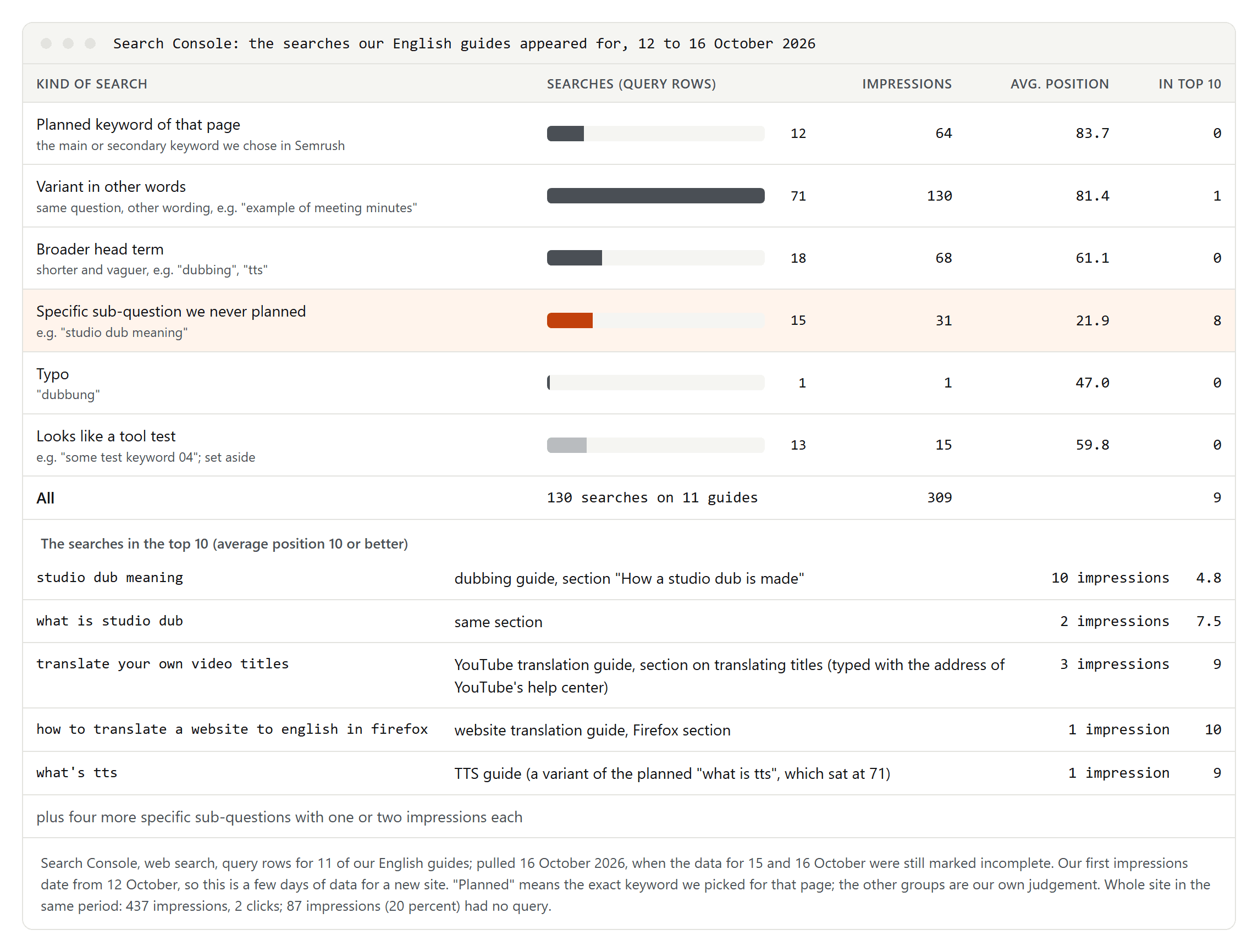
The top 10 tells the story. Nine rows reached an average position of 10 or better: eight were specific sub-questions, one was a variant ("what's tts"), and none was a planned keyword.
- Studio dubs. Three phrasings of "what is a studio dub" sat at average positions between 5 and 8 on our dubbing guide, which answers them in one section, "How a studio dub is made". The guide's planned keyword, "what is dubbing", appeared once, at position 29.
- Firefox. "how to translate a website to english in firefox" reached position 10 on our website translation guide, which has a Firefox section.
- YouTube titles. A search for YouTube's help text on translating your own video titles reached position 9 on our YouTube translation guide, which has a section on exactly that.
What we take from it: a section that answers a specific question can reach the first page before the page's main keyword does. These rows have one to ten impressions each, the classes are our own judgement, and we haven't looked the unplanned searches up in Semrush yet, so we can't say how many of them show a volume of 0.
Why Search Console hides the rarest searches
Search Console is the only place that shows the real Google searches your own pages appeared for, but it leaves out exactly the rarest ones. Google calls them anonymized queries: queries that aren't issued by more than a few dozen users over a two-to-three-month period. To protect searchers' privacy, they never appear in the tables, but they are included in the chart totals unless you filter by query.
On our site, 87 of the 437 impressions between 12 and 16 October, or 20 percent, had no query row. In our first pull, covering 12 to 15 October, it was 29 of 116. Part of that gap may come from a second limit: Search Console stores and shows only the most important data rows, and Google says not all queries beyond the anonymized ones appear in the table. Its bulk data export gives the most complete list and marks rare queries with a field called is_anonymized_query, whose query text is empty.
The practical consequence: a search that a keyword tool shows as 0 may be invisible in your own Search Console too. Google doesn't say whether "a few dozen users" means all searchers or only those who saw your site, so don't read a listed query as proof of a particular number of searches. For the basics of the Performance report, see the free route in how to find your competitors' keywords.
Impressions aren't search volume
It's tempting to treat Search Console impressions as the true volume of a rare keyword. They measure something else:
- An impression counts your link, not the search. Google counts an impression when your link appears on the current page of results, whether or not it was scrolled into view. In carousels and expandable sections, the item usually has to be scrolled into view or expanded first, and with infinite scrolling it has to be scrolled into view. Scrolling away and back doesn't count twice.
- You're not shown in every search. Searches where nobody reached the page of results with your link don't count at all. Our planned keywords averaged position 83.7, far below the first page, so their impressions say little about how often they are searched.
- Anonymized queries are missing from the rows, as described above.
One agency guide claims that Search Console gives you the accurate number of searches once you rank on page one. That's too strong: even on page one, a rare query can be anonymized, and the count only includes searches in which your page was shown.
Ahrefs ran the one small test we found on this. Its example "hreflang tag seo" had an estimated 10 searches a month in both Ahrefs and Semrush, and Ahrefs' page, ranking in the top five, got 20 US impressions in 28 days. Across all of its blog's top-five rankings with an estimated volume of 10 or lower, most got the same number of US impressions in 28 days as estimated or fewer, under 1 percent got more than 100, and the average was 11.3. Ahrefs calls the sample very small and doesn't say how many keywords it included.
So use impressions as a lower bound. They show demand your pages already touch, not how many searches exist.
Do low-volume keywords convert better?
Sometimes, and it depends on intent, not on the number. Ahrefs, testing the claim, concludes that low- and zero-volume keywords may be more likely to come from people close to a decision, but that this isn't a given, and that plenty of them are far from lucrative.
We can't add conversion data of our own: our site had 2 clicks in the period above, far too few to measure anything. You'll also find conversion rates for long-tail keywords quoted in SEO guides without a source; we leave them out.
What a specific search does give you is a clearer picture of the need. Compare two searches from our own Search Console: "minutes note" could mean almost anything, while "minute taker for council meetings" tells you who is searching and what for. A section that answers the second kind precisely is more likely to satisfy the person who typed it, whatever the volume. Whether that leads to a sale depends on what you offer.
When a low-volume keyword deserves its own page
Most small searches belong in a page you already have. Give one its own page only when several of these are true:
- A different intent. Its top 10 differs from the head term's, which suggests Google treats it as a separate question.
- Something only you can add. A test, your own data, a template or a file that the ranking pages don't offer.
- Results not owned by the maker. If the product's own site or YouTube fills most of the top 10, as with "elevenlabs v3 tags", a new page has little room.
- A new term or product. Google Ads notes that waiting for its weekly recheck can help for a new brand, term or product, and Ahrefs suggests creating a page for a trending topic before any volume is reported, to get in first.
- Real value per visitor. Ahrefs points out that for a lucrative topic, even a few visits can be worth a page.
If only one or two apply, write a section instead: a heading that asks the question in the searcher's words, with the answer in the first sentence underneath.
One page, many small searches
The opposite mistake is a page for every variant. Google's spam policies describe doorway abuse as sites or pages created to rank for specific, similar search queries, which lead users to intermediate pages that are less useful than the final destination. A separate page each for "meeting minutes sample", "example of meeting minutes" and "meeting minutes format" would be exactly that. We explain the rule in more detail in SEO keywords 101.
What works instead:
- One page per intent. Variants of the same question share a page.
- One heading per sub-question. Our dubbing guide's section on studio dubs is the example above: it answered a question we never planned and reached the top 10 for it.
- Grouped short answers. Semrush's long-tail guide cites Choose Chicago, which answers several related questions about a single attraction on one page, and argues that this serves readers better than splitting each question into a thin page of its own.
- The searcher's wording. Put the sub-question in a heading the way people ask it, and answer it right below. Our guide to keyword placement covers which places on a page Google actually documents.
How to find low-volume keywords without paying
- Your own Search Console, once you have a few weeks of data. In the Performance report, open the queries table, sort it by impressions or position, and look for questions your pages only answer in passing. The query filter's "Custom (regex)" option accepts regular expressions in RE2 syntax and isn't case-sensitive by default, so
^(how|what|why|can|does)lists question searches. - Questions from customers and readers: support emails, sales calls and comments. They're phrased the way people search, and no tool has them.
- Forums and communities, read by hand. Ahrefs notes that people ask questions there in their own words, which often reveals more than a keyword database.
- A keyword tool with a difficulty filter. We used Semrush's difficulty filter (20 or less) for our second research round. Read its 0 and N/A as explained above.
- Google's autocomplete, typed by hand. Don't script it: Google's spam policies count sending automated queries to Google, including scraping results for rank checking, as machine-generated traffic that violates its policies and its terms of service.
- AI chats for phrasing ideas, not for numbers. Treat any search volume a chat gives you as unverified.
A checklist for a new site
- Pick topics by difficulty first. Semrush calls a Personal Keyword Difficulty under 30 a good opportunity for new sites.
- For every page, list the sub-questions people ask about its topic, and give the specific ones their own heading.
- Read a 0 as "fewer than ten" or "not in the database", never as "nobody".
- Before you plan a page for a rare phrase, compare its results with the head term's.
- Check who owns a small top 10. A maker's own site or a wall of videos leaves little room.
- Give a rare search its own page only if it has its own intent and you have something of your own to add.
- Never build near-identical pages for variants of one search.
- Once Search Console has data, compare its queries with your plan, as we did above.
- Check Search Console again every month, and promote sub-questions that get impressions into sections, or into pages when they meet the conditions above.