To find keywords, start with the questions your readers have, collect the words they use from free sources such as Google's search box and Search Console, and then check each idea's search volume and difficulty in a keyword tool set to the right country. Before you pick one, look at who already ranks for it, and give each topic one page. ChatGPT helps with ideas, not with numbers. We show every step with our own plan: 95 topics for the US, researched in Semrush on 12 and 13 October 2026.
Step 1: Start with topics, not tools
A keyword tool can only expand a word you give it, so the first list has to come from you: what your readers ask, where they get stuck, and what you can answer better than most because you have done it yourself. Write each topic down as a problem, such as "my subtitles show broken characters", not as a single word like "subtitles".
Then think about how different people would phrase it. Google's SEO Starter Guide points out that people who know a topic well search with different words than newcomers do: some search for "charcuterie", others for "cheese board". The same guide says you don't need to anticipate every variation, because Google's language matching can connect your page to related searches.
Our own starting list came from the tools we test. The 95 US topics fell into SEO (20), video (18), meetings (15), building with AI (15), automation (13), voice (11) and translation (3).
Step 2: Collect ideas for free
- Google's search box. Type your topic and write down the predictions. Google says they reflect real searches, but they also depend on the language, your location, trending interest and your own past searches, and Google removes predictions that break its policies. They show you phrasings, not a ranking by popularity. Do this by hand: Google's spam policies say that sending automated queries to Google, including scraping results to check rankings, violates its policies and Terms of Service.
- "People also ask" and related searches. Google's own documentation suggests paying attention to these related searches when you think about topics to write about. They show how people phrase a whole question.
- Search Console. Once your site is verified, the Performance report shows the searches your pages already appear for, by default for the past three months. Some rare searches are left out to protect searchers' privacy. This is where the surprises are: from 12 to 16 October 2026, our English guides appeared for 130 different searches, and only 12 of them were keywords we had planned for those pages. Our guide to low-volume keywords shows what the other 118 were.
- Bing Webmaster Tools. Bing offers its webmaster tools for free. Its Keyword Research tool shows Bing's search volumes and trends, lists related keywords, question keywords and newly discovered ones, and shows the top 10 URLs for a keyword. You can filter by country, language and device, for any period in the last six months.
- AnswerThePublic turns a word into lists of questions and phrases that people search. You can start for free.
- Your inbox. Questions from customers and readers are already written the way people search, and no tool has them.
Step 3: Check search volume and difficulty
Before you choose, each idea needs numbers. These are the free ways to get them, as of October 2026:
| Tool | What you get | The catch |
|---|---|---|
| Google Keyword Planner | Average monthly searches for a keyword and its close variants, rounded, plus a Competition column | It sits inside Google Ads: you must finish your account setup with billing information. Competition counts advertisers, not the pages that rank |
| Semrush free account | Search volume, keyword difficulty (KD) and intent in its keyword tools | 10 reports a day across its main tools and one demo project, no credit card |
| Bing Webmaster Tools | Bing search volume and trend, question keywords, top 10 URLs | Bing searches only, and you need to sign in |
| Google Trends | Interest over time and by region, on a scale from 0 to 100 | No search volumes, and terms with little interest show as 0 |
Google calls Keyword Planner a free resource for advertisers. Very rare keywords don't show up in it at all.
Three habits make the numbers useful:
- Compare within one tool and one country. Each tool models its own numbers. Keyword Planner averages searches over 12 months by default, counts them regardless of language and follows the location you set. Semrush keeps a separate database per country.
- Write the date next to every number. Volumes and difficulty scores change from one update to the next.
- Read difficulty as a range. Semrush's KD runs from 0 to 100. It calls 0 to 14 "very easy", 15 to 29 "easy" and 30 to 49 "possible". How volume and KD are calculated is in our guide to SEO keywords.
How we built our US keyword plan
We did all of the above in Semrush in two rounds, one day apart:
| Step | What we did | Result |
|---|---|---|
| Round 1, 12 October | Keyword Magic Tool with 72 seed keywords, broad match. We sorted the results by volume and added a long-tail pass filtered to a difficulty of 35 or less | 50 topics |
| Round 2, 13 October | Keyword Magic Tool again, with 230 seed keywords across our four markets, filtered to a difficulty of 20 or less and, for the US, at least 200 searches a month | 45 more topics |
| Cleanup | We removed other meanings by hand, such as the animal otter, IRS transcripts and Dodge SRT cars | Fewer false hits |
| Held back | 13 keyword groups that need our own measurements, such as "semrush alternative" | Saved for test pages |
| Plan | One main keyword per topic, plus secondary keywords with the same intent | 95 topics, 222 keywords |
Across both rounds and all four markets, we scanned 29,988 keywords to get there. What the US result looks like:
- No hard keywords. The main keywords' difficulty runs from 2 to 42. In Semrush's terms, 25 topics are "very easy", 46 "easy" and 24 "possible". 57 of the 95 have a KD of 20 or less.
- A wide range of volumes. The median main keyword has 1,000 searches a month. The smallest has 110 ("website translation seo"), the largest 90,500 ("how to write meeting minutes").
- Few secondary keywords per topic. The 95 topics carry 127 secondary keywords: a median of one per topic, at most six, and 43 topics have none.
Step 4: Look at who ranks
Numbers don't tell you what a searcher wants. The results page does: guides, videos, tools, forums or shops. Semrush records the top 10 for the keywords in its database, and we kept that record, by domain, for every main keyword in our plan. In the US:
- YouTube appeared in the top 10 for 63 of our 95 keywords, and three times or more for 32 of them.
- Reddit appeared for 61 of the 95. In our French plan it appeared for only 8 of 68 keywords, in our Spanish plan for 13 of 66.
- Google's own help pages on support.google.com appeared for 11.
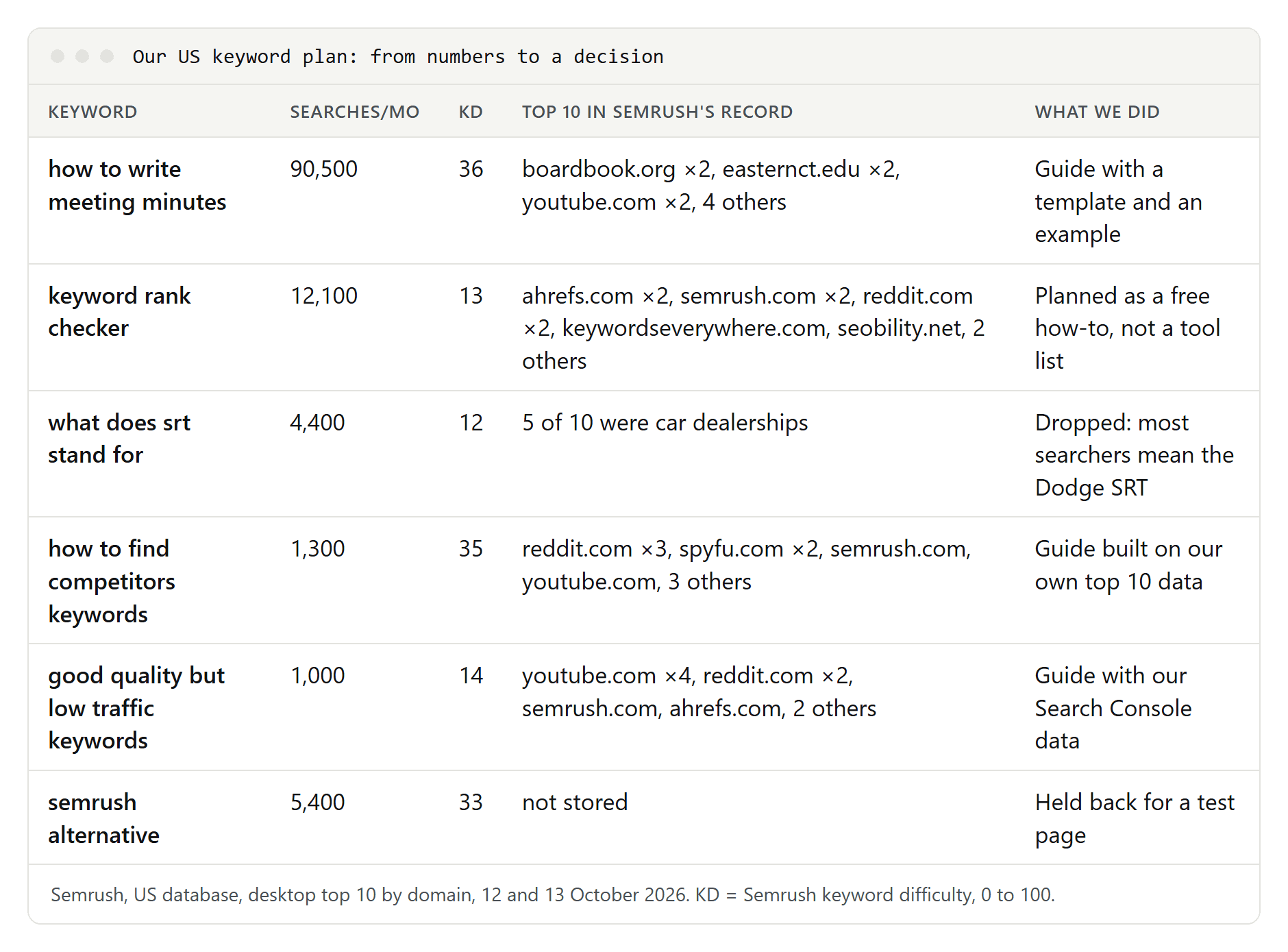
What we took from it:
- A low KD doesn't mean an easy page. "keyword rank checker" has 12,100 searches a month and a KD of only 13, but Ahrefs and Semrush held two places each, and Keywords Everywhere and Seobility one each. People want a tool, and tool makers own that page. We planned a free how-to instead of another list of tools.
- A keyword can mean something else. "what does srt stand for" (4,400, KD 12) looked ideal for our subtitle guides, but five of the top 10 were car dealerships: most searchers mean Dodge's SRT models. We dropped it.
- Video and forum results raise the bar. When YouTube or Reddit holds several places, a text page needs something a video or a thread can't give, such as a tested file, exact steps or a table you can copy.
A stored top 10 is a snapshot with a date. Before you write, search the keyword yourself and look at today's results. Our guide to competitor keywords shows how to turn the domains you keep meeting into a list of real competitors.
Step 5: One topic per page
Group the keywords that ask for the same thing, give the group one page, and pick a main keyword that describes it. The main keyword isn't always the biggest one. Our guide on competitors' keywords targets "how to find competitors keywords" (1,300 searches, KD 35), while its secondary keyword "competitor keywords" has 1,900 searches and a KD of 29. In 13 of our 95 US topics, a secondary keyword has more searches than the main one.
Two pages for the same search compete with each other, and Google's site diversity system generally won't show more than two results from the same site in the top results. That is why we held back 13 keyword groups, such as "semrush alternative" (5,400, KD 33) and "n8n alternatives" (1,300, KD 27). They need our own measurements, and a blog post on them today would compete with the test page later.
Don't make a page for every row of a list, either. Google's spam policies call it scaled content abuse when many pages are generated mainly to manipulate rankings rather than to help people. Once you have your keyword, our guide to keyword placement shows where it belongs on the page.
Finding keywords with ChatGPT
ChatGPT is good for ideas and bad at numbers. OpenAI's own help page says it can give incorrect facts and even invent sources, and advises using it "as a first draft, not a final source." Its web search is available on the free plan and even without signing in, but it searches web pages, which OpenAI says can be incomplete, outdated or wrong. It doesn't search a keyword database. A search volume in a chat answer is at best copied from some web page, with that page's date and method.
Prompts that work, because they don't ask for numbers:
- Topic lists: "I write for US freelancers about video subtitles. List 30 subtopics, each with one phrasing a beginner would type and one an expert would type. Don't give search volumes."
- Grouping: paste a list you exported from a keyword tool and ask: "Group these keywords by topic and search intent. Don't change any numbers."
- Variants: "Which of these terms would people in the UK, Canada or Australia spell or phrase differently? Only mark candidates; I'll check them myself."
Then check every suggestion in a keyword tool and on the results page. A chat can only give you real numbers when a data source is connected to it. Semrush, for example, connects ChatGPT, Claude, Gemini and Perplexity to its data through MCP, with read-only access, if you have a Semrush One, SEO Classic or Trends API plan.
The US isn't the whole English-speaking market
All our numbers come from Semrush's US database. Search volume is counted per country: Semrush splits its data into more than 140 databases, with separate ones for the UK, Canada, Australia, Ireland and New Zealand, and Keyword Planner's numbers follow the location you set. If you write for readers outside the US:
- check your keywords in that country's database, not only in the US one;
- try both spellings where British and American English differ, such as "optimization" and "optimisation", because a tool treats each spelling as a separate keyword;
- look at that country's results, where local sites may rank instead of American ones.
For German, French and Spanish, our guide to international keyword research shows why translating an English list doesn't work.
Mistakes we'd avoid next time
- Trusting one day's numbers. Semrush updated its data between our two research days, and for 39 first-round topics across our four markets, the main keyword, its difficulty or its secondary keywords changed. Note the date next to every figure.
- Missing other meanings. "otter" also brings the animal, "transcript" brings IRS tax transcripts, and "srt" brings cars. Read the list before you trust a count.
- Starting from volume. Our biggest keyword, "how to write meeting minutes", has 90,500 searches a month, but its KD of 36 puts it in Semrush's "possible" range, not the easy ones. We chose it because we could add a real template and example, not because of the number.
- Trusting a stored top 10 alone. Check today's results before you write, as in step 4.