Full verbatim includes everything a speaker says, exactly as it sounds: filler words like "um" and "you know", false starts, stutters, repetitions, slang forms like "gonna", self-corrections, a listener's "mm-hmm" and, in most guides, tags such as [laughs]. What full verbatim does not include is anything that changes, adds or tidies the words: corrected grammar, paraphrased or summarized sentences, words you guessed and filler you deleted for readability. If a test question asks what full verbatim leaves out, look for the option that edits the speech.
The short answer: three styles at a glance
Transcription companies use the names loosely, but most styles fall into three groups. The table uses the most common names first and the other names you'll see in style guides and order forms.
| Style | Also called | Keeps | Removes | Typical use |
|---|---|---|---|---|
| Full verbatim | true verbatim, strict verbatim, verbatim | every word and sound as spoken, fillers, false starts, stutters, repetitions, slang forms, listener sounds | nothing that was said | legal records, research on speech, quotes you must prove |
| Clean verbatim | non-verbatim, intelligent verbatim (at some companies), clean read | every word that carries meaning, the speaker's grammar and word choice | fillers, false starts, stutters, unneeded repetitions, most listener sounds | interviews, podcasts, meetings, most research |
| Edited | edited for clarity, intelligent verbatim (at other companies) | the meaning | anything that slows reading; sentences may be reworded | articles, Q&A pieces, show notes, reports |
Two warnings: "intelligent verbatim" means different things at different services, so ask before you order or accept a job; and the client's or platform's own style guide beats every general rule, including the ones here.
One passage in three styles
We wrote a short interview passage for this post; it isn't a real recording. Maria, a volunteer, talks about a community garden. It contains most of the things that full verbatim keeps and other styles drop.
Interviewer: So, um, how did you first get involved with the garden?
Maria: Well, I-- uh, my neighbor kinda dragged me along one Saturday. [laughs] I wasn't, I wasn't really a plant person.
Interviewer: Mm-hmm.
Maria: And then, like, the tomatoes came up and I was h-hooked, you know? Now we gotta be there every Tues-- no, Thursday. [phone rings]
Interviewer: Sorry, I'll just-- [crosstalk]
Maria: [crosstalk] No, no, no, it's fine. There's always three of us on Thursdays. The hardest part is the [inaudible 00:00:41] in August. It's, um... [silence] It's a lot of water.Interviewer: How did you first get involved with the garden?
Maria: My neighbor kind of dragged me along one Saturday. [laughs] I wasn't really a plant person. Then the tomatoes came up and I was hooked. Now we got to be there every Thursday. [phone rings]
Interviewer: Sorry, I'll just-- [crosstalk]
Maria: [crosstalk] No, no, no, it's fine. There's always three of us on Thursdays. The hardest part is the [inaudible 00:00:41] in August. It's a lot of water.The clean version deletes the hesitations, fillers, the false start, the repetition, the stutter and the slip "Tues--". Without the "Mm-hmm", Maria's two turns join into one. Several things stay on purpose:
- "kind of dragged me along": "kind of" is a filler in some sentences, but here it softens "dragged", so removing it would change the meaning. "Kinda" is written out as "kind of".
- "No, no, no": a repetition for emphasis, not a stumble.
- "There's always three of us": clean verbatim doesn't fix grammar.
- The tags: whether [laughs] and [phone rings] stay depends on the guide, as you'll see below.
Interviewer: How did you first get involved with the garden?
Maria: A neighbor brought me along one Saturday. I wasn't much of a plant person, but once the tomatoes came up, I was hooked. Now three of us go every Thursday. The hardest part is [inaudible] in August: it takes a lot of water.
The edited version reads like an article. The interruption is gone, sentences are joined, the grammar is standard. It's also less faithful: "brought me along" is softer than "dragged", and "three of us go" isn't what Maria said. That's fine for a newsletter, but you shouldn't quote it as her words. For the same idea applied to six formats of one longer conversation, including time-coded and research versions, see our transcript examples.
What full verbatim includes
A full verbatim transcript records the speech as it happened. These are the items the public guides list, with examples from Maria's passage:
- Hesitation sounds and filler words: "um", "uh", "well", "like", "you know", "I mean", "sort of". GoTranscript's guidelines name most of these for full verbatim. Tigerfish asks for "uh" or "um" only, not spellings like "ah" or "er".
- False starts: a sentence dropped and restarted, marked with a double dash: "I-- uh, my neighbor".
- Stutters: "h-hooked", "I-I".
- Repetitions: "I wasn't, I wasn't".
- Speech errors and self-corrections: "every Tues-- no, Thursday". The slip and the correction both stay.
- Slang as spoken: GoTranscript's full verbatim keeps "kinda", "gotta", "wanna" and "dunno".
- Listener sounds: "mm-hmm", "uh-huh". Rev's v5 guide lists "interjections (active listening)" among what verbatim captures.
- Grammar as spoken: "There's always three of us". W3C's accessibility guidance says it's usually not appropriate to correct grammar.
- Profanity as spoken: Rev captures it in both its styles; a word the audio itself bleeps gets (beep) or (censored).
- Some non-speech sounds: laughter in most guides; other sounds vary by guide (see "Where the guides disagree").
What full verbatim does not include
This is the list behind most "full verbatim does not include …" questions. Every item either changes the words or adds something that wasn't said.
- Corrected grammar. "There's always three of us" doesn't become "There are always three of us".
- Paraphrase or summary. Rev's guide says never to add content or paraphrase, and GoTranscript's says never to paraphrase or reconstruct the speech.
- Deleted fillers or tidied stutters. Removing "um" is what clean verbatim does, by definition.
- Expanded slang. Writing "going to" for "gonna" belongs to clean verbatim. In a full verbatim job it's an error.
- Guessed words. When a word can't be made out, the guides use a tag such as [inaudible 00:00:41] instead of a guess. The UK Data Service example says not to guess at anything you can't understand.
- Eye spellings. Full verbatim records words, not accents. The UK Data Service example asks transcribers not to write "enuff" for "enough". Rev allows correcting a badly mispronounced word to its correct spelling when context makes it clear.
- Song lyrics, in some guides. Rev's guide notes singing only as (singing) and says not to transcribe lyrics, in both styles.
- Translation. Speech in another language gets a tag such as [foreign language] in Rev's guide, not a translation, unless the job says otherwise.
Some things are not part of the style at all. Timestamps and speaker labels are separate settings: you can order full verbatim with or without time codes. Our guide to time-coded transcripts covers timestamp formats, and speaker label format covers how to name who is talking.
Clean verbatim: what goes and what stays
Clean verbatim keeps the speaker's words and removes what only gets in the way of reading. The rules below come from GoTranscript's public guidelines, which spell out clean verbatim in more detail than most:
- Removed: speech errors, false starts (unless they add information), stutters, repetitions, and filler words that leave a perfectly understandable sentence when you take them out.
- Kept: repetitions for emphasis ("No, no, no", "very, very happy") and expressions like "Oh my God" or "Oh dear", which GoTranscript keeps in every style.
- Changed: slang is written out ("going to", "want to", "because"), and "yeah", "yep" and "mm-hmm" become "yes". Reactions like "yeah" are dropped unless they answer a question.
- Never changed: grammar and spoken contractions such as "it's", "don't" or "ain't".
The most important rule is the one about meaning: GoTranscript says not to remove a filler word if it changes the meaning of the phrase. Compare these sentences.
Filler, remove in clean verbatim:
  "It was, like, really hard to find a parking spot."
Not a filler, always keep:
  "It looked like a parking spot, but it wasn't."
Hedge that carries meaning, keep:
  "She kind of agreed." (She didn't fully agree.)
Rev's default "non-verbatim" style is a light edit that mustn't change the structure or meaning of the speech. It removes false starts that are quickly reworded unless they give context, and says a complete sentence is not a false start, a useful test when you're unsure.
Intelligent verbatim and edited transcripts
Here the terminology stops being reliable. Some companies use "intelligent verbatim" for clean verbatim, others for a version that also fixes grammar and finishes broken sentences. Treat it as a label to define, not a standard.
Tigerfish's guide describes an "Edited for Clarity" style that sits between the two: it drops stutters, false starts and repetitions, but asks transcribers to stay as close to the spoken material as possible and keep the speaker's cadence and meaning. A fully edited transcript goes further and reads like written prose, as in the third version of Maria's passage.
Two rules keep an edited transcript honest:
- Don't quote from it. Quote from the verbatim or clean version, where the words are the speaker's own.
- Keep gaps marked. An [inaudible] tag should survive every edit. Smoothing over a missing word can reverse a sentence.
What the public style guides say
These are the transcriber guides that companies and institutions publish openly, summarized for verbatim rules only.
Rev (Transcription Style Guide v5)
Two styles: verbatim and the lightly edited default, non-verbatim. Laughter, written (laughs) or (laughing), is the only non-speech sound Rev captures, and only in verbatim projects; coughs, sneezes, clapping, dog barks and other sounds are not transcribed. Informal contractions such as "gonna", "wanna" or "'cause" may be corrected in non-verbatim projects. Rev lists its notation tags and says not to create others.
GoTranscript (transcription guidelines)
Full and clean verbatim as described above. Significant sound events such as [laughs] are noted in square brackets regardless of format, in lowercase and in two words at most. It separates [inaudible] (can't be heard) from [unintelligible] (heard but not understood) and uses [silence] for a pause of four to ten seconds, a timed [pause] tag beyond that.
Speechpad (general transcription style guide)
The general guide asks for clean copy without "um", "ahh", false starts and stutters, and says not to type descriptive tags or sound effects such as [laughter] or [cough]. Filler words such as "like", "you know" and "I mean" stay unless a speaker uses them three or more times in one sentence and they're not needed for the meaning. Slang is transcribed as spoken ("gonna", "kinda"). Speechpad keeps a separate verbatim guide for verbatim jobs.
Tigerfish (Transcription Style Guide)
A verbatim transcript captures every word, including stutters, false starts and minimal responses, with a fixed list of spellings: "uh", "um", "uh-huh", "mm-hmm", "nuh-uh". Tigerfish uses [unintelligible] only, not [inaudible], and [Laughs] or [Laughter] when required.
Scribie
A 2016 post on Scribie's blog describes its default format as non-strict verbatim: fillers such as "ummm" and "uh-huh" are left out unless they're indispensable, and strict verbatim is available when ordered.
UK Data Service (example research instructions)
The UK Data Service publishes example transcription instructions from a PhD project that requires full verbatim. They keep false starts, repeated phrases, fillers ("umms", "errs", "uhs"), unfinished sentences and pauses marked with ellipses, emphasis in italics, and background noises and tone notes such as (sighs) in brackets. Grammar is not tidied. One exception stands out: the interviewer's back-channel sounds ("right", "yeah", "mmhhmm") are left out so the respondent's speech isn't broken up.
Where the guides disagree
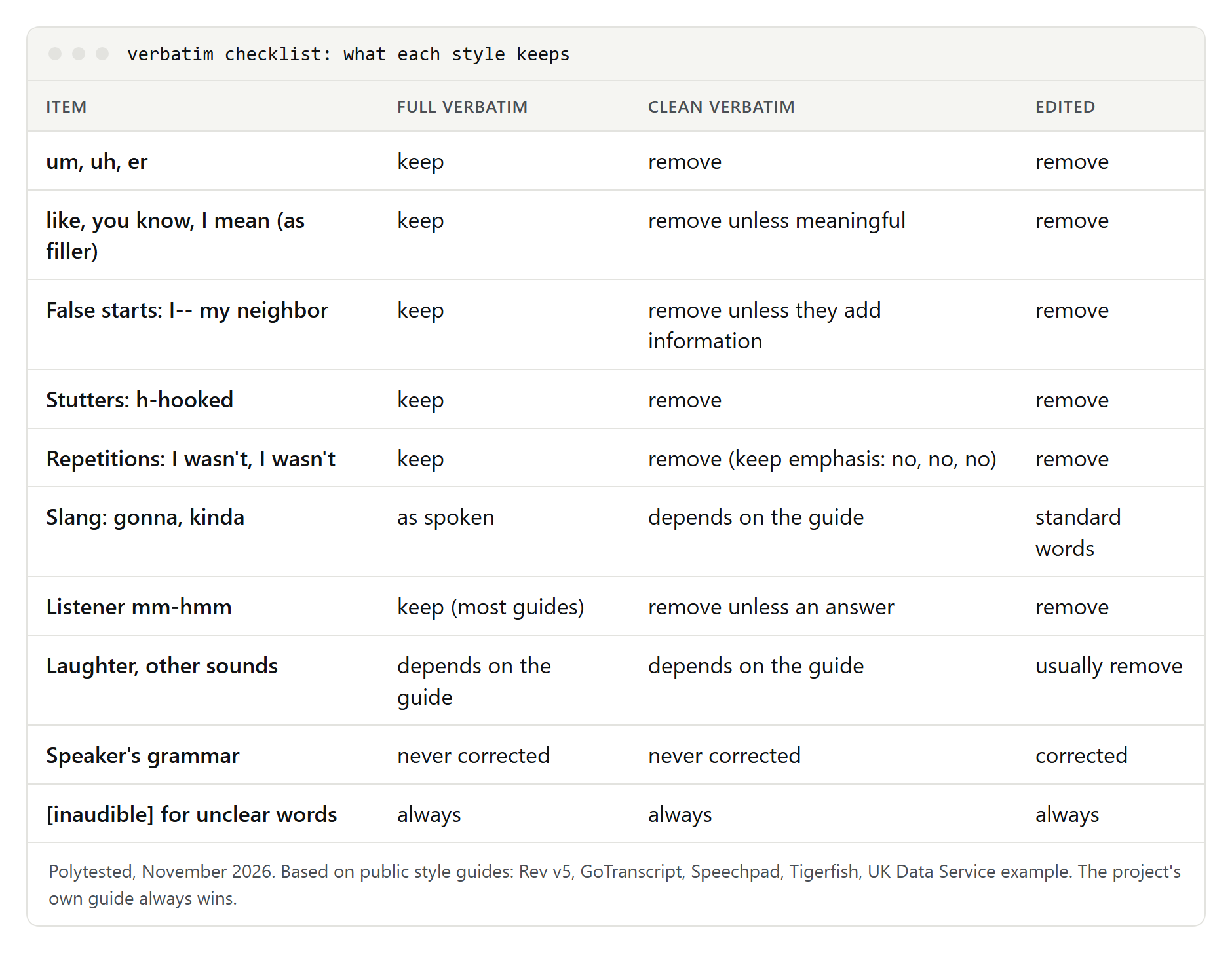
Most guides agree on fillers, false starts and stutters. They split on sounds, listener responses, slang and tag spelling.
| Question | Rev v5 | GoTranscript | Speechpad (general) | Tigerfish | UK Data Service example |
|---|---|---|---|---|---|
| Laughter | (laughs), verbatim only | [laughs] in every format | no sound tags | [Laughs] when required | (laughs loudly) style notes |
| Other sounds | not transcribed | significant ones in brackets | no sound tags | no long descriptions | background noises in brackets |
| Listener mm-hmm | kept in verbatim | kept in full verbatim | dropped unless an answer | minimal responses kept | interviewer's dropped |
| Slang like gonna | may be corrected in non-verbatim | written out in clean verbatim | kept as spoken | not covered | not covered |
| Unclear words | [inaudible hh:mm:ss] | [inaudible] or [unintelligible] with time | [inaudible 00:00:00] | [unintelligible] only | (inaudible), in bold |
| Brackets | parentheses for sounds | square brackets only | square brackets | square brackets | parentheses |
The practical lesson: there is no single correct way to write [laughs] or decide on "gonna". There is only the guide for the project. If you set the rules yourself, write them down once (see the template at the end) and apply them to every file.
How to answer "full verbatim does not include …" questions
Transcription tests and training quizzes often ask what a style includes or excludes. You don't need to memorize lists if you apply three tests in order:
- Was it said? Full verbatim includes anything the speaker actually said, including mistakes. If an option describes something that was said, it's included.
- Does the option change the words? Correcting, paraphrasing, summarizing, guessing, expanding slang and deleting fillers are edits. Full verbatim never includes edits, so these are almost always the answer.
- Is it a sound, not a word? Here the guide decides. If the question comes with a style guide, check its rules for laughter, background noise and listener sounds before answering.
Here are practice questions we wrote, with the reasoning.
1. Full verbatim does not include:
   a) filler words  b) stutters  c) corrected grammar  d) false starts
   Answer: c. The others were said; correcting grammar edits the speech.

2. Full verbatim does not include:
   a) "um" and "uh"  b) a summary of a long answer
   c) repeated words  d) a self-correction ("Tuesday, no, Thursday")
   Answer: b. A summary replaces the words with new ones.

3. A transcriber types "going to" where the speaker said "gonna"
   in a full verbatim job. Correct or not?
   Answer: Not correct. Full verbatim keeps the slang form;
   writing it out is a clean verbatim rule.

4. In clean verbatim, which do you keep?
   a) "I-I-I think"  b) "No, no, no, it's fine"
   c) "Well, um, so"  d) "the, the meeting"
   Answer: b. It's emphasis, not a stumble.

5. Does full verbatim include a cough?
   Answer: It depends on the guide. Some note significant
   sounds in brackets; others transcribe no sounds but laughter.
   Choose "words, not sounds" only if the guide says so.

6. The speaker says "I seen it yesterday." What goes in
   a clean verbatim transcript?
   Answer: "I seen it yesterday." Clean verbatim removes
   clutter, not grammar.
If an answer still feels unclear, ask: would this choice make the transcript say something the speaker didn't say? If yes, full verbatim doesn't include it.
Beyond full verbatim: notation for speech research
Some research needs more than words. Conversation analysis uses a detailed notation, most of it based on what's called the Jefferson system after its developer, Gail Jefferson, according to Loughborough University's tutorial. It marks timed pauses, overlaps, stretched sounds and breathing. Here is one line of Maria's answer in that style, written by us to show the symbols:
Maria:  I wasn't (.) I wasn't really a plant person=
Int:    =mm hm
Maria:  and then the tomatoes came u:p (0.8) and I was h- hooked
(.) is a just noticeable pause, (0.8) a timed pause, = shows no gap between two turns, : a stretched sound and h- a cut-off. Unless your supervisor or method asks for this, full verbatim or clean verbatim is enough. Our guide to analyzing interview data explains what comes after transcription.
Which style to choose
| Use | Style | Why |
|---|---|---|
| Depositions, police interviews, evidence | Full verbatim | How something was said can matter; W3C names depositions as verbatim content |
| Discourse or conversation analysis | Full verbatim or CA notation | Pauses, fillers and overlaps are the data |
| Qualitative interviews, theses | Clean verbatim, unless your method needs fillers | Readable for coding, words stay the speaker's |
| Journalism and quotes | Clean verbatim, full verbatim as backup | Quotes stay accurate; keep the audio |
| Podcasts and video pages | Clean verbatim | Easy to read, faithful to the speaker |
| Business meetings | Clean verbatim or meeting minutes | Decisions matter more than wording |
| Articles, newsletters, Q&A | Edited | Reads like writing; don't quote from it |
| Audio or video editing | Full verbatim | Editors need to find every stumble to cut it |
When in doubt, make full verbatim your master copy. Deleting fillers later is quick; adding fillers you never typed means listening again. For research interviews, consent and a notation key, see how to transcribe an interview.
How AI transcription tools handle filler words
Automatic transcripts are rarely full verbatim by default, and the vendors document different approaches.
Descript detects filler words such as "um", "uh" and "you know". Its help center says the AI Tools panel has a Remove filler words option that lists each detected filler with four choices: Delete (text and audio), Delete and replace with gap, Ignore (struck through in the script, audio removed) and Remove from transcript (script only, audio unchanged). An Avoid harsh cuts setting skips fillers that can't be removed cleanly. Detection works for English transcripts only, and on current plans the feature uses AI credits. For a transcript only, "Remove from transcript" leaves the recording alone.
Otter works the other way round. Its accuracy FAQ says filler words, interjections and hesitation markers such as "hmm", "um", "ah" and "uh" are programmatically ignored, even if you add them to your custom vocabulary. An Otter transcript is therefore closer to clean verbatim out of the box; for full verbatim you have to add the fillers yourself while listening.
Microsoft Word's Transcribe feature labels speakers "Speaker 1", "Speaker 2" and lets you correct text through Edit transcript section in the Transcribe pane. Its help page doesn't describe a filler-word setting, so plan to check fillers by hand against the audio.
Whatever the tool, no software decides whether "like" or "kind of" carries meaning in a given sentence. That judgment, and the tags for sounds and crosstalk, stays with the person who checks the transcript. Free ways to get a first draft are compared in transcribing audio to text.
A style sheet template to copy
A style sheet settles the questions where guides disagree, before anyone starts typing. Fill it in, save it with the project and send it with every file.
TRANSCRIPTION STYLE SHEET
Project: [project name]
Style: [full verbatim / clean verbatim / edited]
Language and spelling: [American English]

FILLERS
  um, uh, er:            [keep / remove]  Spell as: um, uh
  like, you know, I mean: [keep / remove when not meaningful]
FALSE STARTS:            [keep with -- / remove]
STUTTERS:                [keep as "h-hooked" / remove]
REPETITIONS:             [keep / remove, keep emphasis "no, no, no"]
SLANG (gonna, wanna):    [as spoken / write out]
LISTENER SOUNDS:         [keep mm-hmm / drop unless an answer]
GRAMMAR:                 never corrected

TAGS (square brackets, lowercase)
  [laughs]               [yes / no]
  other sounds           [significant only / none]
  [crosstalk]            [yes / no]
  [inaudible hh:mm:ss]   always, never guess
  [silence]              [from how many seconds]

TIMESTAMPS:              [none / every speaker change / every N minutes]
SPEAKER LABELS:          [Name: / Interviewer:, P1:]
NAMES AND PRIVACY:       [keep / replace with role in brackets]
QUESTIONS TO:            [contact]
Keep the filled-in sheet at the top of each transcript or next to it in the project folder, so anyone who reads the file later knows whether a missing "um" was a choice or an error.