Subtitles put the dialogue on screen for viewers who can hear the audio but don't understand the language. Closed captions put the dialogue and the sounds on screen (a door slamming, music, who is speaking) for viewers who can't hear the audio, and the viewer can switch them on and off. That is the American and Canadian distinction; in the UK and much of Europe, "subtitles" usually covers both. Below we show the difference with our own sample files in four languages, then explain SDH, open captions, how players label each kind, what the rules ask for, and what a small team publishing in several languages should provide.
The difference, in one scene
Here is a short made-up scene as three kinds of file: dialogue-only subtitles, captions for viewers who can't hear, and subtitles translated into German, French and Spanish.
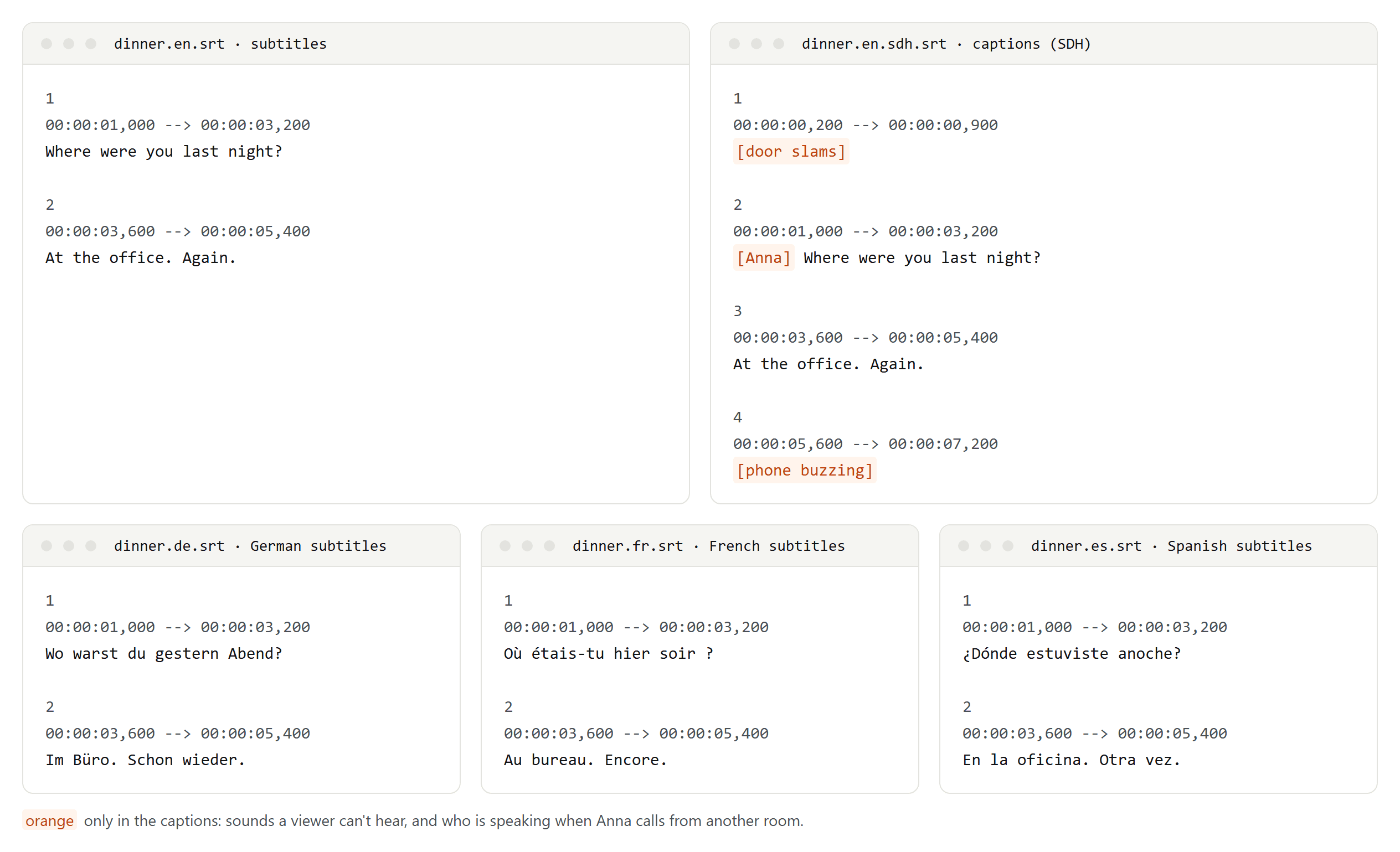
- Subtitles carry the dialogue and nothing else. They are usually written for hearing viewers, often in another language, and can be shortened to keep up with reading speed.
- Captions add what a viewer who can't hear would miss: sound effects, music and lyrics, and who is speaking when you can't see it. Netflix's English style guide puts them in square brackets, in lowercase except for names, and uses a speaker ID only when the speaker can't be identified on screen.
- Translated subtitles don't replace captions. The W3C's accessibility initiative says captions are needed for accessibility, while subtitles in other languages are not directly an accessibility accommodation.
Netflix's help center sums it up for viewers: subtitles are dialogue turned into text on screen, closed captions are dialogue plus a description of the sounds. Replacing the voices instead of adding text is dubbing, which we explain in what is dubbing.
What SDH means
SDH stands for subtitles for the deaf and hard of hearing. The US Described and Captioned Media Program describes them as subtitles that add sound effects, speaker identification and other essential non-speech information, as close to verbatim as possible. In practice SDH are captions formatted like subtitles, which is why some streaming services and discs list "English SDH" among the subtitle languages.
Why the words get mixed up
The W3C notes that "captions" and "subtitles" are used for the same thing in different regions, and that some regions say "subtitles" for both same-language text and translations. So a British "subtitles" button may well show captions.
If you publish internationally, don't rely on the word alone. Label each track so nobody has to guess: "English (CC)" or "English SDH" for captions, the language's own name for translated subtitles.
Open captions, closed captions and burned-in text
- Closed captions are a separate track that viewers switch on and off.
- Open captions are part of the picture and always visible. The W3C counts them as a valid way to caption a video.
- Burned-in subtitles are the same idea for a translation. They can't be switched off or swapped for another language, and changing a word means exporting the video again.
For your own site and for platforms that accept files, keep captions and each translation as separate files (SRT or WebVTT). Burn text in only where a platform gives you no other way.
How players label each kind
In a web page, the HTML track element says which kind a file is:
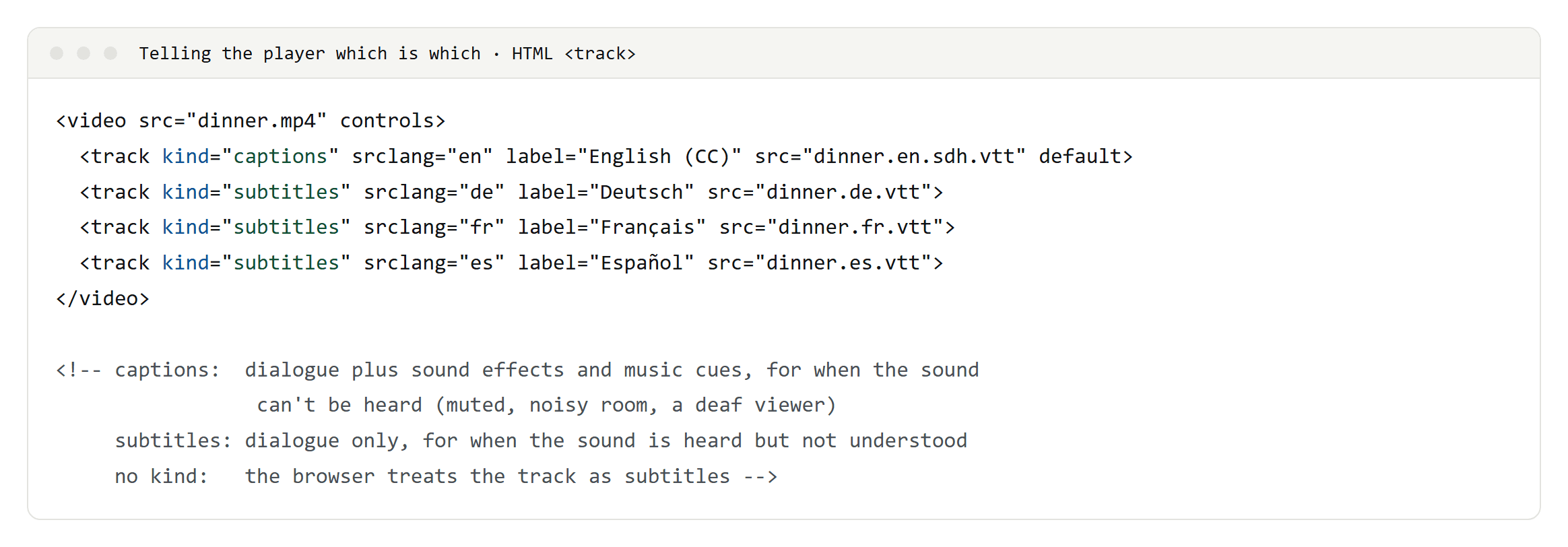
The HTML standard describes subtitles as suitable for when the sound is available but not understood, and captions as the dialogue plus sound effects, musical cues and other relevant audio information. A track without a kind is treated as subtitles.
On YouTube both live in one menu called Subtitles/CC, and machine-made tracks are marked "auto-generated". When we opened a French video on YouTube in October 2026, the menu showed "French (auto-generated)". For files and formats, see what an SRT file is; to read captions in another language, see how to translate a YouTube video.
What the rules ask for
This is a summary of the standards, not legal advice.
- WCAG 2.2, the web accessibility guidelines that many laws and standards refer to, requires captions for all prerecorded audio in synchronized media at its lowest level (A), and captions for live audio at level AA. Captions that leave out dialogue or important sound effects fail the requirement.
- Automatic captions: the W3C says automatically generated captions don't meet accessibility requirements unless they are confirmed to be fully accurate. They usually need editing.
- In the EU, the European Accessibility Act has applied since 28 June 2025. Services that give access to audiovisual media must pass on access services such as subtitles for the deaf and hard of hearing, audio description, spoken subtitles and sign language, in full, in sync, and under the viewer's control. Microenterprises providing services, with fewer than ten employees and an annual turnover or balance sheet of no more than EUR 2 million, are exempt.
- In the US, the FCC's online captioning rule covers programs and clips that were shown on TV with captions; it doesn't expressly cover video made only for the internet. Other laws can apply depending on who publishes the video.
What a small team publishing in several languages should provide
- Captions in the video's own language, edited by a person rather than raw automatic captions.
- Subtitles for each language you translate into, dialogue only, one file per language.
- Clear labels: "English (CC)" for captions, "Deutsch", "Français" and "Español" for the translations.
- Open captions only where you must, for example in apps that don't take caption files, and a separate file everywhere else.
- A transcript on the page for longer videos. The W3C notes that a transcript with headings and links also helps with search engines, and a descriptive transcript serves people who are both deaf and blind.