International keyword research means finding the words people actually type in each market you want to reach, instead of translating your English keyword list. In October 2026 we planned Polytested's content for the United States, Germany, France and Spain with Semrush: 200 topics, four country databases, one decision per market. This guide walks through our method with our own data, including what surprised us and the checks we would not skip again.
Translation isn't keyword research
Here is the same topic in four markets, with the query we chose to target in each:
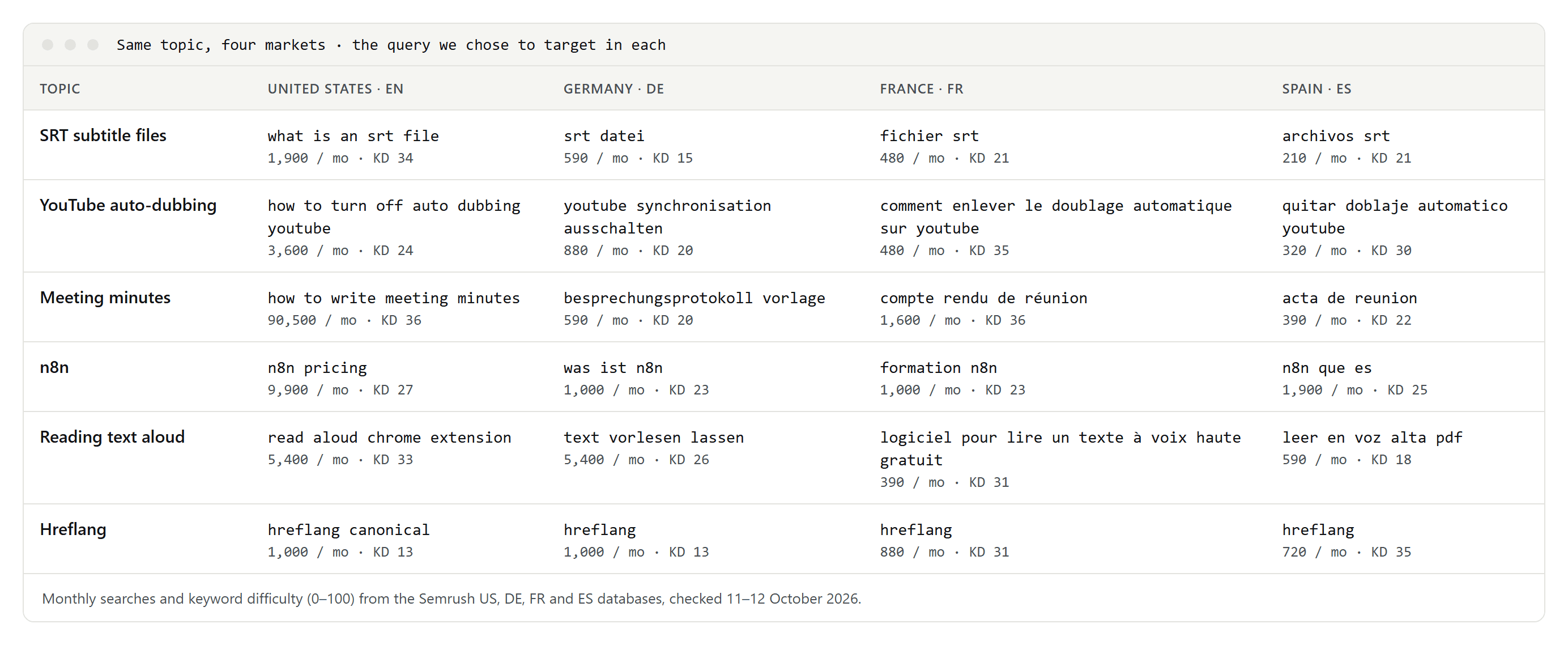
Three things stand out:
- The words differ. Americans ask "what is an srt file"; Germans type "srt datei". The German query isn't a translation of the English one but a shorter shape of the same question.
- The intent differs. For n8n, the biggest American query is about pricing. The biggest German and Spanish ones ask what n8n is ("was ist n8n", "n8n que es"), and the French one looks for training ("formation n8n"). A pricing page would answer the wrong question in three of four markets.
- The difficulty differs. The single word "hreflang" is searched in Germany, France and Spain alike, but Semrush rates it far easier in Germany than in France or Spain. A topic that is crowded in one market can be open in another.
Vendors who sell translation make the same point with their own examples: Weglot shows that the French words for English "trainers" are searched far less and mean something else, and Wordbank shows three German words for "loyalty card" with very different demand.
Our method in five steps
1. Choose markets, not only languages
A language is not a market. Spanish in Spain and in Mexico uses different words for everyday things: the Real Academia Española notes that Spain says "ordenador" for a computer, while most of Latin America says "computadora". German in Austria and Switzerland has its own vocabulary too, and Duden marks words such as "Jänner" as Austrian and "Velo" as Swiss.
We picked one country per language to start: the US for English, Germany, France and Spain. Each has its own Semrush database, and each will have its own URLs on our site: one language per page and no automatic redirects, as Google recommends. Google detects a page's language from its visible text, not from the lang attribute or the URL, and asks sites not to redirect visitors by IP address or language.
If you later add a second Spanish market, plan separate pages for it. Google's hreflang only accepts ISO language and country codes, so a Latin America code like es-419 isn't supported; you would name each country.
2. Start from topics, then find each market's query
We began with topics (a problem a reader has), not with keywords. For each topic we looked for the shape the question takes in each language:
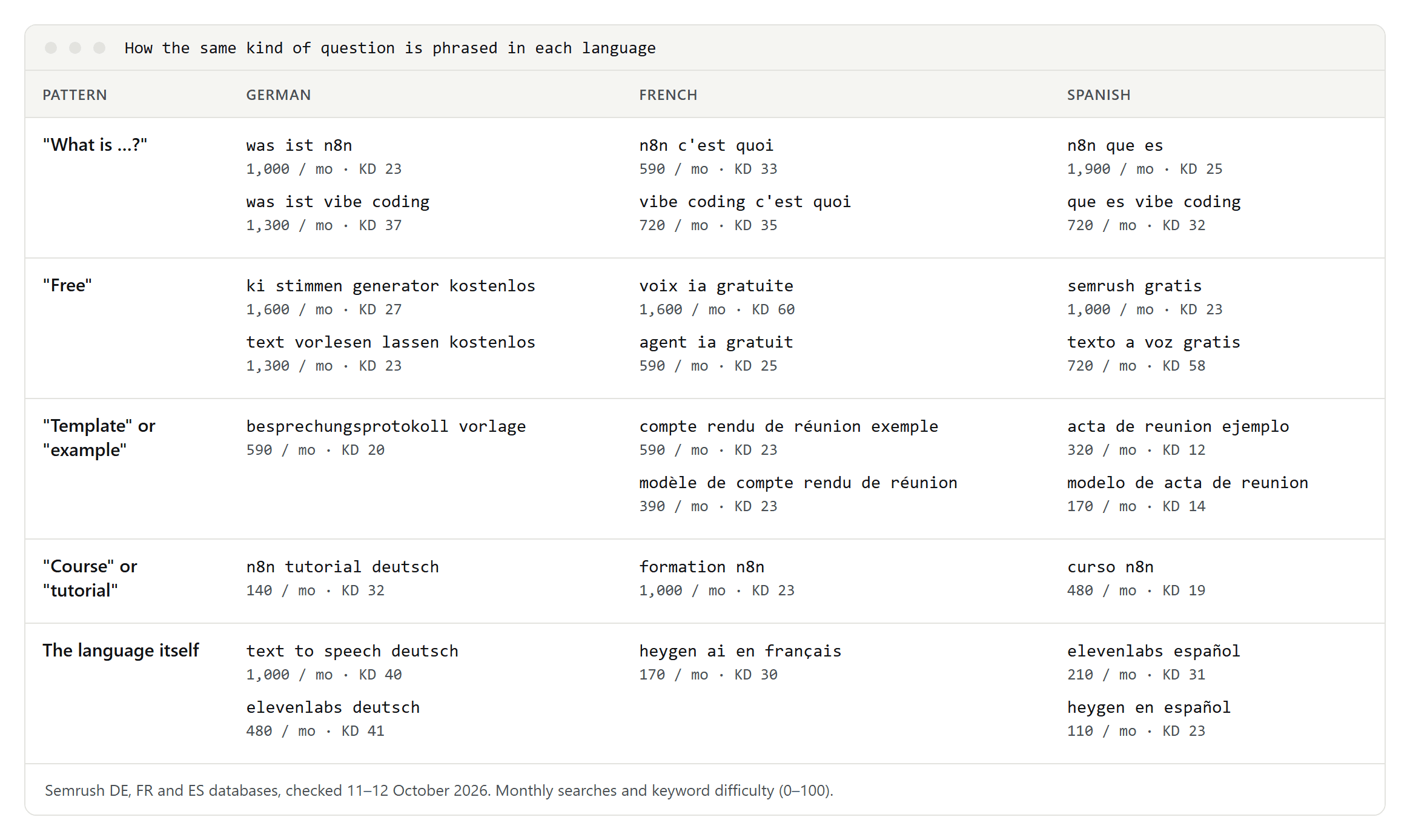
- "What is …?" becomes "was ist", "c'est quoi" and "que es". In French the question words often come after the term ("n8n c'est quoi").
- "Free" is "kostenlos", "gratuit" or "gratuite", and "gratis".
- Templates and examples are "Vorlage", "exemple" or "modèle", and "ejemplo" or "modelo".
- Learning is "tutorial deutsch", "formation" and "curso".
- The language itself often appears in the query. Germans add "deutsch" to tool names, as in "elevenlabs deutsch", because they want to know whether a tool works in German. That is exactly the question a four-language test site should answer.
Some terms stay English everywhere. "Vibe coding" is searched as an English phrase in all three markets, but with native question words around it: "was ist vibe coding", "vibe coding c'est quoi", "que es vibe coding".
3. Pull numbers from each country's database
- Semrush keeps a separate database per country, with national volumes by default. Its search volume is an estimate: the average of the last 12 months, modeled from third-party and clickstream data, with mobile and desktop combined. Treat it as a way to compare options, not as a forecast of your traffic.
- Google Keyword Planner sets the location and the search network for its numbers. Its help page says the average counts searches for a term regardless of language, averaged over 12 months. That explains why an English loanword like "vibe coding" can show large numbers in a German location: the volume follows the place, not the language of the searcher.
- Google Trends compares relative interest by region on a 0–100 scale. It shows terms with little search volume as zero, so it is only useful for the larger queries.
One thing we hit in practice: in our Semrush trial in October 2026, Keyword Magic Tool returned results for the US database, but not for the German, French and Spanish ones. Keyword Overview worked in all four, so we researched those markets one keyword at a time.
4. Look at who ranks in each market
Numbers don't tell you whether you can win. We opened the results for each target query in the country it belongs to. To see another country's Google results, change the region in Google's search settings, which Google documents in its help center.
The check changed our plan more than any volume did. For generic terms such as "ki stimme" or "voix ia", the top results were the tool makers' own product pages. A review site rarely displaces a product's homepage for its own category name, so we left those terms out and went for questions that a test answers: whether a tool works in German, what it costs in euros, which alternative to choose. We show which domains ranked most often for our 200 searches in how to find your competitors' keywords.
5. Decide per market
With numbers and results side by side, the decisions were rarely the same in all four markets:
- Some topics are easier outside the US. "srt datei" has a much lower difficulty in Germany than "what is an srt file" in the US.
- Some are bigger outside the US. "text vorlesen lassen" in Germany has the same volume as our US query for reading text aloud, but a lower difficulty.
- Some don't travel. The French query for turning off YouTube dubbing is long and harder to rank for than the German one, so the German version comes first.
- Every language gets its own title and slug, written in that language. The pages are linked to each other with hreflang and a canonical tag, so Google shows each reader the version in their language.
Mistakes to avoid
- Translating your English list. Use it to find topics, then look up each market's own query.
- Treating one language as one market. Pull numbers per country: Spain is not Mexico, and Germany is not Austria or Switzerland.
- Trusting volume alone. Check who ranks. Vendor pages and big publishers can make an easy-looking query unwinnable.
- Comparing numbers across tools. Semrush, Keyword Planner and Trends measure different things; compare markets within one tool.
- Redirecting visitors by location or browser language. Google advises against it, and it can hide pages from Googlebot, which mostly crawls from the US without an Accept-Language header.
- Mass-translating pages. Google's spam policies name scraped content run through automated transformations such as translation, with little value added, as an example of scaled content abuse.
Tools we used
- Semrush: country databases, Keyword Overview for the four markets, and its difficulty score.
- Google Keyword Planner: free with a Google Ads account, useful to cross-check volumes by location.
- Google Trends: to compare interest between countries for the bigger topics.
- Google's region setting: to look at another country's results ourselves.
- Google Search Console: after launch, its Performance report filters by country, which shows what each market really searches to find you.
Google is the search engine to plan for in all three countries: StatCounter measured its share at about 88 percent in Germany and France and about 94 percent in Spain in September 2026. On desktop in Germany, Bing is larger than the overall figure suggests, at about 19 percent.