"Sub" means you watch the original audio with subtitles in your language. "Dub" means the voices have been replaced with a recording in your language. Neither is better in general: subtitles keep the actors' own voices and help language learners, while a dub lets you watch the picture and works for people who can't read subtitles. Studies found no clear advantage for dubbing in understanding or enjoyment. Below: what the words mean in anime, why the subtitles and the dub never say quite the same thing, who needs which, where Europeans stand, and how to switch on the big platforms.
What sub and dub mean
- Sub (subbed): the original audio stays, and a translation appears as text. For an anime, that means Japanese voices with English subtitles.
- Dub (dubbed): the original dialogue is replaced by voice actors speaking your language. Our guide on what dubbing is explains how studios make one.
- "Is sub or dub English?" For a viewer in the United States, the dub is the English version: English voices, no reading needed. The sub keeps the Japanese (or Korean, Spanish, German…) voices and puts English on screen.
The words come up most around anime, where many series are offered in both versions. Crunchyroll's help center even answers why a dub sometimes shows up as a separate season, and notes that in some regions certain Japanese-audio anime always show subtitles. For a show made in English, there is no choice to make: English subtitles there are captions, a different thing that we explain in subtitles vs closed captions.
Why the subtitles and the dub don't match
Both versions are translations, but they are written for different limits.
- Subtitles are cut to be read in time. Netflix's English style guide allows two lines of 42 characters and a reading speed of up to 20 characters per second for adults, 17 for children. Amazon's Prime Video subtitling guidelines set 17 characters per second for adults and tell subtitlers to condense or paraphrase long phrases without losing the meaning.
- Dub lines are rewritten to fit the mouth. Prime Video's dubbing guidelines ask for lip sync, which matters most in close-ups, and for lines that start and end about when the original ones do. They also say sync must not override the meaning and intent of the dialogue.
So the dub often has more words than the subtitles, and different ones. There is a second trap. Netflix's English guide says that when a title has been dubbed into English, the closed captions for deaf and hard-of-hearing viewers (SDH) are based on the dubbing script or the dubbed audio. If you watch the Japanese audio but pick the English SDH track, you read the words of the English dub, not a translation of what the Japanese actors say.
An invented example of one line, same timing in both files:
12
00:01:12,400 --> 00:01:14,900
Wait! You forgot your bag.12
00:01:12,400 --> 00:01:14,900
Hey, hold on a sec!
You're forgetting your bag!We counted both with a short script: the subtitle has 26 characters, about 10 characters per second; the dub caption has 46 characters, about 18 per second. Both are under Netflix's English limit, but the second one leaves your eyes much less time for the picture. If you want the translation of the original, pick the plain subtitle track, not the CC or SDH one.
What studies say about reading subtitles
Dub fans often say subtitles make you miss the picture. The research is more relaxed:
- Fast subtitles are manageable. In an eye-tracking study, 74 English, Polish and Spanish viewers watched clips subtitled at 12, 16 or 20 characters per second. Speed did not change how much they understood, and most viewers could read the subtitles and follow the images (Szarkowska and Gerber-Morón, PLOS ONE, 2018). Slow subtitles made people re-read more and enjoy English clips less.
- No advantage for dubbing. A study compared the dubbed and the subtitled version of the same film excerpt with young and older adults. Dubbing gave no advantage in understanding or appreciation, subtitles seemed to help more with the words themselves, and older viewers did not struggle more with subtitles (Perego and colleagues, Perspectives, 2015; we read the abstract).
- Same enjoyment. An experiment with 154 viewers found no significant difference between a dubbed and a subtitled version in how absorbed people were, and no effect of the translation method on enjoyment (Wissmath and colleagues, Journal of Media Psychology, 2009; abstract).
These were short clips in a lab. A long series on a phone, a tired evening or a busy kitchen are different, and that is where a dub earns its place.
Who needs which: accessibility
- Deaf and hard-of-hearing viewers need text either way. Ordinary subtitles only carry the dialogue; SDH adds sounds and music. Netflix shows an SDH badge on a title's details page and warns that without SDH you may get subtitles with dialogue only.
- Blind and low-vision viewers can't use subtitles at all. They need audio in their language and, ideally, audio description. Prime Video labels those tracks with "[Audio Descriptions]" in the track name.
- Young children who can't read yet need the dub. Even Netflix's limits for children's subtitles are lower than for adults.
- Mixed households: the dub with SDH works for a hearing and a deaf viewer on the same sofa, because Netflix bases the SDH of a dubbed title on the dub.
Learning a language: subs win
If you want to learn the language of the show, the dub removes exactly what you need to hear.
- Children: a study of 374 pupils in their last year of primary school in Flanders, Belgium, found that those who often watched subtitled English programs and movies scored significantly better on two English translation tests (Kuppens, Learning, Media and Technology, 2010; abstract).
- Countries: economists who compared countries around the world found a large positive effect of subtitled original-version TV, compared with dubbed TV, on English skills, strongest for listening (Rupérez Micola and colleagues, Journal of Economic Behavior and Organization, 2019; abstract).
Both studies looked at hearing the foreign language with subtitles in your own language. Once you understand a lot, you can try subtitles in the language you are learning; we didn't find a study we could open that settles which works better.
Where Europeans prefer subtitles
The EU's language survey, Special Eurobarometer 540 (fieldwork in autumn 2023), asked people whether they prefer to watch foreign films and programs with subtitles rather than dubbed. We read the official data tables and published the results in our dubbing guide on 13 October 2026. The survey doesn't cover the United States, but it shows how strongly habits differ:
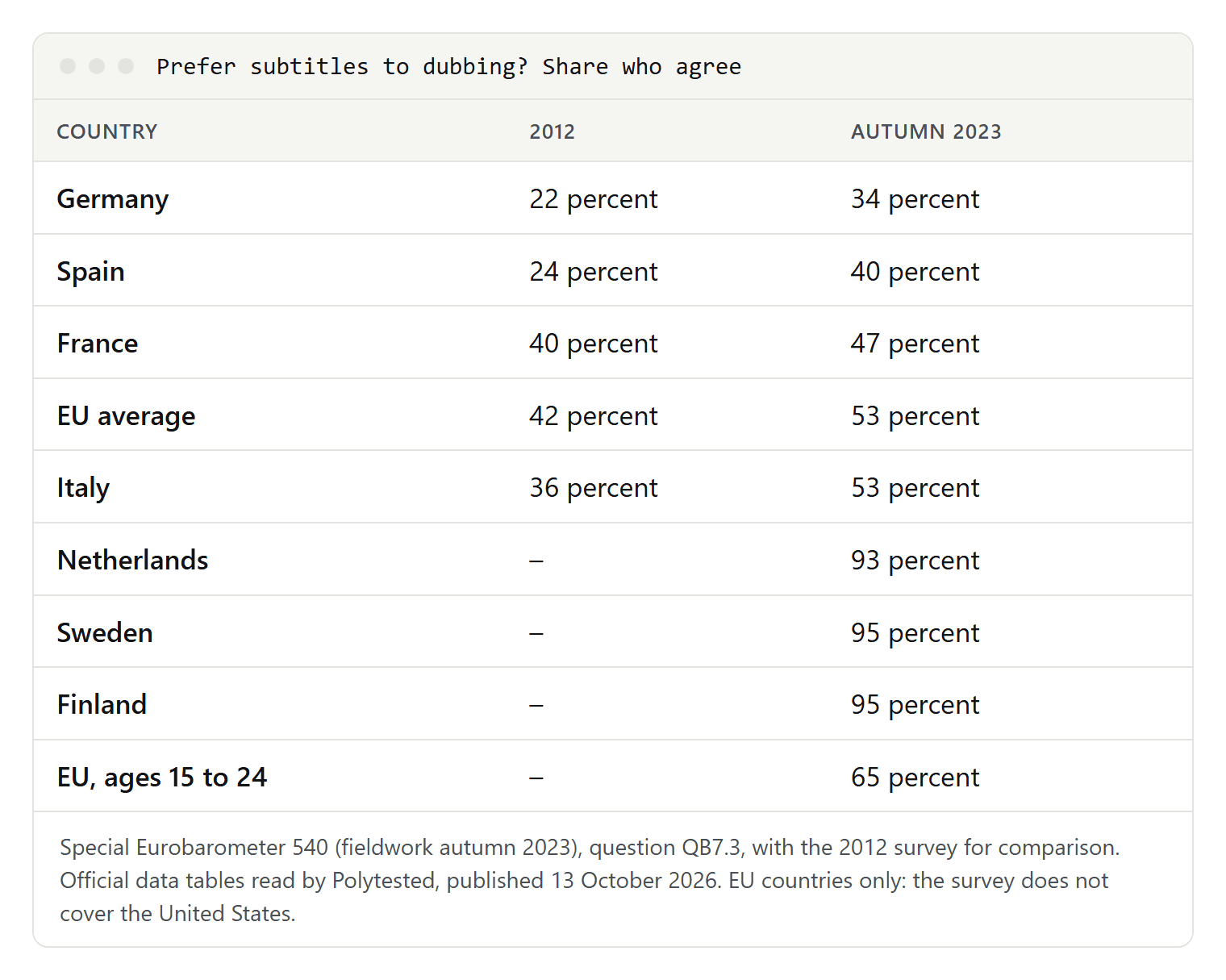
- The EU as a whole now leans to subtitles: 53 percent, up from 42 percent in 2012, and 65 percent of 15- to 24-year-olds.
- Dubbing countries are moving, slowly: Germany went from 22 to 34 percent, Spain from 24 to 40, France from 40 to 47 and Italy from 36 to 53.
- Subtitle countries stay put: 95 percent in Sweden and Finland, 93 percent in the Netherlands.
If you publish videos for Europe, that matters more than any general rule: German and Spanish viewers still expect a dub far more often than Dutch or Swedish ones.
How to switch between sub and dub
Menu names below are from each service's English help pages, checked on 25 October 2026.
| Service | Where | Note |
|---|---|---|
| Netflix | During playback, select Audio & Subtitles; Other shows every language | Set defaults per profile under Audio and subtitle languages |
| Prime Video | Select the Closed Caption or Subtitles icon; some devices show a separate Audio option | Audio description tracks are marked in the track name |
| Disney+ | Open the settings menu: top right on web and mobile, bottom right on TVs | Captions (CC) sit under the subtitle options |
| YouTube | Settings, then Audio track; captions with the Closed captions button | Only videos with several audio tracks offer a choice |
| Crunchyroll | Change the audio language inside the video player | Some dubs are listed as a separate season |
Two details save time. Netflix may show subtitles even when they are off, for dialogue in a language other than the title's original one. And Netflix lets you browse by audio language at netflix.com/browse/audio, the quickest way to find out whether a dub exists before you start.
How AI dubbing changes the choice
With automatic dubbing, you now meet dubs on videos that never had one, often without asking for them.
- On YouTube, automatic dubs are marked "auto-dubbed", and creators can't edit them. YouTube dubs English videos into 20 languages and French or German videos into English, so a foreign-language video can start in English. When we checked a French recipe video on 13 October 2026, the audio played in English while the captions stayed on "French (auto-generated)": sub and dub didn't match at all. Switching back takes a few clicks; see how to turn off YouTube auto-dubbing.
- For creators, dubbing tools now keep the speaker's own voice. ElevenLabs dubs into more than 90 languages and keeps each speaker's voice and the background audio. HeyGen re-voices the speaker in a clone of their voice, can sync the lips and has a "Review & Edit" step for the translated script, but it doesn't translate text that appears on screen.
- What doesn't change: an AI dub still needs a native speaker to review the script, deaf viewers still need captions, and wordplay still breaks in translation. Subtitles stay the cheapest way into other languages; translating your subtitles shows what free translators do to an SRT file, and translating a YouTube video covers both routes.
Which should you watch?
- Watch the sub for drama and comedy where the voice carries the scene, when you are learning the language, and when the dub is machine-made.
- Watch the dub while cooking or folding laundry, with young children, on a small screen, or when you or someone watching with you can't read subtitles comfortably.
- Watch the dub with SDH when hearing and deaf viewers watch together.
- Try both for a series you love: the first episode in each version tells you more than any debate.