Integromat is now Make. The automation platform from Prague was bought by Celonis in October 2020, renamed Make on 22 February 2022, and switched off on 30 September 2023. If an old tutorial, a bookmark or a client's setup still says Integromat, here is what happened to accounts and scenarios, where the old links lead today (we checked them), and what has changed in Make since.
The short version
- October 2020: Celonis, a process mining company, buys Integromat. TechCrunch put the price at over $100 million, citing Celonis's CEO.
- 22 February 2022: Integromat is renamed Make. The old platform stays available as a legacy product for existing customers.
- 30 June 2023: Make stops supporting Integromat.
- 30 September 2023: the Integromat platform shuts down, and scenarios that were never moved to Make are deactivated.
- 27 August 2025: Make starts billing in credits instead of operations, converted one to one.
Why Integromat became Make
Make's own explanation is that the Integromat name no longer fit the product, the community or the company, and that "make" is a verb for what people do on the platform. The rename came with product changes: live execution details, webhooks processed in parallel, a public API, and a choice of hosting region in Europe or North America.
Make is still owned by Celonis and runs as its own business unit. It is the same platform, so an Integromat scenario and a Make scenario are the same thing under two names.
What happened to old accounts and scenarios
The move to Make wasn't automatic. Each customer migrated their organization with Make's migration tool, and Make's FAQ warned that billing details would not be transferred automatically. Customers who migrated before the deadline were put on Make's Legacy plan, which kept their subscription price and their number of operations.
On 30 September 2023 everything left on Integromat was deactivated. Make said those scenarios could not be changed without migrating. Today integromat.com itself forwards to Make, so there is no Integromat login page to go back to. If you have scenarios you never migrated, Make's support is the only place to ask about them.
Where old Integromat links lead today
We requested the old addresses one hop at a time on 13 October 2026:
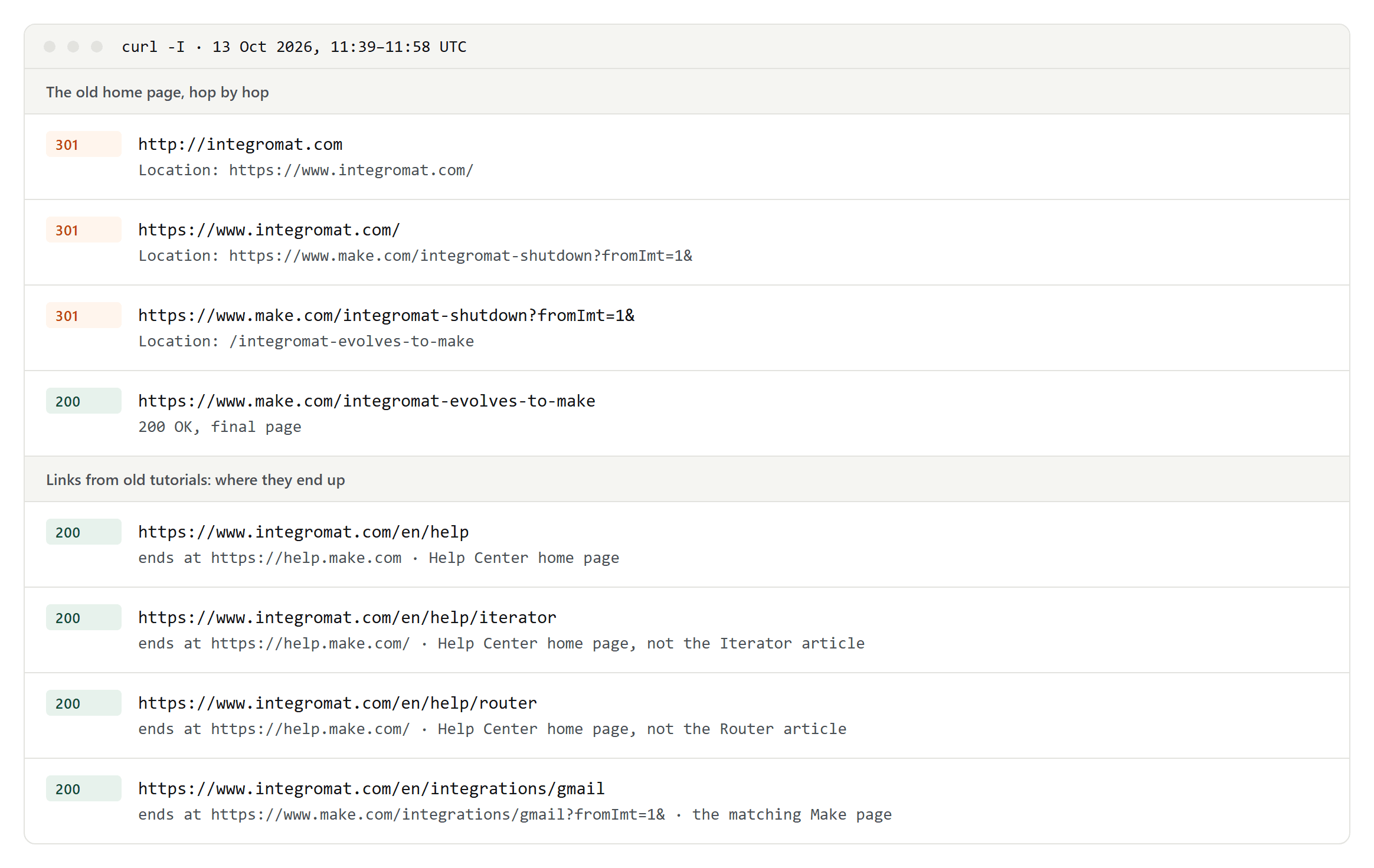
- The home page passes through three permanent redirects and ends on Make's "Integromat evolves to Make" page.
- Old help articles don't lead to their new versions. The links to the Iterator and Router articles both land on the Help Center's home page, so you have to search for the topic again.
- Old integration pages still work: the Gmail page leads to Make's Gmail page.
Make today, in plain terms
- Scenario: one automation. Make now offers standard scenarios, AI scenarios and AI agent scenarios.
- Module: one step. Every scenario starts with exactly one trigger: a polling trigger ("Watch…") that checks for new data on a schedule, or an instant trigger that reacts as soon as data arrives.
- Operation and credit: each module run that processes or checks data is an operation. You pay in credits: one credit per operation for standard apps, while some AI and advanced apps use a varying number based on tokens, file size, pages or run time.
- Router and filter: a router splits a scenario into routes that run one after another; a filter sits on the link between two modules and only lets matching data through.
- Iterator and aggregator: an iterator turns a list into separate bundles, and an aggregator combines bundles back into one.
- Data store: storage for data that has to survive between runs or be shared between scenarios.
- Webhooks: Make processes incoming webhooks in parallel by default, or in order if you switch that on.
- Scheduling: a new scenario runs every fifteen minutes by default. The shortest interval depends on your plan.
- AI: Make AI Agents arrived as a beta in April 2025 and were rebuilt inside the Scenario Builder in early 2026. Maia, an assistant that builds and fixes scenarios from a plain-language request, is in public beta on paid plans. Our guide to intelligent automation explains when an AI step is enough and when an agent is worth it.
Following an old Integromat tutorial? What changed
The basic ideas carry over: scenarios, modules, routers, filters, iterators. The details in older tutorials have drifted:
- Credits instead of operations. Plans and usage are counted in credits since 27 August 2025. Operations still show what each module run did.
- Renamed error handlers. Break is now Retry and Ignore is now Skip. Resume, Commit and Rollback kept their names.
- No more "Cycles per run". Make removed the setting on 1 October 2026, and every scenario run now completes one cycle. Work that used to finish across several cycles carries over to the next run. Make suggests raising the maximum number of results in the trigger or running the scenario more often.
- Branches can rejoin. Router routes still can't be merged again. The If-else and Merge modules, in open beta since March 2026, split a scenario and bring the routes back together, and they don't use credits.
- New navigation. A left sidebar replaced the old top tabs for everyone on 4 November 2025, so menu paths in old screenshots won't match.
- Old help links. As shown above, they open the Help Center's home page, not the article the tutorial meant.
The same ideas in n8n and Zapier
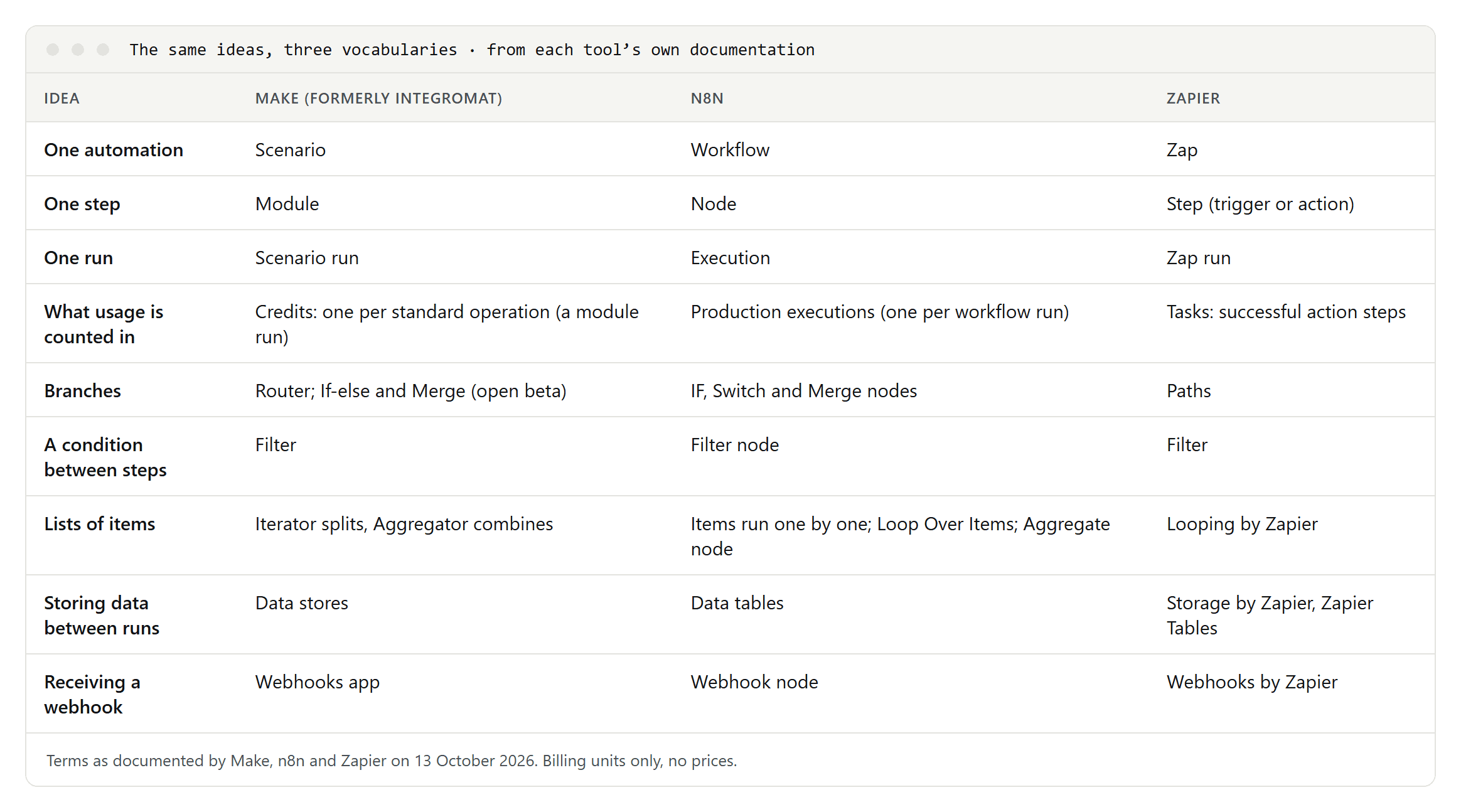
The difference that matters most for your bill is what gets counted. Make counts every module run, n8n counts whole workflow runs (and only production ones, not manual tests), and Zapier counts successful actions, while triggers, filters and paths are free. The same workflow can therefore use very different amounts on each platform.
We are preparing a side-by-side test of Make, n8n and Zapier, with the same workflows in English, German, French and Spanish.