Dubbing replaces a video's original dialogue with a new recording, usually in another language, so viewers hear it in their own language instead of reading subtitles. In a studio dub, translators rewrite the script to fit the actors' mouth movements and voice actors perform it. In AI dubbing, software transcribes the speech, translates it and generates a new voice, sometimes a copy of the speaker's own. This guide covers how dubbing differs from voice-over and subtitles, how a studio dub is made, where audiences expect dubs, and how AI dubbing works. We also compared a channel's own dubs with one of YouTube's automatic dubs.
What dubbing means
- Dubbing: the original voices are replaced with new ones, usually in another language. Merriam-Webster defines dubbing a film as giving it a new soundtrack, especially dialogue in a different language. The word is short for "double". The finished version is called a dub, and a film shown this way is "dubbed".
- Same-language dubbing: in film production, dialogue is often re-recorded after shooting, by the same actors and in the same language. That is usually called ADR, for automated dialogue replacement.
- Dubbed vs subbed: a dubbed video replaces the voices. A subbed (subtitled) video keeps the original audio and adds translated text on screen. Anime fans use both words a lot.
Dubbing, voice-over and subtitles
Netflix's guides for dubbing studios distinguish lip-sync dubbing, voice-over and lector dubbing, plus "simul sync" for reality shows.
- Lip-sync dubbing: new voices replace the original ones, and the lines are written to match the actors' lip movements. Used for films, series and animation.
- Voice-over: the translated voice plays over the original, which stays faintly audible underneath, and lips aren't matched. Netflix's guide for nonfiction titles uses it for interviews. It is sometimes called UN-style voice-over.
- Simul sync: for reality and competition shows, Netflix times the translation to the original speech without adapting it to the lips.
- Lector: a single voice reads every character's lines over the original. It's the tradition in Poland, and Netflix's dubbing specifications mention Polish lector by name.
- Subtitles: the original audio stays, and the translation appears as text. We explain the different kinds in subtitles vs closed captions.
How a studio dub is made
Amazon's Prime Video Dubbing Guidelines are written for dubbing studios, translators, adapters, directors and voice actors. They cover these stages:
- Translation and adaptation. A translator translates the script, and an adapter rewrites the lines so they fit the timing and the mouth movements while keeping the meaning.
- Synchronization. The lines have to match the visible mouth movements, which is lip sync, and the length of each original line, which is called isochrony.
- Casting and performance. A dubbing director casts voice actors for each character and directs them.
- Recording. Voice actors perform the lines to picture.
- Editing and mixing. The new dialogue is edited and mixed with the original music and sound effects.
- Quality control. The finished dub is checked before delivery.
Lip sync matters most in close-ups. Amazon lists the sounds to watch, because viewers can see them: lip consonants (m, b, p, w), the semi-labials v and f, and open vowels. Its guidelines also say accurate lip sync must not come at the cost of the original meaning. Netflix's dubbing principles add that the best lip sync also matches the original's intensity, loudness and breathing.
Where audiences expect dubbing
The EU's latest Eurobarometer survey on languages, carried out in autumn 2023, asked whether people prefer to watch foreign films and programs with subtitles rather than dubbed. Across the EU, 53 percent agreed, up from 42 percent in 2012, and 65 percent of 15- to 24-year-olds did. We read the country results in the survey's data tables:
- Dubbing countries are moving, slowly. Germany had the lowest share of any EU country at 34 percent, up from 22 percent in 2012. Spain was at 40 percent (24 in 2012), France at 47 (40) and Italy at 53 (36).
- Subtitle countries: Sweden and Finland were at 95 percent and the Netherlands at 93.
- Voice-over countries: Poland and several other Central and Eastern European countries traditionally use voice-over or a lector.
History explains part of the split. In 1941, Franco's regime made dubbing into Spanish compulsory for foreign films. The rule was lifted at the end of 1946, but dubbing stayed the norm.
For creators, the market matters more than the EU average. In Germany and Spain, most people disagreed that they prefer subtitles, and France was split evenly. These are three of the four markets we test in.
How AI dubbing works
AI dubbing tools chain several steps that used to need different people:
- Speech recognition writes down what is said, with timings and speakers.
- Machine translation translates the transcript.
- Speech synthesis reads the translation in a stock voice or a clone of the original speaker's voice. Our guide to text-to-speech explains how these voices work.
- Mixing puts the new voice over the original music and sound effects.
- Lip sync, in some tools, changes the speaker's mouth movements in the video to match the new language.
The tools differ in which steps they do:
- ElevenLabs' dubbing works in more than 90 languages and keeps each speaker's voice characteristics and the background audio, but it doesn't change the picture.
- HeyGen's video translation re-voices the speaker in a clone of their own voice and can sync the lips. It also has an audio-only mode and a proofreading step, but it doesn't translate text that appears on screen.
- YouTube's automatic dubs can't be edited at all.
Check what a tool lets you correct before you rely on it: that review is where a native speaker catches the errors. AI dubbing tools are on our test list for German, French and Spanish.
Dubbing on YouTube
YouTube has two kinds of dubs, and viewers find both in the same place: Settings, then Audio track.
- Audio tracks the creator uploads. The creator records or commissions dubs and adds them in YouTube Studio. YouTube opened this to millions of creators in September 2025.
- YouTube's automatic dubbing. YouTube transcribes, translates and voices the video itself, and marks these tracks as auto-dubbed. It launched in December 2024 for hundreds of thousands of channels in the YouTube Partner Program and opened to everyone in February 2026, in 27 languages. Creators can review dubs before they go live but can't edit them. Lip sync is still an experimental pilot.
We compared both on 13 October 2026:
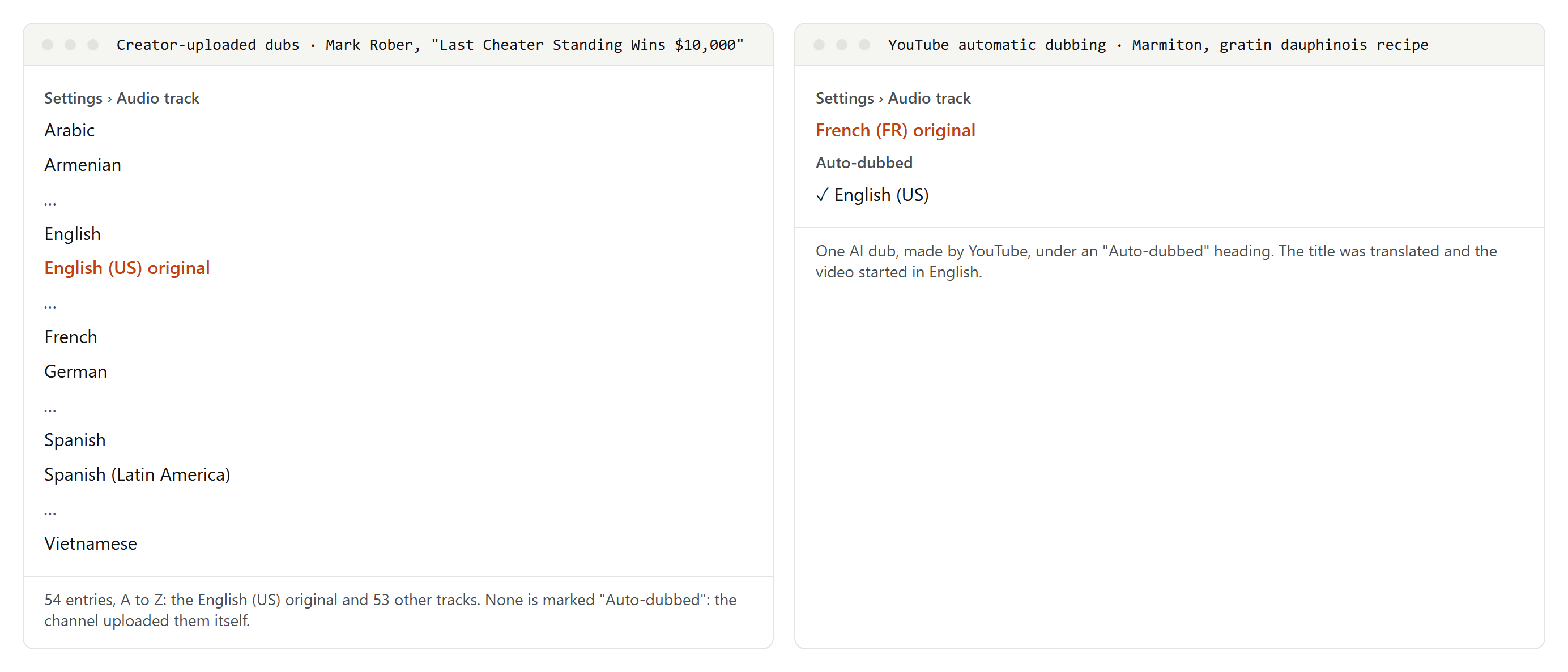
- Mark Rober's video listed 54 entries from Arabic to Vietnamese: the English original and 53 other tracks, none of them marked "Auto-dubbed". The channel uploaded them itself.
- A recipe video from Marmiton, a French cooking site, had the French original and a single track under an "Auto-dubbed" heading: English. For us, the title was translated and the video started in English.
If you'd rather hear the original, turning off YouTube's auto-dubbing takes a few clicks. If you want to reach viewers in other languages, see how to translate a YouTube video.
Consent and labels
- Cloning someone's voice needs their consent. ElevenLabs' usage policy bans cloning a living person's voice without their explicit, informed consent or other valid authorization. HeyGen requires consent from anyone whose avatar you create, and its terms make you responsible for having the rights and consents for what you upload.
- YouTube's disclosure rule: you don't need to label a dub made with a clone of your own voice, but you do need to disclose content that makes a real person appear to say something they didn't.
- The EU AI Act's transparency rules (Article 50) apply from 2 August 2026. Tools that generate audio or video must mark it in a machine-readable way, and anyone who uses AI to make a deep fake must say so. After an amendment published in July 2026, generative AI tools already on the market before August have until 2 December 2026 for the marking. Whether a particular AI dub counts as a deep fake depends on the case, so label AI dubs clearly anyway.
Which should you choose?
- Subtitles first. They are the cheapest option, keep the original voice and work for viewers who watch without sound. An SRT file is the usual format.
- AI dubbing fits talking-head videos, tutorials and explainers, where lip sync matters less, as long as someone who speaks the language reviews the script before the voice is generated.
- A studio dub is still the choice for drama, comedy and ads with close-ups, where the performance carries the scene.