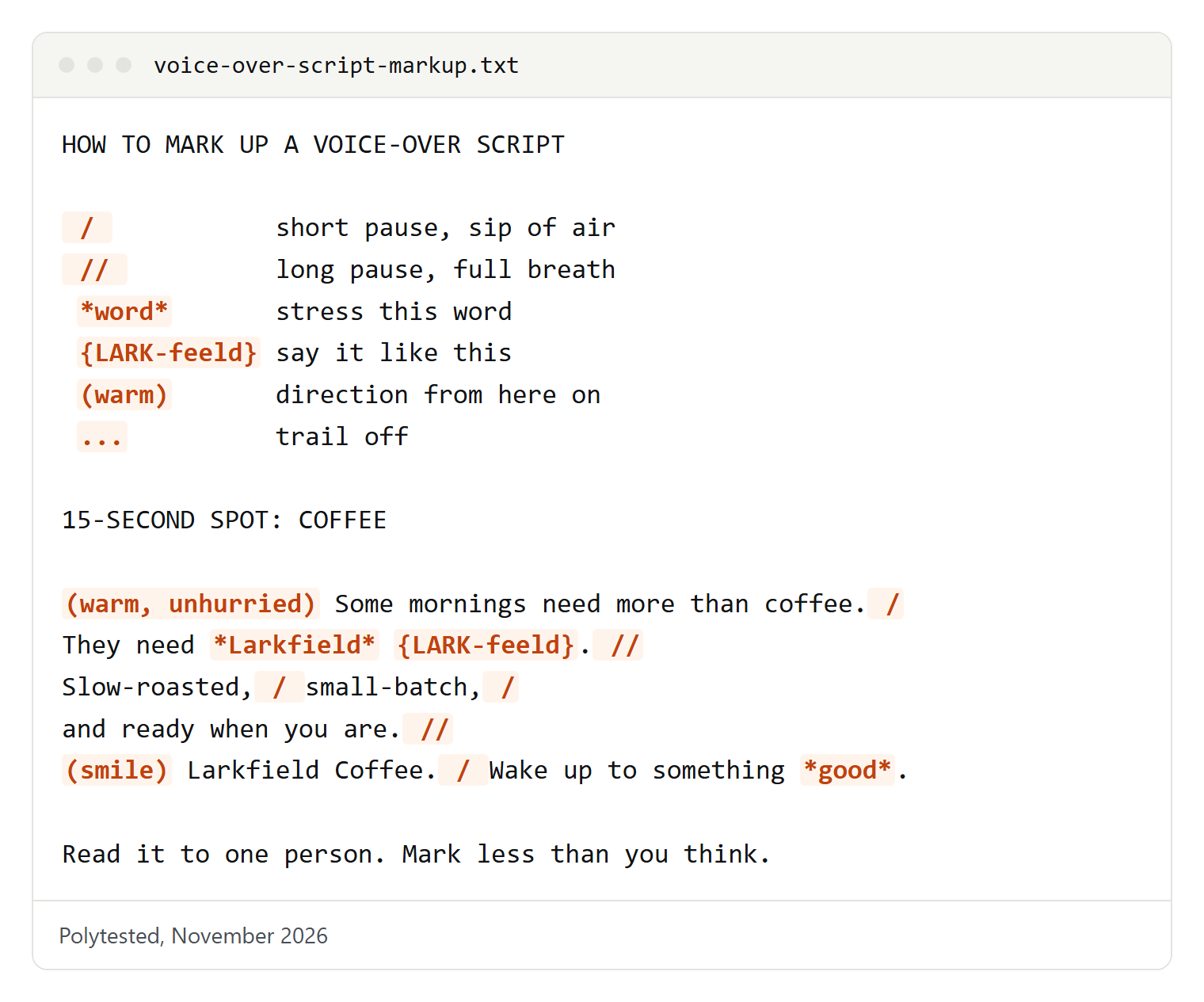
Here is a script you can read right now: "Some mornings need more than coffee. / They need Larkfield. // Slow-roasted, / small-batch, / and ready when you are. // Larkfield Coffee. / Wake up to something good." Read it warm and unhurried, as if to one friend across a kitchen table. Below are 25 more original practice scripts, grouped by genre, each with a read direction, breath points and the words to stress, plus the audiobook script format, a timing method and tips for AI voices. All names in the scripts are invented.
How to read the markup in these scripts
Every script on this page uses the same simple marks. On paper, most voice actors underline stressed words and draw slashes for pauses; in the code blocks below, asterisks stand in for the underline.
| Mark | Meaning | How to perform it |
|---|---|---|
/ | Short pause | A beat. Sip some air if you need it, but don't drop the thought. |
// | Long pause | The thought ends. Take a full breath and reset. |
*word* | Stress | Lift the word with pitch, length or weight, not just volume. |
{LARK-feeld} | Pronunciation | Say it as respelled. Capitals mark the stressed syllable. |
(warm) | Direction | Changes the attitude from this point on. |
... | Trailing off | Let the line fade or hang, unfinished. |
Read the script silently once before marking it, and mark less than you think: if every third word is stressed, nothing stands out.
Commercial scripts: 15, 30 and 60 seconds
Commercial scripts are usually written for a fixed slot of 15, 30 or 60 seconds: one idea and a brand name, a problem and its solution, or a short story. How long each one runs depends on your pace, so time your own read.
(warm, smiling) Fresh bread / doesn't wait. // Neither should you. // Hearthstone Bakery / opens at *six*, / every morning, / on Maple Street. // Hearthstone. / Baked today.Read it to one neighbor, not a crowd. Stress "six" lightly: it's the one fact the listener needs.
(easy, real) You know that feeling / when you check your account / and just... / hope? //
(lighter) With the Tidewell app, / you see every bill / *before* it lands. // One screen. / No surprises. //
Set a goal, / watch it grow, / and get a nudge / when you're close. //
(direct) Tidewell. / Banking that tells you *first*. // Download it today.
The "real person" read: no announcer voice, a little hesitation on "hope," then a lift. Stress "before" and "first," which carry the promise.
(gentle) My dad built the porch on our first house / with a borrowed saw / and a lot of patience. //
He'd drive to Corner Hardware every Saturday / for one more box of screws, / and Mr. Ellis would ask, / "How's that porch coming?" //
(warmer) That porch is still standing. / So is Corner Hardware. //
(smile) These days / I'm the one buying screws, / and the Ellis behind the counter / is his *granddaughter*. //
She still asks / how the project's coming. / She still knows / which aisle / you need. //
(sincere) Some things / are worth building to *last*. //
Corner Hardware. / On Grant Avenue / since your grandparents' time.
A memory piece. Keep the pace relaxed and let the pauses carry the feeling. Stress "granddaughter," where the story turns, and "last."
(bright, fast) It's the Big Spring Clearout / at Polar Appliances! //
Fridges, / freezers, / washers, / dryers: / *everything* must go! //
Buy any washer / and get the matching dryer / at half price. / That's right, / *half* price! //
But hurry. / The Clearout ends *Sunday*. //
Polar Appliances, / on Route Nine. / Cool deals, / hot savings!
Energy comes from crisp consonants and pitch, not shouting. Take quick sips of air at the single slashes so you never sound out of breath.
Explainer and corporate scripts
Explainers walk a viewer through a product; corporate scripts speak for a company. Both want a smart colleague, not a salesperson.
(friendly, clear) Sending an invoice / shouldn't take longer / than doing the work. //
With Paperlane, / you pick a client, / add your hours, / and press *send*. // That's it. //
Paperlane reminds your client / when payment is due, / so you don't have to. //
(warm) Less paperwork. / More of the work you love. // Try Paperlane free.
Read at the pace of someone showing a friend their phone, and leave the pauses open for the animation. Stress "send," the one action to remember.
(calm, assured) Forty years ago, / Northgate started with one truck / and one promise: / deliver it on time, / every time. //
Today / our drivers cover three states, / and that promise / hasn't changed. //
(warmer) Because behind every delivery / is someone waiting: / a shop owner opening for the day, / a family expecting a package. //
Northgate Freight. / We *know* who's waiting.
Aim for quiet confidence, not pride, and stress "know."
E-learning scripts
E-learning narration is long, and learners replay sections, so a clear, even read matters more than color.
(clear, supportive) Welcome to Module Two: / Working Safely at Height. //
In this module, / you'll learn how to inspect a ladder, / how to set it up at the correct angle, / and when to choose a different tool. //
At the end, / there's a short quiz / to check what you've learned. //
Let's start / with the *inspection*.
A patient trainer: a little slower than a commercial, with a clean pause before each list item.
(neutral, precise) To add a customer, / open the *Customers* tab. //
Select *New customer*. // A form opens on the right. //
Enter the name and email address, / then select *Save*. //
The new customer / now appears / at the top of your list.
Menu names are the stress points, because the learner is hunting for them on screen. Pause after each instruction so they can click.
Documentary narration scripts
Documentary narration sits under pictures and music. The voice guides without pushing, and silence is part of the performance.
(hushed, unhurried) At first light, / the marsh is silent. //
Then, / one by one, / the herons arrive. //
They have flown through the night / to reach this water, / and for the next few weeks / this narrow strip of reeds / will be *home*. //
(slower) Every bird here / is waiting / for the same thing... // the tide.
Read as if you mustn't wake the birds, and let "the tide" land after a full pause.
(measured, serious) In the winter of 1911, / the town of Redwater / had one doctor, / one school, / and a mine that never closed. //
The men went underground before sunrise / and came up after dark. // Some weeks, / their children never saw them / in daylight. //
(lower) What happened that February / would change the town / *forever*.
Weight without melodrama. Keep the list rhythmic, and stress "forever" by slowing down, not by getting louder.
Audiobook scripts and the audiobook script format
Audiobooks are the longest form of voice work: narration, often several characters, and the listener's attention for hours.
Fiction excerpt
The rain had not stopped for three days, / and Mara had stopped pretending / she didn't mind. //
(Mara, tired) "If the bridge floods again, / we're stuck here till Sunday." //
Her brother didn't look up from the map. //
(Theo, flat, older) "Then we're stuck." //
(narration) She waited for him to say something else. // He didn't. / He never did / when it mattered. //
(Mara, sharper) "Theo. / *Look* at me." //
He folded the map very slowly, / the way their father used to, / and finally / he looked.
Keep the narrator warm and neutral, and give each character a small, repeatable difference: Mara quicker, Theo lower and slower.
Non-fiction excerpt
Chapter Four. // The Ten-Minute Rule. //
Most of us / don't avoid hard tasks / because they're hard. // We avoid them / because we can't see / where to *start*. //
The rule is simple. / Choose the task. / Set a timer for ten minutes, / and work on it until the timer rings. // Then you're allowed to stop. //
(lighter) Here's the strange part: / most people / don't.
The author talking to one reader, sure and friendly like a good teacher. The pause before "don't" is the joke; give it room.
How to format an audiobook script
There is no single standard for an audiobook script, but a manuscript prepared for narration usually has:
- One file per chapter, starting with the heading exactly as it will be spoken.
- A pronunciation list for names, places, invented words and foreign terms, each with a respelling or the author's recording.
- Character notes: age, accent, pace and attitude, so a voice in chapter thirty matches chapter one.
- Print-only elements removed or rewritten: page numbers, footnote markers, image references.
- Numbers and symbols written as they should be spoken, for example "nineteen eleven."
FILE: 05_Chapter_Four
SPOKEN HEADING: Chapter Four. The Ten-Minute Rule.

PRONUNCIATION
Aoife ........ {EE-fuh}
Kildare ...... {kil-DAIR}

CHARACTER NOTES
Aoife: late thirties, Irish, warm, quick, laughs easily
Author voice: friendly teacher, steady pace

TEXT BEGINS
Chapter Four. // The Ten-Minute Rule. //
Most of us don't avoid hard tasks...
What ACX asks for
ACX, Audible's audiobook marketplace, lists the audio it accepts in its help center. As of November 4, 2026, it says:
- Credits: opening credits state the title, author(s) and narrator(s); closing credits make clear the book is over (ACX suggests "You have been listening to...", the credits again, and "The End"). Credits go in separate files.
- Files: one chapter or section per file, each beginning with its spoken header (such as "Prologue" or "Chapter 1"), no file longer than 120 minutes, and file names in standard US letters and numbers only.
- Retail sample: five minutes or less, ideally the book's first five minutes, without explicit material.
- Sound: consistent tone and pronunciation, no plosives, mouth noise or outtakes, all files mono or all stereo.
- Levels: between -23dB and -18dB RMS, peaks no higher than -3dB, a noise floor no higher than -60dB RMS, and one to five seconds of room tone at the start and end of each file.
- Format: constant bit rate MP3, 192 kbps or higher, 44.1 kHz.
- Narration: by a human unless otherwise authorized. ACX prohibits unauthorized text-to-speech, AI or automated recordings, and says Audible is working toward accepting third-party TTS content.
ACX also recommends leaving out the table of contents. Full list: ACX audio submission requirements.
Video game lines: hero, villain, NPC barks and efforts
Game scripts often come as long lists of short lines, out of story order, each with a note on the situation. They are the best "voice acting lines" for building range.
(quiet, to herself) Okay. / One more bridge. / You can do this. //
(calling out) Kael! / Get the gate open. / I'll hold them *here*! //
(after a hit, gritted) Is that all / you've got? //
(resolved, softer) We're not leaving anyone behind. // Not *this* time.
A hero is grounded, not loud all the time. Play the first line almost under your breath, then project the second from the body, not the throat.
(amused, slow) You came all this way... / for *me*? // How touching. //
(cold) Your king sent children / to do a soldier's work. // That tells me everything / I need to know. //
(almost kind) Kneel, / and I'll let the others live. // Refuse... / and you can watch.
The scariest villains rarely raise their voice. Stay slow and close to the mic, enjoy the words, and let "Refuse..." hang.
SHOPKEEPER
(friendly) Welcome, traveler! / Best prices this side of the river.
(impatient) Buying / or browsing?
(pleased) Pleasure doing business.
(nervous) Not in here, / please! / Not the pottery!

GUARD
(bored) Move along.
(alert) Who goes there?
(searching) Must've been the wind...
(alarmed) Intruder! / Sound the bell!
Barks repeat endlessly in a game, so each must be clear at once. Record every line two or three ways with a clean gap between takes.
(light attack) Hah!
(heavy attack) Hhhrrah!
(jump) Hup!
(small hit) Ugh!
(big hit) Aaagh!
(lift heavy object) Nnnngh...
(out of breath) three heavy breaths
(defeat) Ahh... / no...
Efforts are hard on the voice. Support them from the body, keep them short, and stop if anything hurts.
Animation and cartoon scripts
Animation wants bigger, cleaner choices than live action: the character should be recognizable from the first word, with real emotion underneath.
(panicked, fast) Okay, okay, okay, / nobody panic! / Especially *me*! //
(sudden calm) Right. / The map says left. // (beat) The map is upside down. //
(proud) Did I just save the day? // (small squeak) Somebody say yes.
Pick a voice you can hold all session without strain. A "(beat)" is a silent moment for the joke.
(bright, gentle) Hello, friends! // Today, / Pip the Penguin / is looking for something *blue*. //
Can you help him? // (pause for the child) Is it the sky? / Yes! // The sky is *blue*! //
(whisper) Now let's see / what Pip finds next...
Warm and slow, with real pauses where a child might answer. Smile as you read.
IVR and phone system scripts
IVR (interactive voice response) prompts are the menus callers hear on the phone. They are recorded line by line, because the system plays them in different orders.
(warm, professional) Thank you for calling Brookside Dental. //
If this is a dental emergency, / press *one*. //
To book or change an appointment, / press *two*. //
For billing questions, / press *three*. //
To hear these options again, / press *nine*. //
(calm, for the hold line) Please stay on the line. / The next available team member / will be with you shortly.
Read each option at the same pitch and pace, since the system may splice them, with clean silence after each line.
Podcast intro and outro scripts
A podcast intro is heard every episode by the same people, so it must still sound fine on the fiftieth listen.
(relaxed, upbeat) You're listening to *Small Shop, Big Ideas*: / the show about people / who run tiny businesses / and do huge things. //
I'm Dana, / and every week / I sit down with one owner / to talk about what worked, / what didn't, / and what they'd do differently. //
Let's get into it.
Sound glad the listener came back, and stress the show name so it sticks.
(warm, a little slower) That's it for this episode of *Small Shop, Big Ideas*. //
If you liked it, / tell one friend who runs a business. / It really helps. //
Show notes and links are on our website. //
I'm Dana. / See you next week.
A little slower and softer than the intro, like seeing a guest to the door. One ask, not three.
Movie trailer script
The classic trailer read is deep, slow and dramatic, with pauses left for music. It's good practice because it trains control: low pitch, slow pace, no wasted words.
(low, slow) In a city / that never sleeps... // one man / has stopped *dreaming*. //
(beat) When the lights go out across Harbor City, / detective Ray Coles / has one night / to find out why. //
(building) No backup. / No signal. / No way *out*. //
(quiet) *Blackout*. // This winter.
Lower your pitch only as far as it stays comfortable; the pauses are for music hits.
Character monologues and acting lines
Read each piece three times: neutral, as directed, and with the opposite choice. The contrast teaches more than any single take.
"I didn't think you'd come back."
(joy) ... after years apart, at an airport
(anger) ... to someone who left without a word
(fear) ... to someone you hoped was gone
(relief) ... to a friend home from a dangerous trip
(sarcasm) ... to a roommate who forgot the milk
Picture the other person before each read. Record all five in a row, then ask someone to guess which is which.
(hesitant) I've started this phone call / about twenty times. // In my head, / it goes better. //
(honest) I was wrong. / Not "a little wrong." / *Wrong*. // You trusted me with something that mattered, / and I treated it / like it didn't. //
(quiet) I'm not asking you to forgive me tonight. // I just didn't want another year to go by / without saying it. //
(beat) That's all. // That's... / all.
Play it quietly and close to the microphone, and let the pauses feel uncomfortable. Stress the second "Wrong."
(firm) Look at me. / All of you. //
Nobody out there / thinks we can win this. // *Good*. / Let them think it. //
(rising) We've run every drill in the rain. / We've lost games by one point / and come back the next morning. //
(full voice) So when that whistle blows, / you don't play for the score. / You play for the person / *next* to you. // Now go!
Build from low and firm to full voice, and don't peak too early.
How to time, practice and record a sample
Timing a script by word count
Word count gives a quick estimate of length, never more: pace, pauses and music change the real result.
- Find your rate. Read one script from this page at the pace its direction asks for and time it with a stopwatch. Words divided by seconds is your rate for that style.
- Estimate a new script. Divide its word count by your rate. A warm, slow read covers fewer words per second than a fast retail read, so measure each style separately.
- Check against the slot. Leave room for music or a tagline at the end. If you're long, cut words instead of speeding up.
For audiobooks, ACX gives an average: most performers narrate about 9,300 words per hour, so a book's word count divided by 9,300 gives an approximate finished length. An 80,000-word novel comes out at roughly eight and a half hours. ACX adds that new narrators generally need five to seven hours of recording, editing and checking per finished hour.
Practicing and recording a sample
- Warm up with humming, lip trills and a tongue twister, then mark the script and read it once without recording.
- Record in a quiet, soft room. Clothes, curtains and cushions soak up echo; bare walls add it. Keep the same distance from the microphone for the whole take.
- Do three takes with different choices, and listen back the next day with fresh ears.
- Build a short sample per genre from your best takes: a commercial, a narration, a character set. For audiobooks, use a fiction excerpt with two voices.
For the next steps, our guide to becoming a voice actor covers demos and practice routines, and what dubbing is explains how dubbing differs from voice-over.
Using these scripts with AI voices
An AI voice helps you hear a script before you read it or make a draft video. Paste plain text, not the markup, or slashes and asterisks may be read aloud.
Turn marks into punctuation. A single slash becomes a comma, a double slash a period. Microsoft's Clipchamp help says periods add a moderate pause and commas a short one, while exclamation marks or all caps are unlikely to change the delivery. ElevenLabs offers a break tag for pauses of up to three seconds, but not in Eleven v3 and v4.
Carry the direction. For Eleven v3 and v4, ElevenLabs documents audio tags such as [whispers], [sighs], [laughs] and [excited], and says capital letters increase emphasis in Eleven v4. Elsewhere, rewrite the line so the key word falls at the end.
Fix pronunciation and pace. Type the respelling instead of the tricky name, or use ElevenLabs' alias tags and pronunciation dictionaries in Studio projects. Its speed setting runs from 0.7 to 1.2.
Check the free plan before you publish. ElevenLabs says its free plan has no commercial license, published free-plan audio must include "elevenlabs.io" or "11.ai" in the title, and audio made outside a paid subscription can't be used commercially later, even after upgrading. Murf's free trial doesn't support downloads. Clipchamp says it adds no watermark to free-plan exports. For more tools and their rules, see our free AI voice generators and ElevenLabs alternatives.
Two limits apply to every tool. ACX accepts human narration unless a title is otherwise authorized. And clone only your own voice or one you have explicit permission to use: the ElevenLabs use policy forbids cloning a living person's voice without explicit and informed consent. For rights questions in a real project, start with the vendor's terms; this page isn't legal advice.