To become a voice actor, you need three things more than a special voice: acting skill, clean recordings and a short demo that proves both. Start by reading aloud every day and taking an acting or voice class, set up a quiet corner with a decent microphone, record a demo for one type of work, then audition on casting sites and audiobook platforms. No degree is required. Below: a step-by-step road map for beginners in the US, what pay data actually exists, and how AI voices change the job.
The short answer: your road map by goal
| Your goal | First skill to build | First demo | Where to look for work |
|---|---|---|---|
| Commercials and ads | Natural, conversational reads | Commercial demo, short spots | Online casting sites, local businesses, later an agent |
| Audiobooks | Long-form reading, stamina, character voices | Narration excerpts from public domain books | ACX and other audiobook marketplaces |
| Animation and anime dubs | Character acting, improv, matching timing | Character demo | Casting sites, agents, dubbing studios |
| Video games | Character acting, physical vocal effort | Character or game demo | Casting sites, indie game developers, agents |
| E-learning and corporate | Clear, steady explaining | Narration demo | Casting sites, training companies, local businesses |
| Extra income from your voice data | Consistent, clean reading | None needed | Data collection projects (see the AI section) |
Whatever you choose, the order is the same: practice and training first, then equipment, then a demo, then auditions. Paying for a demo before your reads are ready is the easiest way to waste money.
What voice actors actually do
A voice actor performs a script with the voice alone. The U.S. Bureau of Labor Statistics (BLS) does not count voice actors as a separate job: it groups them with all actors and notes that some actors do voiceover or narration work for animated features, audiobooks and other electronic media. The work falls into a few families:
- Commercials: radio, TV, online and social ads. Short scripts, many takes.
- Narration: documentaries, explainer videos, e-learning and corporate training. Clarity and an even pace come first.
- Audiobooks: long sessions, many characters in one book, often your own editing.
- Animation and dubbing: cartoons, animated films and English dubs of foreign shows, including anime. In dubbing, you match the timing and mouth movements of a character on screen. Our guide to what dubbing is explains how studios handle it, and sub vs dub covers why viewers choose one or the other.
- Video games: characters, battle sounds and long lists of short lines recorded out of order.
- Phone systems and apps: on-hold messages, menus and voice prompts.
The three skills that matter most
1. Acting. Voice acting is acting. Know who you are speaking to, what you want from them and what just happened before the line. The BLS lists creativity, persistence, reading and speaking skills among the qualities actors need, and notes that actors may audition for many roles before getting a job.
2. Reading. "Cold reading" means performing a script well the first time you see it. Practice reading ahead with your eyes while your voice is a few words behind.
3. Microphone technique. The part most beginners underestimate:
- Keep the same distance from the microphone, about a hand's width, and lean back slightly for loud lines.
- Speak slightly across the microphone, not straight into it, to soften hard "p" and "b" sounds.
- Control mouth noise: drink water, and avoid salty or sticky food before a session.
- Leave a short silence before and after each take so editing is easy.
- Mark your script: underline the words that carry the meaning, add slashes where you breathe.
Training: classes, coaching and free practice
The BLS says a formal education isn't always required for actors and that most take classes in areas such as acting, movement, characterization, voice and audition technique. The main routes, from cheapest to most focused:
- Community theater, improv and acting classes. The fastest way to learn to make choices and react; improv helps with animation and games.
- Voice-over workshops. Group classes on commercial reads, narration or characters. Look for teachers who work in the field now.
- Private coaching. One-to-one sessions to fix habits and prepare a demo, once you have practiced on your own.
- Free resources. Public domain books for narration practice, sample scripts on casting sites, and the video lessons ACX publishes for audiobook narrators.
Be careful with programs that sell complete beginners "training plus a professional demo" as one package. A demo should come when your reads are ready, and a good coach will tell you when that is.
Practice lines you can record today
Record each line three different ways, listen back the next day and keep the take that sounds most like a real person talking. Change the details in square brackets.
You know that moment when [your problem] ruins your whole morning?
Yeah. We fixed that.
[Brand name]. Mornings, sorted.
Talk as if to a friend across a kitchen table; the last line is a smile, not a slogan.
Every year, small teams lose hours to tasks a computer could do in seconds.
In this short course, you'll learn how to spot those tasks,
automate the simplest ones, and keep control of the rest.
Steady, warm and clear. Slow down on the key idea, not on every word.
"You're late," said Mara, without looking up.
Tom set the lantern down. "The road was flooded. I came the long way."
"There is no long way," she said. "There's only the way you chose."
Give each character a small, repeatable difference in pitch, pace or attitude. The narration between the quotes stays neutral.
Oh, come ON! I fixed the rocket, I painted the rocket,
I even NAMED the rocket! And you want to launch it without me?
Fine. FINE. I'll just be here. Alone. With my wrench.
Commit to the energy but keep the words clear. Move your body: animation reads sound flat when you stand still.
[Short effort, jumping a gap]
[Hit, light]
[Hit, heavy]
"Cover me!"
"Reloading!"
"They're behind us, move!"
Game sessions often include lists like this. Warm up first and never push your voice into pain: shouting is a technique, not just volume.
Your home setup at three levels
Your room matters as much as your microphone. Start small and upgrade when work requires it.
Level 1: Starting out. A closet full of clothes or a corner with soft furniture, a USB microphone (or a recent phone with a voice memo app), closed-back headphones and free recording software such as Audacity. Soft surfaces absorb echo, which no microphone can remove later.
Level 2: Ready for paid auditions. A microphone that connects with an XLR cable to an audio interface (a small box that turns the microphone signal into clean digital audio), a pop filter, a stand with a shock mount, and acoustic treatment such as thick blankets or foam panels around where you record.
Level 3: Working professional. A treated booth or room, a backup microphone, a quiet computer, and a way for clients to listen and direct you live over the internet. Narrators at this level may hire an engineer for editing and mastering, which ACX mentions as an option.
If you plan to narrate audiobooks, test your room against a real standard. ACX, Audible's audiobook marketplace, requires each file to measure between -23 and -18 dB RMS, with peaks no higher than -3 dB, a noise floor no higher than -60 dB RMS, and one to five seconds of room tone at the start and end. Files must be constant bit rate MP3 files of 192 kbps or higher at 44.1 kHz. ACX offers an audio analysis tool to check a file before you submit. Pay special attention to the noise floor: the silence between your sentences must be very quiet, so fridge hum, traffic and computer fans all count.
How to make a demo reel
A demo (or reel) is a short recording that shows clients what you sound like on the kind of job they are casting. Make one demo per type of work, not one for everything.
Length. Voices.com, one of the large casting marketplaces, says demos range from 30 seconds to five minutes depending on the type: about one minute for a commercial demo, 60 to 90 seconds for a demo with several spots, and up to four or five minutes for an audiobook demo. Voice123, another casting site, recommends separate samples of no more than 30 seconds each. Both point the same way: short, sorted by type, strongest material first.
Structure. Open with your strongest, most natural read, follow with four or five short spots in different moods, and end on something memorable.
Audiobook samples. Use longer excerpts, including a passage of dialogue. ACX suggests recording a sample from a public domain title if you don't have audiobook work yet.
Without experience. Use original scripts or ones you have permission to use, never real ads for real brands presented as if you were hired. Write in the style of current ads, with made-up products and names. This template helps:
SPOT 1 – Signature read (warm, conversational)
[One or two sentences about a made-up product that fits your natural voice]

SPOT 2 – Upbeat retail
[A short sale or event announcement, ends with a call to action]

SPOT 3 – Serious or emotional
[A public service style message, slower, with one real pause]

SPOT 4 – Quirky or character-leaning
[A playful line for a snack, game or app]

SPOT 5 – Tag line
[Brand name]. [Five words or fewer.]
Where your first jobs come from
Online casting sites. Marketplaces such as Voices.com, Voice123 and Backstage post voice jobs you can audition for from home. Read each site's membership terms before you pay for anything. Write a short, specific note with every audition and always deliver on time.
Audiobooks on ACX. ACX is open to individuals and companies living in the US, the UK, Canada and Ireland who have a mailing address, a local taxpayer ID and banking details in one of those countries. You create a narrator profile with samples, find titles accepting auditions and record the audition script. If the rights holder chooses you, you agree on the deal and schedule, then record a "15 Minute Checkpoint" so both of you can agree on voices, accents and pace. The rights holder may request up to two full rounds of changes, and ACX's quality team reviews files within ten business days. ACX says new producers generally need five to seven hours to produce one finished hour of audio, which matters when you set your rate.
Local work. Local businesses, museums, schools and nonprofits need voices for ads, phone messages and videos. A short email with a relevant demo can get you real credits.
Video game voice acting jobs. Larger studios often cast through agents and casting directors; independent developers often post roles on casting sites. Ask early about shouting or combat sounds, session length, and what the contract says about AI use of your recordings.
Anime and animation dubs. English dubs are recorded at dubbing studios, which often cast through agents, their own casting calls and recommendations. Fan projects are practice, not a job.
Agents. Once you have demos, steady auditions and some credits, an agent can open doors to bigger projects. Be careful with anyone who asks for an upfront fee to represent you.
Unions: SAG-AFTRA, non-union work and AI contracts
SAG-AFTRA (Screen Actors Guild-American Federation of Television and Radio Artists) is the main US union for performers, including voice actors. Union contracts set minimum pay, working conditions and rules for AI. Many beginners start with non-union work; the union's website explains membership and rate sheets.
The U.S. Copyright Office's July 2024 report on digital replicas summarizes the union's AI terms:
- In December 2023, SAG-AFTRA ratified an agreement with film and TV producers with rules on consent and compensation for digital replicas.
- In January 2024, it signed an agreement with Replica Studios covering digital voice replicas used by video game studios, and in April 2024 its members ratified a sound recordings contract with voice replica rules. Both include consent and compensation terms.
- The union requires digital replica terms to be "clear and conspicuous," for example in a separate rider, not hidden in standard text.
On ACX, Audible's agreement with SAG-AFTRA lets narrators accept eligible deals "with AFTRA H&R," so part of the payment goes to a union health and retirement account. ACX says a Pay for Production deal must be at least $250 per finished hour to qualify, and members and non-members can both accept qualifying projects.
For non-union work, the National Association of Voice Actors (NAVA), a US nonprofit, publishes a free AI rider: a contract add-on that limits how a client may use your recordings for cloning or AI training. NAVA says the rider is educational, not legal advice. We agree: for a contract you plan to sign, ask a lawyer or your agent and read the platform's terms.
How much voice actors make: what official data says
There is no official US pay figure for voice actors alone. The closest official data, from the BLS Occupational Outlook Handbook, covers all actors, on stage, on screen and behind the microphone.
| Measure | Figure | What it means |
|---|---|---|
| Median hourly wage | $29.05 | Half of employed actors earned more, half less |
| Lowest 10 percent | Under $16.50 per hour | Bottom of the range |
| Highest 10 percent | Over $143.68 per hour | Top of the range |
| Jobs in 2025 | 67,500 | All actors, not only voice |
| Share self-employed | 23 percent | Not included in the wage figures |
| Openings per year, 2025 to 2035 | About 6,300 | Mostly replacing people who leave |
Three things make these numbers less useful than they look:
- They are hourly, not yearly. BLS publishes only hourly wages for actors because they generally don't work 40 hours a week, year-round. Turning the hourly median into a yearly salary would be misleading.
- They leave out the self-employed. The wage survey does not cover self-employed workers, and most freelance voice actors are self-employed.
- They don't separate voice work. Voice rates are set by contracts and negotiation.
The BLS adds that actors' assignments are usually short, part-time work is common, and AI may replace some actors in certain subfields.
Audiobook pay on ACX. ACX documents three deal types. In Pay for Production, the rights holder pays you a fee per finished hour, agreed at the start. In Royalty Share, you get no upfront fee and share the book's royalties with the rights holder, paid monthly by Audible for seven years; under Audible's new royalty model, which started May 26, 2026, the producer receives a 25 percent royalty, the same as the author (20 percent each under the legacy model). Royalty Share Plus combines a smaller upfront fee with the royalty split. A per-hour fee is more predictable than royalties.
How much do anime voice actors make? No official source publishes it. The BLS does not track anime or dubbing separately, and the per-episode figures repeated online rarely name a source. English dub work is paid by contract, union or non-union, and roles can be one episode or a whole series. For real numbers, look at the rate sheet of the contract a job is booked under and ask working dub actors.
AI voices: what changes for new voice actors
AI voices now read scripts in many languages. Our overview of free AI voice generators and our guide to ElevenLabs alternatives describe what each vendor allows. The Copyright Office report notes cases of voice actors already being replaced by AI replicas.
What changes for you in practice:
- Your recordings are data. Any file you deliver could be used to train a voice model, so the contract matters as much as the fee.
- Consent is the line. ElevenLabs' use policy, updated October 9, 2026, prohibits cloning a living person's voice without their explicit and informed consent and bans using recordings of anyone under 18 to create a voice model. If someone clones your voice without permission, report it to the vendor that hosts the clone.
- Cloning your own voice is a business decision. ACX runs a limited beta in which narrators create a "voice replica" of their own voice and offer it as a separate service; titles are labeled as narrated by the narrator's voice replica, and in a Royalty Share deal the narrator receives a 12.5 percent royalty under the new model during the initial seven-year period. ElevenLabs lets owners of a Professional Voice Clone (available from its Creator plan, built from about 30 minutes of audio) share it in its Voice Library and earn rewards when others use it, with a notice period of 30 days to two years before removal.
Before agreeing to any AI use of your voice, ask the questions NAVA suggests: Will my voice be cloned or used to train AI? Is the use limited to one project, or can new content be generated without limits? Will I be paid when new content is created? Can I have my voice removed later? Is there an end date, or is it "in perpetuity"?
"Get paid for AI voice training": real work vs. scams
"Get paid for AI voice training" and "get paid AI voice training from reading text" point to a real kind of work: speech data collection. Companies that build speech recognition and voice systems need people to read scripted sentences or speak naturally in their own language and accent. Appen, an AI training data company, describes collecting read, scripted and spontaneous speech from contributors in over 500 locales and says its collection is consent-based; its "Join our workforce" link leads to its contributor platform, CrowdGen.
This is short project work, not voice acting. Check each project's terms for how your recordings may be used and for how long.
The same searches attract scams. The Federal Trade Commission (FTC) describes the patterns:
- You are asked to pay. Honest employers never charge you to get hired. Fees for starter kits, training or certification are a warning sign.
- A check arrives before the work. You deposit it and send part back or buy gift cards; the check bounces and you owe the bank.
- The offer is an unexpected text, WhatsApp or Telegram message. Real employers don't recruit this way. The FTC's April 30, 2026 alert describes fake recruiters offering vague remote jobs with attractive daily or weekly pay.
- Your "earnings" grow in an app, but you must deposit money to withdraw them. These are task scams. The FTC's December 2024 data spotlight estimated about 5,000 task scam reports in 2023 and about 20,000 in the first half of 2024.
Look the company up yourself, not through links in the message, and never send ID or bank details before you have a real contract. Report suspected scams at ReportFraud.ftc.gov.
Your first-year checklist
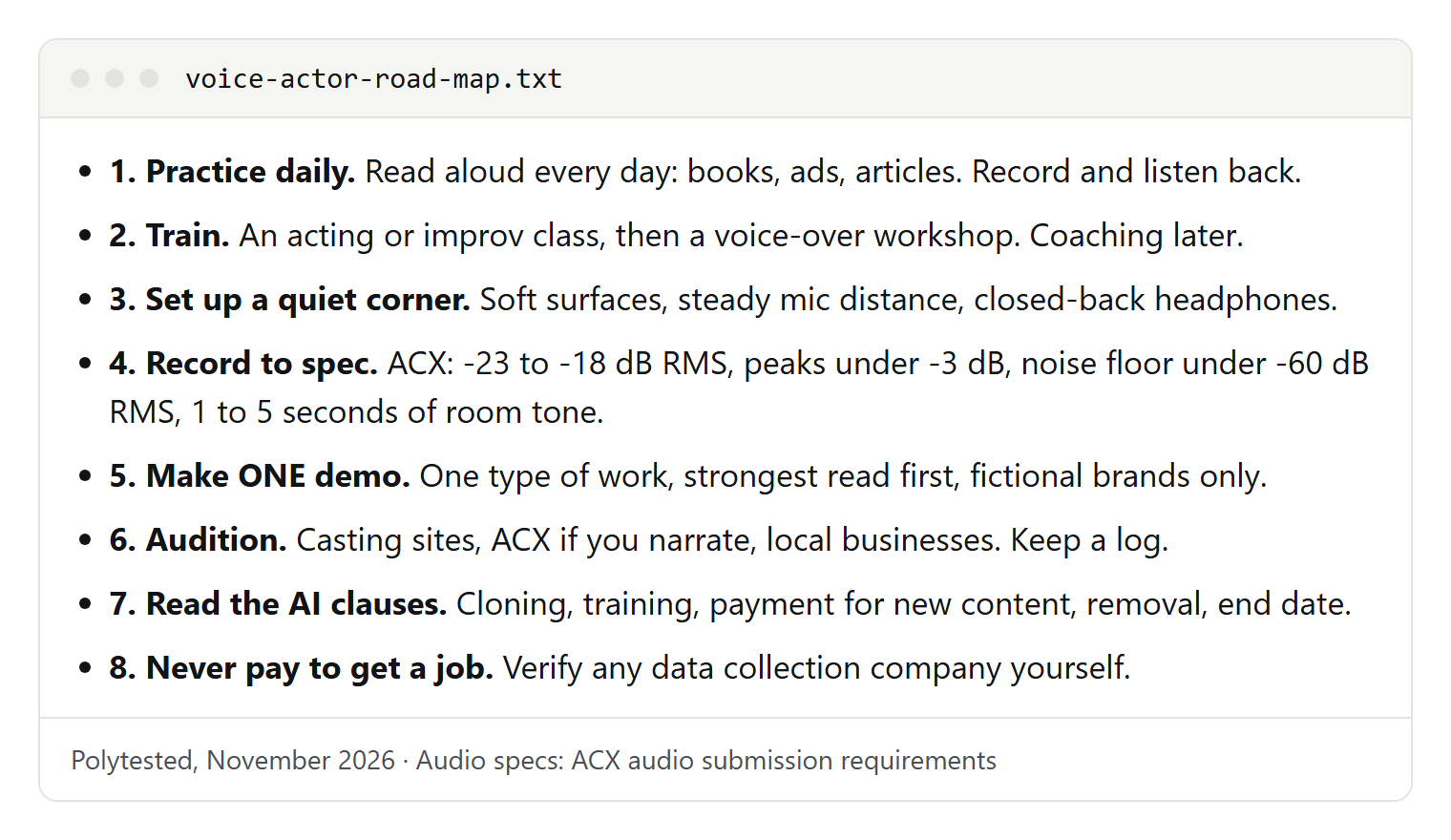
Copy this list and tick it off as you go:
[ ] Read aloud every day (books, ads, articles)
[ ] Take one acting or improv class and one voice-over workshop
[ ] Record practice lines weekly and compare with last month
[ ] Set up a quiet corner; check your noise floor
[ ] Choose ONE first demo type (commercial, narration, audiobook, character)
[ ] Write or source scripts you are allowed to use
[ ] Record your demo, or work with a demo producer when ready
[ ] Create profiles on one or two casting sites, and on ACX if you narrate
[ ] Send auditions regularly; keep a simple log of what you sent
[ ] Read every contract for AI, cloning and "perpetuity" wording
[ ] Never pay to get a job; verify any data collection company yourself
[ ] After a year: review your log, update your demo, consider an agent
The road to paid voice work is long for most people, but each step builds something you keep: a trained voice, a working studio and a demo that sounds like you.