Meeting minutes are the written record of a meeting: who took part, what was decided, and who will do what by when. They are not a transcript of everything that was said. Good minutes are short enough to read in a minute and precise enough that nobody has to ask what was agreed. Below: what to include, a template you can copy, a filled-in example, the rules for formal minutes, how minutes are written in German, French and Spanish, and what AI note-takers can and can't do for you.
Minutes, notes and transcripts
- A transcript is every word, ideally with timestamps. It is evidence, not a summary. (For the formats, see what a time-coded transcript is.)
- Notes are whatever helps one person remember. Nobody else has to agree with them.
- Minutes are the shared record. They state decisions and tasks, and in formal bodies they are approved by the group at its next meeting.
Robert's Rules of Order, the standard parliamentary manual in the US, puts it in one line: minutes record what was done at a meeting, not what was said. Summarizing the debate doesn't belong in them.
What to put in meeting minutes
- The basics: the name of the group or meeting, date, start and end time, place or call link.
- People: who chaired, who took the minutes, who was present, and who was absent.
- The previous minutes: approved as written, or approved as corrected.
- Each agenda item: one or two sentences on what was considered, then the decision in full.
- Action items: a named owner, a task specific enough to check, and a due date.
- The next meeting: date, time and place.
Leave out who said what, opinions, jokes and anything said "off the record". If the meeting was recorded, say where the recording is kept and for how long.
How to write minutes in six steps
- Before the meeting, start from the agenda. Copy the agenda items into the template, so the minutes follow the meeting's own order.
- Agree who takes them. The chair can't run a meeting and write minutes at the same time.
- During the meeting, write decisions as they happen. When a decision is made, read your wording back to the room. A sentence everyone has heard is hard to dispute later.
- Capture every task with an owner and a date. "We'll look into it" is not a task. "Lucía translates the subtitles by 21 October" is.
- Clean up the same day. Fix names, spelling and dates while you still remember the meeting, and keep the past tense or the present consistently.
- Send them to everyone, and to those who were absent. In formal bodies, the next meeting approves them; in a small team, ask for corrections by a set day.
Meeting minutes template
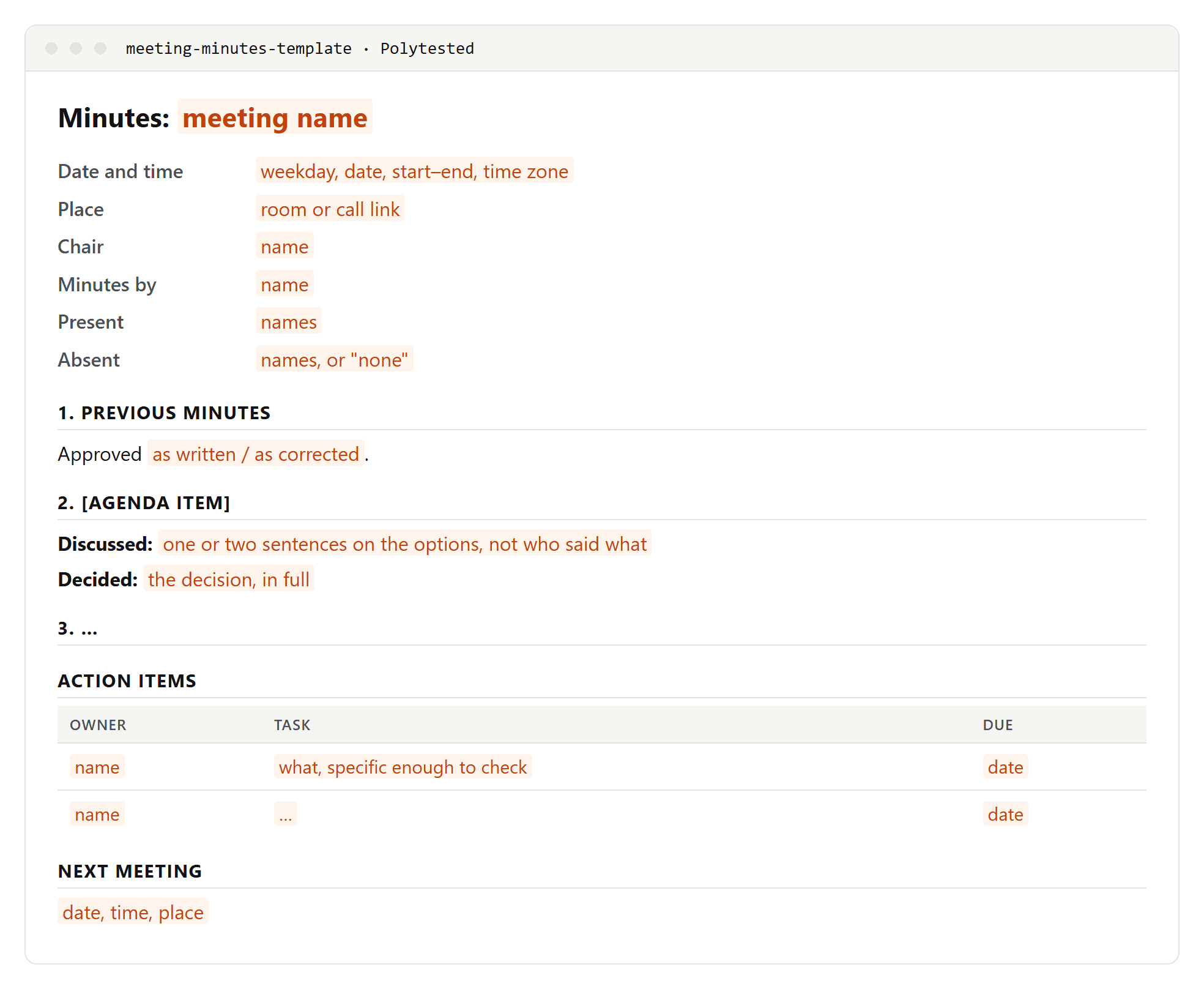
To copy it as text:
- Minutes: meeting name
- Date and time: weekday, date, start and end, time zone
- Place: room or call link
- Chair / minutes by: names
- Present / absent: names
- 1. Previous minutes: approved as written, or as corrected
- 2. Agenda item: discussed (one or two sentences), decided (in full)
- Action items: owner, task, due date
- Next meeting: date, time, place
A filled-in example
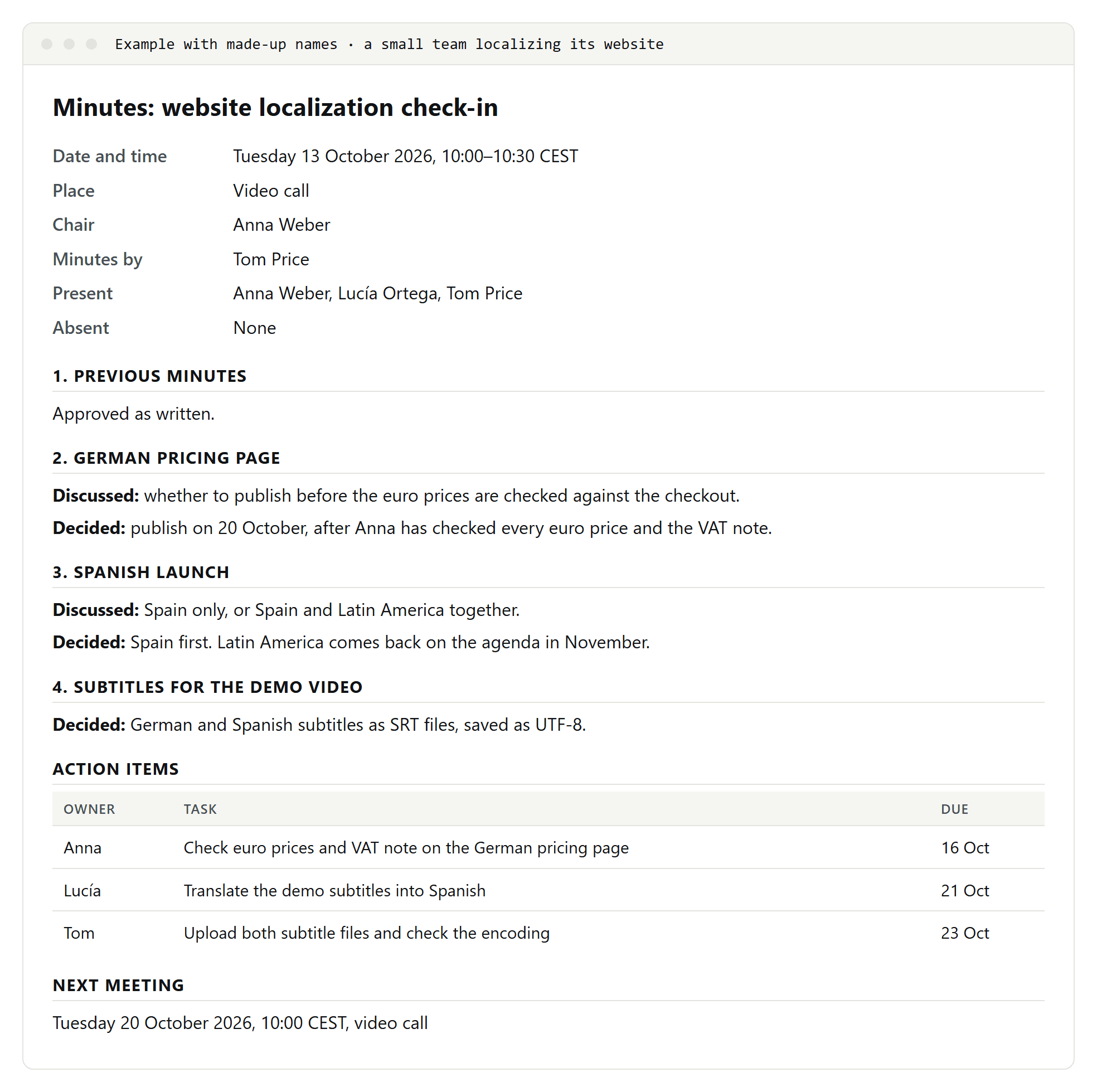
Three things to notice: every agenda item ends with a decision, the discussion lines describe the options rather than the people, and each action item has one owner and one date.
Formal minutes
Boards, associations and committees usually follow stricter rules. Under Robert's Rules:
- Record what was done. Motions are recorded with their final wording and whether they passed. The mover is named; the person who seconded is not.
- Approve them at the next meeting. The chair asks for corrections and, if there are none, declares the minutes approved.
- Correct them properly. Corrections made before approval go into the text, and the new minutes only say "approved as corrected". After approval, a correction needs a motion; the original minutes are never edited.
Companies may have legal duties on top of that. In the UK, for example, the Companies Act 2006 requires records of directors' meetings to be kept for at least ten years. Check the rules for your country and type of organization.
Minutes in German, French and Spanish
If your team meets across languages, the document has a different name, and sometimes a different purpose, in each one:
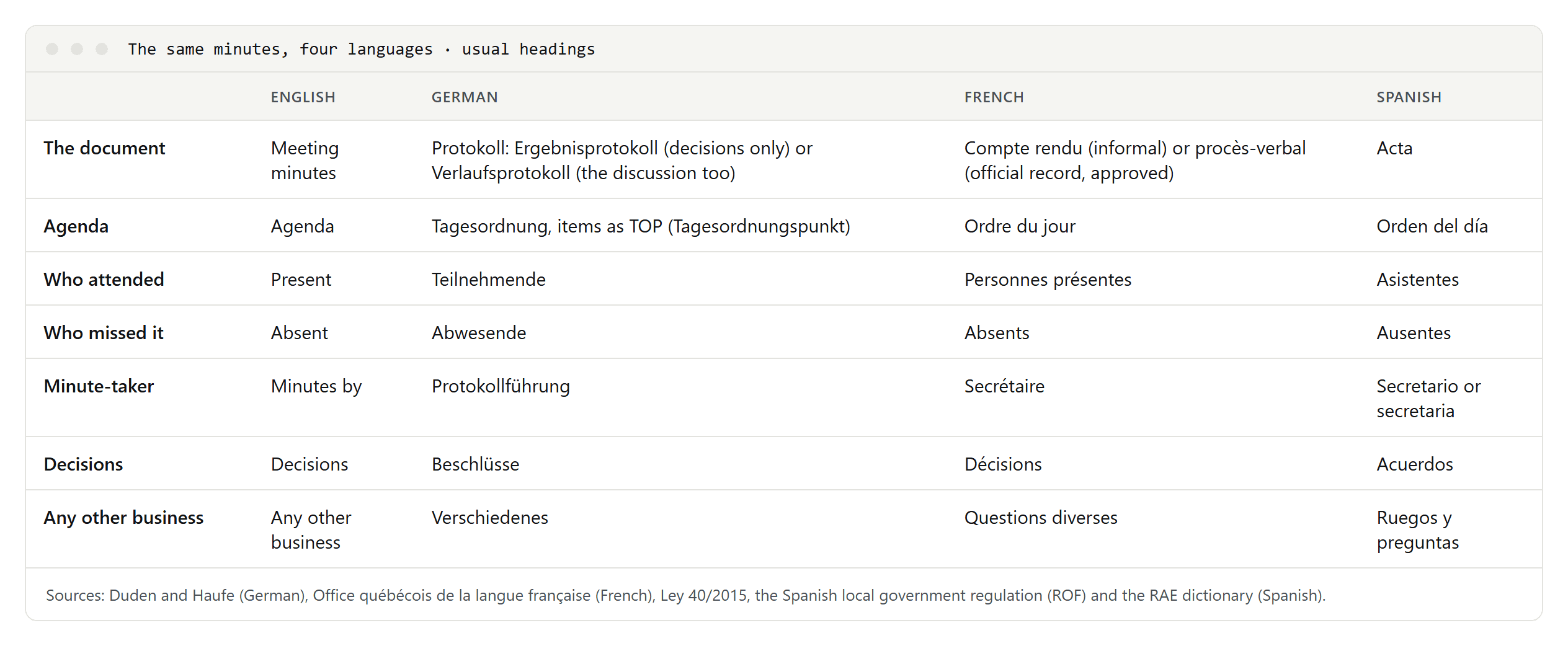
- German: a Protokoll comes in kinds. Duden distinguishes the Verlaufsprotokoll, which records the contributions in as much detail as possible, the Kurzprotokoll with the main points, and the Ergebnisprotokoll or Beschlussprotokoll, which keeps only agenda items and decisions. German minutes are usually written in the present tense, with what people said in indirect speech.
- French: a compte rendu is the informative summary of a working meeting, and the Office québécois de la langue française says it doesn't need to be approved later. A procès-verbal is the official record, approved at the next meeting. The office also advises against "minutes" as a borrowing from English.
- Spanish: an acta is the written record of what happened and what was agreed at a meeting. For Spanish public bodies, the law lists what it must contain: those present, the agenda, place and time, the main points of discussion and the decisions (acuerdos).
Can an AI note-taker write the minutes?
It can draft them. Tools that join a call or listen to it now produce summaries with decisions and action items:
- Fireflies transcribes and summarizes in more than 100 languages, German, French and Spanish included.
- Google Meet's "Take notes for me" writes a summary with decisions and next steps in English, French, German, Italian, Japanese, Korean, Portuguese and Spanish, one language per meeting.
- Microsoft Teams' intelligent recap gives AI notes and suggested tasks with a Teams Premium or Copilot license, and only when transcription is on.
We haven't tested how well they do this yet; that test is on our list. Until then, treat their output as a first draft: check every decision and every owner against what was actually agreed.
If participants are in the EU, recording a meeting is processing personal data. Spain's data protection authority, the AEPD, wrote in April 2026 that the organization using the tool is responsible for the data, that everyone must be told before the recording starts, that a recording indicator should stay visible throughout, that joining the meeting doesn't count as consent, and that people must be told how long the recording and the transcript are kept. It also warns that transcripts contain errors and need human review.